
The Blue Gate was released by Frontenac House this spring. I’m so excited.
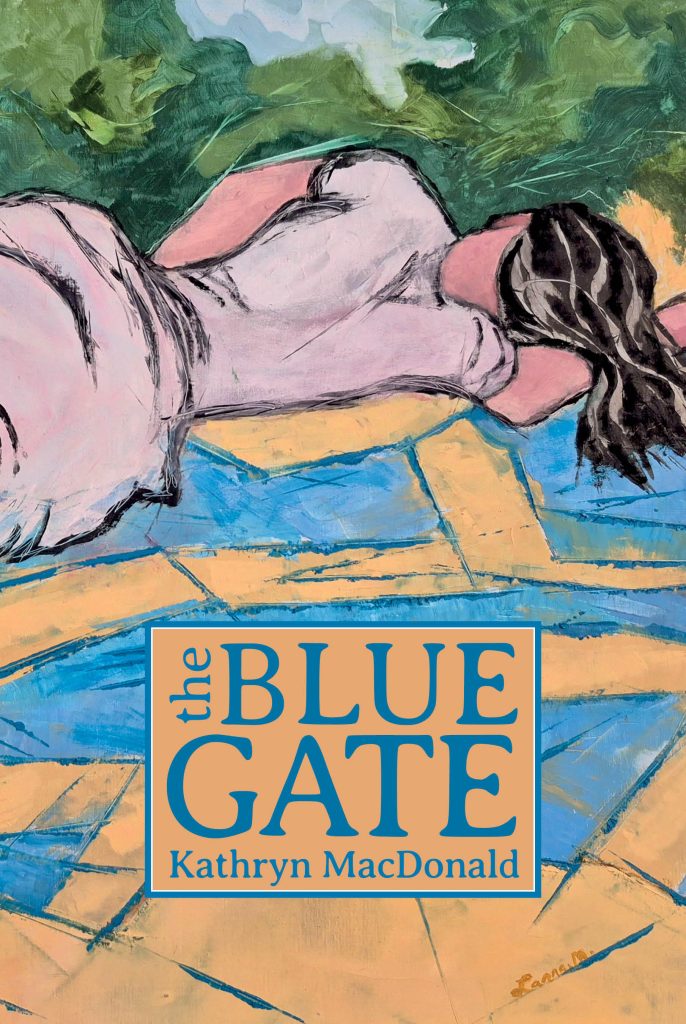
The Blue Gate explores the surprise of love, the shock of loss, and challenges boundaries and liminal spaces. It probes into a love affair that defies conventions, capturing the narrator’s voice from the first lyrical poem. With the death of the belovèd, an invitation to fly to Kenya arrives; it’s accepted; and the long title poem ravels and unravels reality. Poems in the final section question the loss of intimacy, loneliness, change, and unattainable acceptance. The poetry is vivid and grounded in the senses and in nature, whether set in Canada or Africa. The collection seeks – what – understanding,
consolation, release, or does it ask whether love enriches or leaves one lost?
WHAT SHE KNEW
Love felled her like a tree
a robin’s egg in a windstorm
a pretty blue thing
a gift of spring.
Married with children –
she thought she knew
but she did not.
Now this riot of colour
this stillness this scent
of lilacs on the air
life bursting recklessly.
This fire white-hot
she dares to grasp.
The Blue Gate is available to order from your local bookstore or directly from Frontenac House.
To learn more, please check out my ‘Events‘ and ‘About‘ pages for more information.
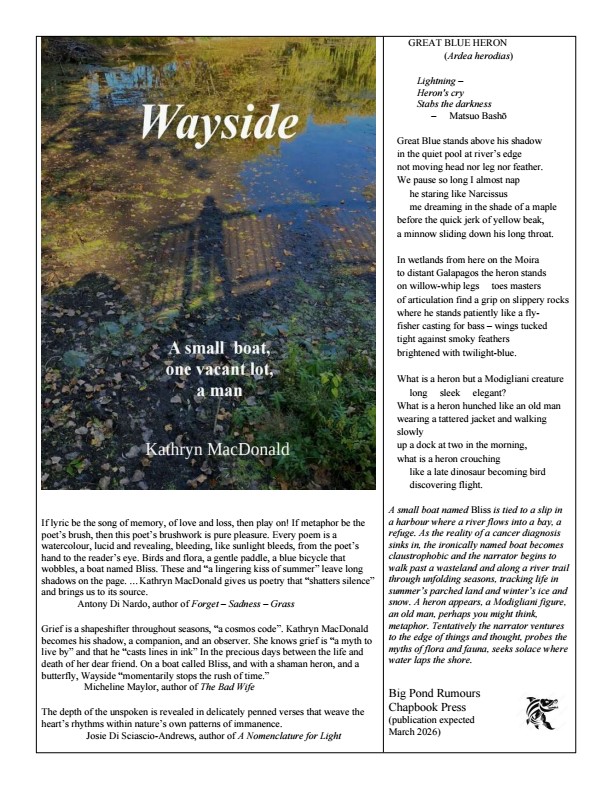
“Hello from the Other Side”
Poetry Winner
Scugog Arts Ekphrastic Writing Contest
Link (2026-04-19)
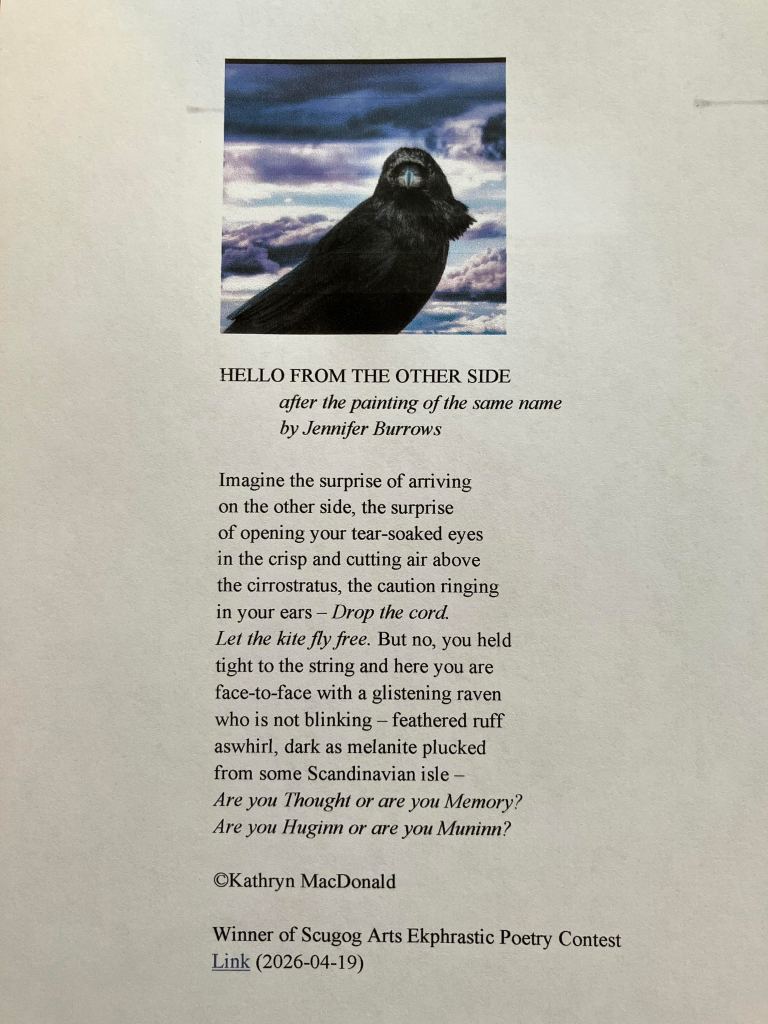
Books published 2005-2025
Excerpt from: Liminal Spaces
Ekphrastic poetry’s deep roots reach back to Greece, as in the Iliad. The form began when only a few people might actually see an original work of art. Early writers used vivid, detailed descriptions, so that others could almost see the art.
Contemporary ekphrastic poetry, not only describes what is seen but also responds to the work. Contemporary ekphrastic poetry explores what is experienced through the work of art – whether that work is painting, music, or dance, for example. This means that we don’t necessarily praise as John Keats did in “Ode to a Grecian Urn,” but we often comment and question the art and/or artist in our sights.
We enter the work emotionally in an “ongoing heart-dialogue.” We engage in a deep and nuanced way, incorporating our responses to the narrative or action we discover in the original work. As I say in the introduction to my section in the collection, “ekphrasis is an invitation to engage with and to discover a personal relationship with a work of art”. . .
- as Felicity does in “Cezanne’s Card Players,” in which she questions the painter;
- or as in “Letters,” how Katie describes an imagined experience with the poet Margaret Atwood;
- in “Flower Gatherers,” Gwynn enters “Danseuses Bleues,” one of Edgar Degas’ dance paintings, which leads her to praise Degas who “notices the beauty / in what others scorn;”
- in my poem “Between the Wars,” I look not only at one painting by Prudence Heward, of the Beaver Hall group, but I consider her oeuvre in the context of the era and the bad reviews the group received because their “jazzy” paintings disturbed the traditional painting of the time in Montreal.
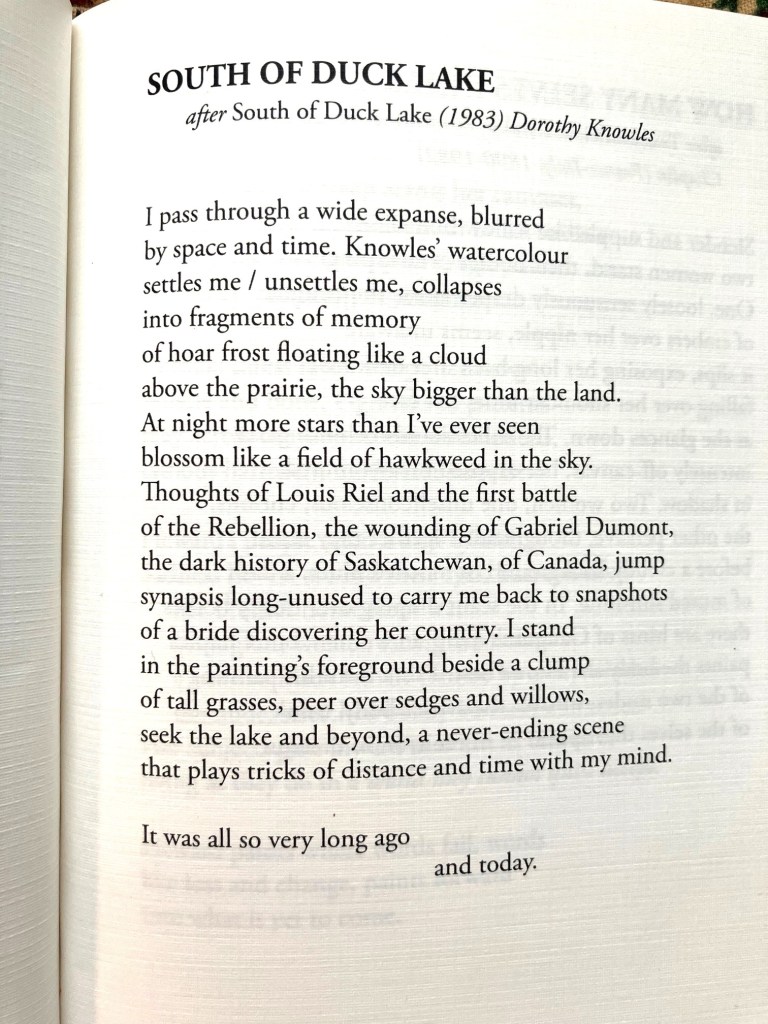
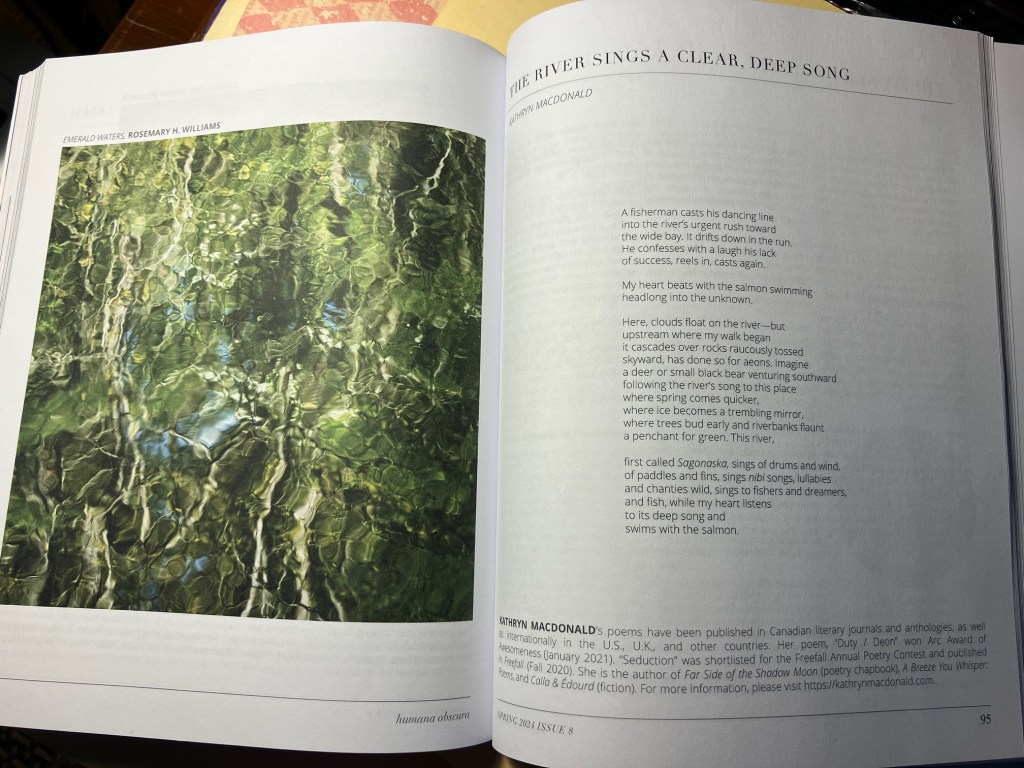
For more about my poetry, please look under the “Poetry” secion where you’ll find poems and links to poems published in literary journals and anthologies. I hope you enjoy this favourite poem published in Humana Obscura, Spring 2024:
My poetry books are available at River Bookshop, Amherstburg, Ontario (or email me at whiteoakstudio21@gmail.com.
I also write reviews of books that have intrigued and pleased me. Besides this website, they’ve been published in a number of Canadian literary journals. Sometimes I add writing tips (although there is a separate section for the tips).
For more about my books and me, please see “About.”
I hope you’ll enjoy browsing my website. I always enjoy receiving emails from you at whiteoakstudio21@gmail.com.
Kathryn

