Review: Where family stories might lead (Palm Trees in the Snow by Luz Gabás; The Bolter by Frances Osborne)


Secrets are revealed through old letters and a personal search in Palm Trees in the Snow, as they are in Possession: A Romance (the previous book reviewed). But that is where the similarity of the two stories ends.

Palm Trees is purported to be fiction, but in the Author’s Note readers learn that the novel was “inspired by real events” and informed by Luz Gabás’ father and grandfather’s stories. She writes, “Thanks to their memories, both spoken and written, I knew from a very early age of the existence of the island of Fernando Po and so many other things….” Yet, while the research about place and circumstances feels authentic – Spain’s Rabaltué and the African island – Gabás has difficulty lifting characters and their experiences off the page.

Palm Trees in the Snow is a big ambitious book that was recommended by friends. It attempts to describe Spain’s colonial period on Fernando Po, an island off the coast of Africa, first from a Spanish point-of-view and later the indigenous perspective. The story revolves around two very different brothers, their loves and their children, which makes it a bit of a complicated family saga seen through the eyes of one of the daughters. Unfortunately, Gabás’ characters seldom seem real, the storyline often feels flat, and her sex scenes read like Harlequin Romance. While Gabás has potential for a really good story, she could have used the help of an editor or maybe a reading of Frances Osborne’s The Bolter.

Osborne also sets out to discover family secrets. She succeeds in telling an insightful, page-turning tale. The biography unfolds during a similar African colonial period to that of Gabás’ story, although in this instance England and Kenya.

Like Gabás, Osborne is a granddaughter who discovers her link to a mysterious heritage when she was little more than a child. Idina Sackville was a contemporary of Karen Blixen/Isak Dinesen and Beryl Markham (Out of Africa and West with the Night, respectively) but this reference is for context and those book reviews can come another time. Idina Sackville was daring, “her scandals were manifold.” Idira’s behaviour so extravagant, shall we say, she was fictionalized into a Nancy Mitford character; she became Michael Arlen’s Iris Storm, and this year (2017), she appeared as Lady Idina Hay in Wilbur Smith’s War Cry, an adventure story set in post WWI Kenya. Osborne’s challenge was to dig beneath the colourful legend in search of the “whole” woman who was her great grandmother – the black sheep of the family, the woman behind the legend.

Gabás’ ambitious attempt to explore the colonial experience on both colonizers and colonized kept me turning pages despite its frequent textbooklike tone and shallowly-drawn characters; Palm Trees in the Snow is recommended with qualifications. Osborne, on the other hand, creates emotional involvement while her context of the social and cultural values of the time (in both England and Kenya) keeps her storyline focused on character and the pages almost turn themselves; I highly recommend The Bolter.

Books available at your local bookstore or online:

Palm Trees in the Snow

The Bolter


Review: “All obsessions are dangerous” (Possession: A Romance by A. S. Byatt)

“The book was thick and black and covered with dust. Its boards were bowed and creaking; it had been maltreated in its own time…The book sprang apart, like a box, disgorging leaf after leaf of faded paper….Under page 300 lay two folded complete sheets….They were both letters in Ash’s flowing hand….

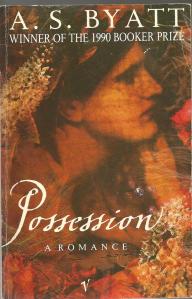
I bought Possession: A Romance, by A. S. Byatt (previously read) from the Friends of the Library. It sat on the bedside table, unopened, for a very long time, passed over by others somehow less intimidating. The sepia-tone cover suggests historical romantic – a time-mottled face and dried flowers with just hints of colour – a moody Victorian or Rossetti feel to it. The book is thick, the type small, and the paper thin. It won the 1990 Booker Prize.

The first few pages reflect the denseness I anticipated and I wonder why I continue to read. Then I become curious about draft letters researcher Roland Michell finds in the Reading Room of the London Library and about the man who “borrows” them, not to mention curiosity about their Victorian author and mysterious recipient. I recall my decade working in an English Department, the petty politics, the egos, and the ambitions. I keep reading enjoying the satirical insights, the analysis of Victorian poetry, and the sense of so much hidden in time and shadows, obscured beneath the surface of things.

Two stories weave together: a Victorian-era story of two (fictitious) poets and an illicit love, along with a contemporary pair of academic researchers thrown together by their interests and passions. In both stories, place shifts from London to Lincoln, to northern moors and to Brittany – all atmospheric. Contemporary characters inhabit the lives of the poets that possess them, like alter-egos:  “…it is the constant shape-shifting life of things long-dead but not vanished.” The past is very much alive, the boundary of time blurred. We experience Victorian angst and mores, classics and myths, legends and fairy tales against a backdrop of contemporary intrigue and suppressed desire.

The sleuths move through time and place, crossing a variety of thresholds and being restrained or repressed within others. Byatt writes, “We are defined by the lines we choose to cross or to be confined by” (431). This, perhaps, expresses the overriding theme of the novel.

Overall, Byatt has a bit of fun with stories, poems, and literary criticism and the push to publish, not to mention letters (from intellectual-to-frenzied) in which she wraps Possession. Is this a detective story wrapped in literature, or a literary story wrapped in mystery?

Possession is not a book for everyone, but for those who like period novels and sleuthing, it is a very satisfying read. Its brilliance requires thoughtful patience and a couple of summer days sitting, perhaps, on shady Victorian verandah.


Possession-A Romance

Available through your local bookstore, or in a different edition online: Possession