
Karen Connelly makes many journeys. Travel introduces us to strangers and both her poems and prose reveal ways of understanding the other and experiencing ourselves.
In her 2017 novel, The Change Room, she notes two paths toward knowing: listening and storytelling. “Listening,” she writes, “was a way of pulling a stranger toward you without touching.” And so is storytelling: Shar or Shaharzad or Sheherazade – the great storyteller of One Thousand and One Nights – is the siren of enticement in The Change Room and the sensual “amazon” of the story. Listening and storytelling, strangers and borders, are common themes in Connelly’s oeuvre.
Writers’ recurrent themes interest me. I like their unfolding like fans, and their closing tight. I like the way they spread across continents and genres – always surprising, maturing, shifting but remaining, in important ways, the same. In Karen Connelly’s writing, the travellers and lovers among us glimpse ways of knowing ourselves and the other. This holds true from her earliest stories to the most recent novel.
In Connelly’s stories, strangers often become intimate in a variety of ways, sensuality being one. In “Esmeralda, a story” (One Room in a Castle 36-67), readers glimpse insights into what has matured into the novel The Change Room.
From Castle: “Our greatest similarity was our love of water, the freedom of motion it creates. ‘It’s flying,’ Esmé said. ‘It’s the closest we’ll come to being free of our bodies.’ We began to meet in the change-room before swimming….” Esmé swims; she is also a musician. Music, like water, is freeing and sensuous: “She closed her eyes, bent herself over the piano, and laid her hands on its black surface…. Then I leaned forward and kissed her eyelids.” These themes sown in Castle dominate in Room.
In The Change Room, the writing is more complex, layered and mature, but in the early work, we glimpsed seeds that later became mature fruit. (For more on recurring themes of individual writers, please also see my review of Bicycle Thieves by Mary di Michele.)
Connelly writes across genres, which leads me to think about truth in nonfiction and fiction. One Room in a Castle, for example, was published as nonfiction – purportedly as correspondence and travel. The Change Room – 22 years later — as fiction. It begins with an Emily Dickinson quote:
“Ourself, behind ourself, concealed,
should startle most.”
And we are left wondering about the difference between reality and imagination – a conundrum for writers and readers. Connelly does provide hints. For example, in “Extrah-dinary” (Castle 33-35) she writes “It is difficult to get to the truth of one’s self; how much more difficult to create an imaginary world and reveal its truth.” Still…. (For more on this topic of fact and truth, please see my review of Beatrice and Virgil by Yann Martel.)
I was introduced to Connelly’s writing through a book club reading of her mid-1990s memoir, Burmese Lessons, which still pops into consciousness despite the time lapse. But it’s the poetry collection, The Border Surrounds Us, which remains my favourite – especially section II – which I’ve read over-and-over again. It is only recently that I discovered Grace & Poison, a compilation of Connelly’s first two poetry books. Even in 1990 her themes were clear and her voice strong. From that collection, a prose poem – “A Story for Suradev, In Bangkok” – stands out. In it we find her mature themes of intimacy/compassion, strangers/self. The closeness of her observations stand stark.
Her passion for travel and imagining the experiences of those she meets into story is continuous. Perhaps Connelly’s most intense book is The Lizard Cage, published in 2005, which drew me back to Burmese Lessons. Burmese Lessons is essentially a love story/a political story. The Lizard Cage is darker, taking readers inside a Burmese prison and into the isolation of an ancient man and a small boy, cruelty beyond comprehension, love, and survival. Somehow Connelly manages to maintain dignity, love, compassion, and beauty.
Karen Connelly began her writing career with the idea of borders, journeys from the known into the unknown: “Our lives begin and end with journeys made alone,” she wrote in her early twenties. In between life’s bookends, many other journeys are made and borders crossed: some geographic and cultural; some social and political; most intimate and sensual. They are all crossed personally, alone, and usually with risk of one sort or another. The intimacy with which she crosses borders can challenge us; she touches the heart, the soul, and the body.
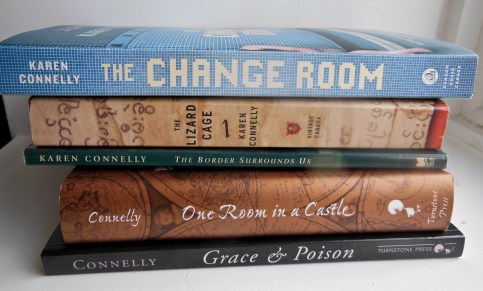
Various publishers have put Karen Connelly’s writing into print. Search her name or the name of one of her books and that will take you to a source. Most are available through your local bookstore or online.

 Kathryn MacDonald