Openwork and Limestone by Frances Boyle: Book Review

I wish I’d had a lifeline to throw, / a silken cord for her safe passage back through time. – “Passage” (41)

 Openwork and Limestone by Frances Boyle is a collection of poems to be read carefully. Boyle draws on many sources for inspiration. Her subjects include history, family relationships, art, nature, time/space, and five fascinating poems about Lil. But thematically, the collection is not as scattered as the range of subjects suggests. A line in the prologue poem, “Inhumed,” attunes us to a key theme – posed as a question that runs throughout the collection: “What flows unseen beneath our lives?” – holds it all together.

I am always fascinated by the way poets structure their manuscripts. Structurally, Boyle’s collection is divided into four sections, each beginning with an untitled poem.

In the first section’s prologue poem, the narrator asks: Shall I too play the scientist, / study prehistory in stone… as she imagines time-travelling with Le Guin. And she does travel, imagining Kate, my finespun grandmother who is leaving Ireland with No promise of a quick return (“That Faraway Place”). This poem includes one of the most haunting images of the collection: Kate leaves in a mothdance of handkerchiefs.

In the second section, we find tension between the blight-blasted and openings, and we continue to time-travel. In “Passage,” during the Solstice the family enters the passage tomb at Newgrange…

We squeeze along its length, shoulders brushing stone.
Reaching the chamber, see chevrons, sheaves, triple

//

spirals faint-carved on rock. Charred bone-bits, soot-
shadows. A tomb. Grave goods strewn on passage floor.

The daughter leaves; she couldn’t carry on. The poem concludes with …

I wish I’d had a lifeline to throw,
a silken cord for her safe passage back through time.

Are you reminded of Theseus, Ariadne, and the Minotaur, the spool of thread?

In the third section prologue poem, there is a silent buzz / of hivemind hysteria and it is this section that we meet Lil. There are five intriguing Lil poems, and I want more of this fascinating character. As my mind went to Greek myth in the previous quote, here my mind leapt to Lilith, first wife of the Biblical Adam. In “Lil’s Rounds, She won’t be sucked under. She won’t drown. In “Singalong,” Lil reminds me of Yeat’s “A Crazed Girl” improvising her music. / Her poetry, dancing upon the shore.

Singalong
Lil was flotsam those years, never
quite sinking. Maybe she landed there
by happenstance; she wasn’t jetsam, no hands
delivered the overboard fling. When she flew

on her feet, whirled with spun eloquence
of fleet deer, she prefigured the bringing
of birdsong, commentary written
in runic, best executed in daytime,
accompaniment dipping at twilight to dirge.

In the final section, hope breaks through. In “Endurance,” Boyle writes: We’re hulking ships mired in frozen seas, / but spring is creaking open. The poems reconnect with earlier ones, as they do in “Tide of Limestone” in which the speaker crawls through caverns: The stuck place. / Dark matter filters us, / flows through our invisible nets. / We leave handprints, / scratches. Scant record. The final poem – “What Letting Go Means” – time travels through memory etched in glass. The speaker admonishes her sister to stand back from the fire, a plea (a hope) for the future.

Lacework and Limestone is Frances Boyles second poetry collection.

Available through your local bookstore or online: Openwork and Limestone. (Frontenac House Ltd., Okotoks, AB, 2022). ISBN 978-1-989466-43-8

Two books by Simon Constam – Domestic Recusals and Brought Down: Book Review

Poetry is wrestling with what lies behind the curtain – Simon Constam

I’ve been rereading Brought Down by Simon Constam since last fall, trying to understand what is layered beneath the obvious beauty of the poems. One middle-of-the night I scribbled on a piece of paper: These poems feel like Buddhist koans – a search for insight – tests. Or maybe, not to provoke “great doubt,” but to express both doubt and faith. It is with this idea that I’ve approached the review. The first poem is a good place to enter the collection, since prologue/first poems generally set the tone and subject for a book.

The first two lines of “Every Glory is Diminished by the Truth” establishes one of the issues nagging away at Constam: And do I flinch at the mention of Deir Yassin? / And do you flinch at the mention of Ma’alot? (The Glossary tells us that Deir Yassin is the site of a massacre of Arabs by Jews in 1948 and it tells us that Ma’alot is the site of a 1984 Palestinian terrorist attack that resulted in the deaths of 25 hostages.) Brought Down was published in 2022 before the current war in Gaza; war is not what this collection is about. (Although it might be the backstory.) This collection is one man “wrestling with what lies behind the curtain.”

Writing in a “blurb” for the book, George Elliott Clarke says: “Constam appears as … a Seinfeld-mode Job, questioning God about his ‘masquerading as the dark.’ God is ‘arbitrary’ and we are fickle … .” A disquiet comes through Constam’s struggle, as in:

Simon Agonistes

I am hiding from Him,
like Adam.
Way down in the labyrinth
of Tokyo’s malls,
Eve knows nothing about it,
she thinks it is just a trip,
into the city.

Not to belabour the struggle aspect of the poems, I also want to quote from “HaMakom” (a name for God, also meaning place), and the struggle for place resonates across the decades. “[T]he mind wanders,” the people wander, the book is a jail daring the heart to accept. Finally, I am left with the suggestion of the diaspora.

HaMakom

We meet in a small place, a shel shul,
beneath a tallis’ embrace. There is a book
in my hands, but I do not need it.
The text is a jail. Behind its black bars
the mind wanders. Behind the music
of the words, the meaning is obscure.
Some say the words themselves are
Prayer. Some say the emptiness behind them
is the God who deigns to meet you there,
dares you, some say, dares
your heart, to be without meaning,
to come unrooted as a tree would give in
to the wind and a leaf would float to the sea.

Before turning to Domestic Recusals, let’s look at the title poem, “Brought Down,” the final poem in the collection. It begins: Blood is a river that will not stop and toward the end Constam writes … Everywhere we look, / there is an explanation of who we are and / who they are and what we might become. / In every room we gather, we see certain things / about ourselves but never speak them. We see how they [the ancestors] have suffered // and humanity suffers, every beautiful child / who came from long, long ago … .

There is beauty in the writing; there is pain in the struggle. Brought Down is poetry with subject, tension, music, and craft.

The poet’s conflict, found in Brought Down, continues in Domestic Recusals, but it is different. Simon Constam writes that the poems “come from experiences in and out of marriage, in and out of depression, into and out of different ideas of how men and women operate in relationships.” In these poems readers will find the seriousness cut with something close to humour:

Billet-Doux

Walking out this evening,
wrapped against the snow,
when I see
the idea of home
in the eyes of passersby.

I miss you deeply.

And when I am warm again in my rooms,
my footsteps are alone.
But I lie down with you.
Listen, the future comes calling ceaselessly.
I cannot keep even your absence
Here for long.

The poems in Domestic Recusals are love poems with a twist of angst and self deprecation, although that might be too strong a word. But argument and God are still present although limited, as in the short poem “Certainty.”

Certainty

With certainty, we subdue the inexactitudes of God.
With certainty, praise of Him comes easily.
With certainty, no one, not even God disturbs us.
With certainty, we’ve won the argument
with ourselves.

In Constam’s writing, he argues with his loves, within himself, with his God, and with the forebearers who carry the weight of religion. His self-questioning even flows through the more earthy, lush, sensuous poems that run throughout Domestic Recusals. Consider the titles: “Come to Bed with Me Tonight, Solo Traveler,” “Little Black Book of Scars,” and “Seduced.” Constam’s undercurrent of arguing with himself is his voice, the voice that remains constant regardless of his subject. I am captivated by the way it holds me.

I admit that my first reading of these collections left me uncertain (not unusual for me) and so I returned again and again. The more I read the poems, the more certain I’ve become that Simon Constam is a poet to follow.

Available through your local bookstore or online:

Brought Down by Simon Constam (Resource Publications, Eugene, Oregon, 2022). ISBN 978-1-6667-3435-5.

Domestic Recusals by Simon Constam (AOS Publishing, Montreal, Quebec, 2024). ISBN 978-1-990496-47-9.

[…] by Fady Joudah: Book Review

You who remove me from my house / are blind to your past / which never leaves you, / blind to what’s being done / to me now by you “[…]” (69-70).

In literature, an ellipsis is a narrative device indicating that something has intentionally been left out of the narrative, or it might suggest the passage of time. An ellipsis might also be a symbolic doorway, a gap, a silence. There is no statement in the collection as to exactly what Fady Joudah intends us to read into the space. […] is not only the book’s title, but also the powerful title of a series of poems, suggesting a number of things including the passage of time during the on-again, off-again conflict in Palestine, the generational trauma of the diaspora, the war, colonialism and so on.

Joudah is a Palestinian-American, physician, and prize-winning translator and poet. He writes “witness” poetry, although his poetry is not from the “battlefield,” as was my “teaser” review of A Crash Course in Molotov Cocktails by Halyna Kruk and the reminder of Goran Simić’s from Sarajevo with Sorrow that I published a few days ago. (You can read that review here.)

Joudah lives in the United States, a first-generation American of Palestinian-born parents. His experience of war is more like Keith Garebian’s whose subject is the Armenian genocide of 1915-1920. Garebian bears witness to the continuing trauma left in war’s wake. (In my review of Garebian’s Poetry is Blood, you will find notes on generational trauma, click here.) Joudah experiences the losses through his parents: “… What childhood does / a destroyed childhood beget? / My parents showed me the way” (12).

As with Garebian, Joudah lives with “home” missing. His past a mirage, a source of loss, a source of anger. The poem quoted at the top of this review, concludes:

You who remove me from my house
have also evicted my parents
and their parents from theirs:
How is the view from my window?
How does my salt taste?

Shall I condemn myself a little
for you to forgive yourself
in my body? Oh how you love
my body, my house.

Joudah’s poems are also poignant with the loss of mother tongue, a people’s language, as in […]” (6):

From time to time, language dies.
It is dying now.
Who is alive to speak it?

Another narrative technique that Joudah uses is dialogue as in “[…]” (24):

“Your oppressor,” they said,
“has suffered more than you have.”

“As have others,” you said,
… .

Finally, there is one more poem I’d like to quote from: “I Seem As If I Am: Ten Maqams,” #5:

… At a traffic light an old man hands me a rose and says,
It’s for nothing. He meant, I don’t have to pay nothing

or sign a petition.
How our faces appear to him. Quickly
he walks away to let the weight

of the rose grow sovereign in my heart

to the extent it can
on the eve of a new war.

(Note: maqam is Arabic for place.)

Fady Joudah won the Giller International Prize (2013) for his translation of Like a Straw Bird it Follows Me and Other Poems. In the preface, he writes, “Ghassan Zaqtan’s poems, in their constant unfolding invite us to enter them, exit them, map and unmap them, code and decode them, fill them up and empty them, with the living and nonliving, the animate and inanimate, toward a true freedom.” This could be said of Joudah’s own writing in […].

Available through your local bookstore or online: […] by Fady Joudah. Minneapolis (Minnesota, USA): Milkweed Editions (2024). ISBN 978-1-63955-128-6.

Poetry is Blood by Keith Garebian. Toronto (ON, Canada): Guernica Editions, 2018. ISBN 978-1-77183-279-3.

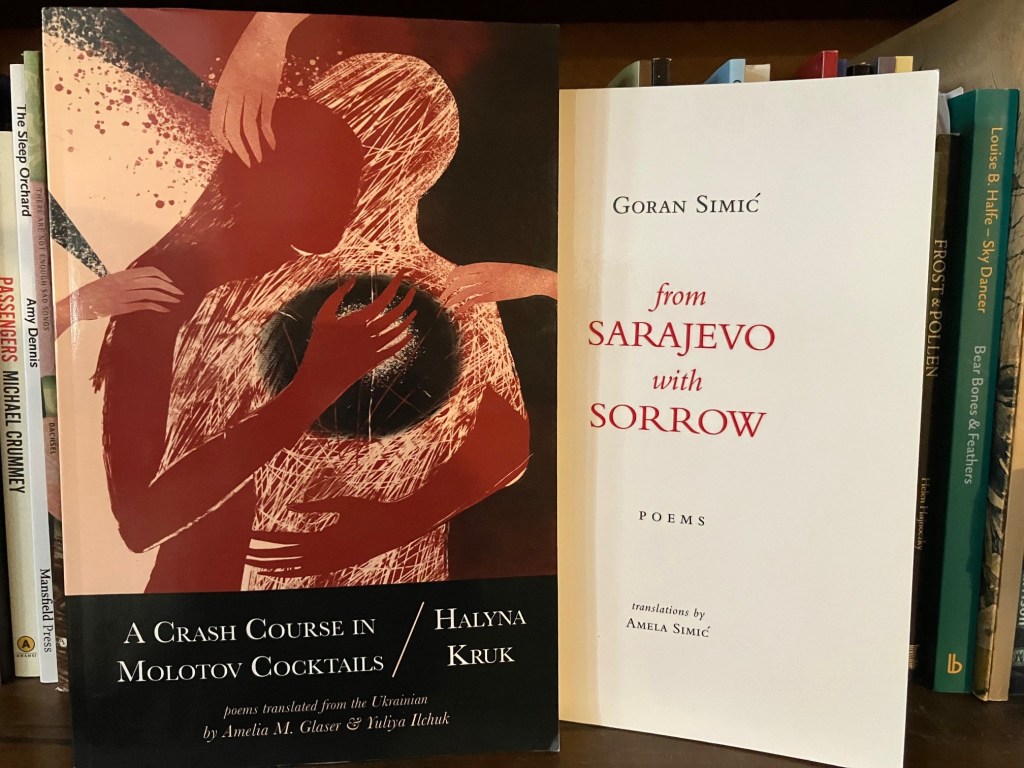
A Crash Course in Molotov Cocktails by Halyna Kruk: Book Review / a teaser

Books have collected in piles and so I’m going to post a few “not quite” book reviews, call them teasers. They are about books that I want to share and that I hope will pique your interest so that you check them out at the library or nearest bookstore.

A Crash Course in Molotov Cocktails by Halyna Kruk (trans. by Amelia M. Glaser & Yuliya Ilchuck) – shortlisted for the Griffin Poetry Prize

From Sarajevo with Sorrow by Goran Simić (trans. by Amela Simić)

Halyna Kruk’s book is new and currently shortlisted for the Griffin Poetry Prize, it reminded me of Goram Simić’s collection that I have read and reread many times. They each offer accessibility and insight on the horror of war, Kruk’s Ukraine and Simić’s Bosnia.

In a poem titled “war,” Kruk writes: “… a human walks in the woods like an echo, / lost in thought, distracted // some bullet moves with its own trajectory, let loose / in a right or left hemisphere. somebody’s. the earth’s.” In another poem titled “we act like children with our dead,” Kruk writes, “… as if none of us knew until now / how easy it is to die / everyone still hopes they’ll lie there for a while and rise again ….”

In the introduction, Kruk is quoted as saying that her“poems have changed since the outbreak of war.” She says they no long pay attention to “form and style, now my poems are almost entirely focused on content — they document the reality of war, literally, emotionally, and sensually….” They are intense. I can read only three or four at a time. They are beautiful. They are horrific. And something about them made me go to my bookshelves and take Goram Simić’s Sarajevo collection down to read alongside Kruk’s poems.

Simić says of his poems: “In Sarajevo hell I wrote these poems as epitaph and testimony.” One poem I always search for among the many “flags” stuck to the pages of his book is “Love Story.” It describes a scene on a bridge that seems to me more chilling than the rest. I quote from that poem in a book review that I previously posted. You can read it here.

Available through your local bookstore or online:

A Crash Course in Molotov Cocktails by Halyna Kruk, trans. by Amerlia M. Glaser & Yuliya Ilchuk (Arrowsmith Press, 2023), ISBN: 9798986340197.

From Sarajevo with Sorrow by Goran Simić, trans. by Amela Simić (Biblioasis, 2005), ISBN: 978-0-9735971-5-8.

UPDATE: I’ve just come across this Youtube post: Amelia M. Glaser, Yuliya Ilchuk, and Halyna Kruk interviewed by Griffin Trustee Aleš Šteger. You can view it here.