Still arriving is Bruce Kauffman’s fourth full-length collection of poetry, which earned an honourable mention in the Don Gutteridge Poetry Award (2022) competition. In addition to his full-length work, Kauffman has published four chapbooks. But writing is not the sole reason for the widespread recognition of his name. For those living in the Kingston area, Bruce Kauffman needs no introduction. In 2020, he was presented with the Mayor’s Arts Champion Award; his work in the community as a poetry booster was featured in The Queen’s Journal (April 2, 2021).
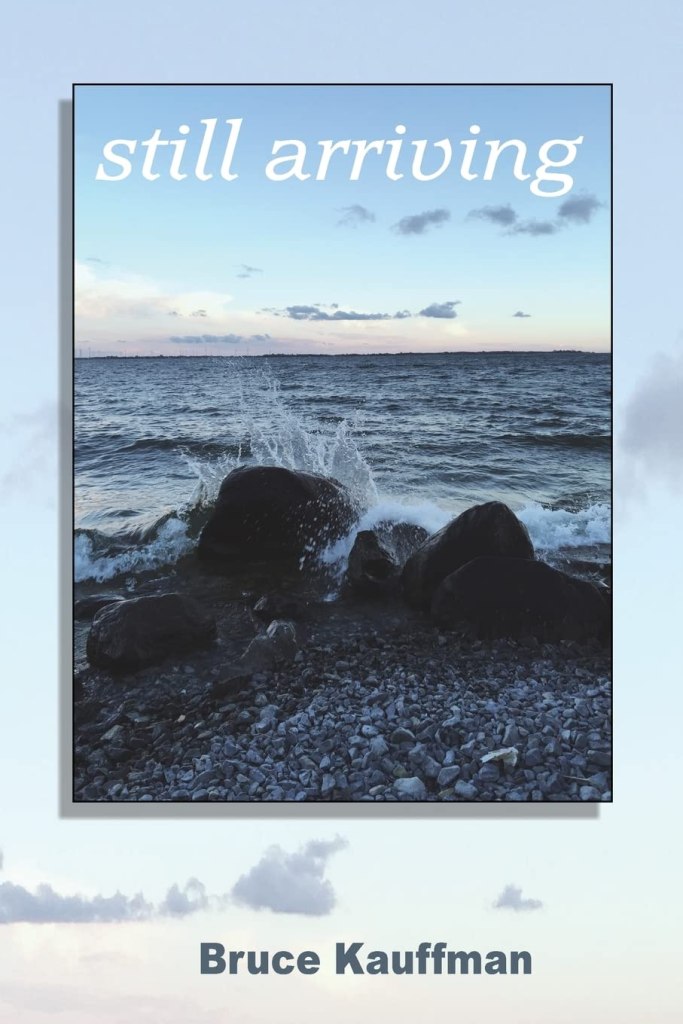
I met Bruce in 2011 during the launch of my first poetry collection and more recently know him as a poetry editor for Devour: Art and Lit Canada, an online journal. Our paths crossed again at the Northumberland Festival of the Arts (NFOTA, September 2024) where he read during the WOW! Words on a Wire event. That is where I found a copy of still arriving, drawn to it by Bruce’s reading and by the quiet pensiveness of the cover image.
The poems have a haunting quality to them, yet feel immediate. In the Queen’s Journal article, Kauffman is quoted as saying, “A lot of my work seems to be sort of nature-drive, sort of Zen-like. Where I get inspiration is in a process called intuitive writing […] I find it important to not think. That’s the first step.” In this sense, the poems are experimental, if not in form. It is easy to accept that some of the poems, such as “unfinished notes from a journal #15” (43) were written using this method. They are reflective, a bit like notes-to-self.
Besides a peek into his journals, Kauffman alludes to Greek mythology, reminding readers of Virgil’s Charon who ferried the dead across the River Styx. Kauffman’s “ferryman” (14) waits. There’s a sense of mourning the impending loss of the self:
quiet comes
the ferryman
the water
before behind
shows no trace of
ripple wave
From whatever references or allusions Kauffman draws, they are well known, needing no explanation. His poems are direct, intimate – as if he’s talking to you over a glass of wine in a quiet spot – accessible, written by a man of certain years and life experience.
Early in the collection, the poet establishes the season of his life and the overriding tone of the poems, as in “autumn” (11):
we all
in an autumn
of our days
not simply any autumn
instead perhaps
that final one
…
His meditative mood becomes an undercurrent running throughout the collection.
In “epiphany” (20) he seems surprised that his present view of life differs greatly from that of youth:
epiphany
for this poet
this late in life
a reminder that
lesser writ
those mourning and vibrant poems
of youth
instead now
these evening and mourning poems
of and to
the dead
the dying
In “gone,” the mourning is for another. The poem begins: “this morning i packed up / the few things left of you / in a box,” and ends with “in the drought / of a lifetime // a last morning dew.” Although the book’s title looks forward, this elegiac feeling drifts across the pages.
Perhaps my favourite poem in still arriving falls midway between the book’s covers:
Zhivago, again
After Boris Pasternak’s novel, “Doctor Zhivago”,
with reference to a scene in David Lean’s 1965 film
based on the book
oh, Pasternak
Zhivago
how you arrive again
in these days
and my dreams
to comfort to haunt
we both all
torn inside outside
by family place
yours and my
fiction or not
different era-ed
distant but somehow
parallel lives
either of us married to ink
as much as flesh
and this morning
dear Larissa
after I now too
have become
the deserter
having crossed through blizzards
over frozen tundra
left my steed dead
along the way
Despite Kauffman’s attempts to put a positive light on aging, “Zhivago, again” captures disquiet, loss, regret, the toll of being “married to ink.” This despite the theme suggested by the title and his neighbourhood walks, coffee in a corner café – the things that occupy the “intuitive” poems. This tension in the collection makes it interesting, but it also feels at odds, portraying a conflicted poet who wants a Zen-like life and death, but one who is living and facing it with some trepidation. Still arriving is a thoughtful collection written by a skilled and sensitive writer.
Still arriving by Bruce Kaufman (Wet Ink Books, 2023) is available through your local bookstore or online (ISBN 9781989786819).
 Kathryn MacDonald