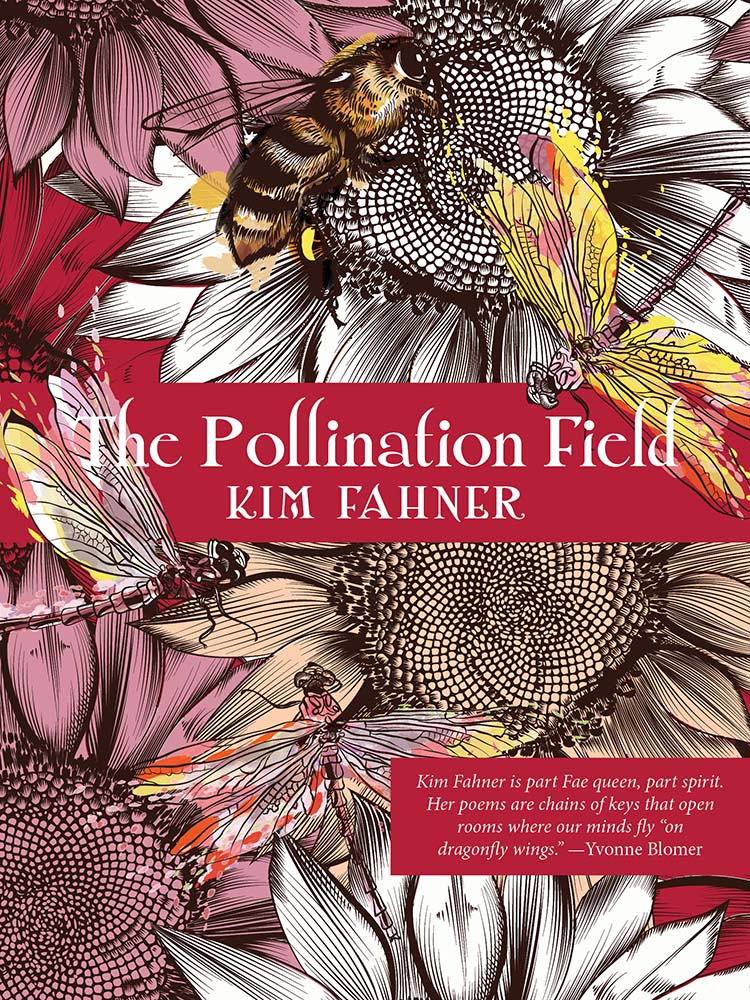
The Pollination Field by Kim Fahner gifts lovers of bees and devotees of folklore (perhaps the first of the natural sciences) with poetry rich and layered. In these pages, Fahner confronts the immense time that bees have done the pollinating work that led to a riot of flowering plants early in the warm Cretaceous period through to today. The collection explores not science alone, it also revels in the folklore of bees, lore carried across the ocean by the Irish, Scots, and British diaspora.
In “A Bee in the House” (3), the speaker listens to “a baritone that conjures a bagpipe’s drone.” Fahner describes the bee as “Stained glass, those wings, like tiny windows / you look through, trying to find answers to questions / that have only been imagined….” She tells us, “A bee is good luck.” Here, in the prologue poem, Fahner establishes the overriding theme, the blessing of bees, and the searching tone of the collection.
While some of the poems, like the prologue poem, are lyrical, others flirt at being prose poems. Poems with long lines. Poems that present fact. It is primarily in these that we glean the science as we do in “Bee Grabbers” (68) that looks at the “chameleon” predator, Conopidae that inject their eggs into the abdomen of bees:
Ten to twelve days. Larvae that grow, silent invasive alien, and a bumble
that buries itself—headfirst, head in sand—before it dies. In between,
from start to finish: bee suckles, ignorant of false pregnancy,
internal parasites that mark its end.
However, look deeper. Conopidae may be metaphor after all: Lost is the “keen prospects / of lively offspring. Don’t look back; your conscience might / catch up to you, turn your ankle.” The poems in The Pollination Field can trip you up, tease you; Fahner’s poetic mastery creates a honeycomb of meaning.
The review is published in FreeFall Magazine. To read the whole review, please click here.

 Kathryn MacDonald