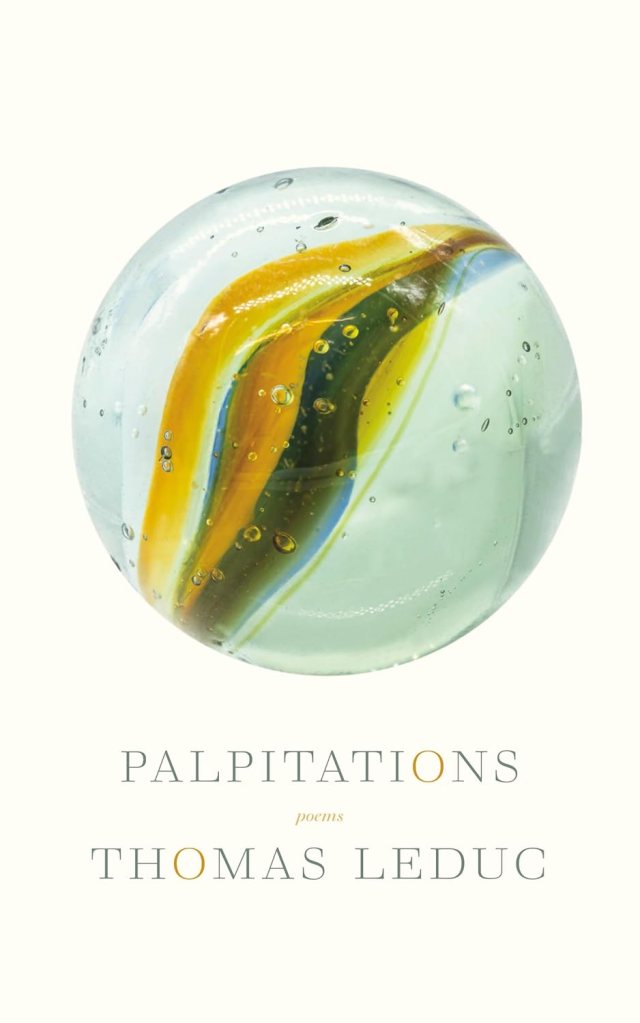
In his second collection, Palpitations: poems, Thomas Leduc takes us on a journey from boyhood to manhood. The poems sometimes bristle, sometimes soberly reflect. Throughout, there’s something alive, gritty and tender too, often with a sarcastic adolescent edge.
The prologue poem in a collection often establishes a tone and themes that readers might expect to recur again and again. The first poem in Palpitations, “Last Hours of High School,” begins: “I stood before the guidance counsellor. / Stared at my menu choices, / pre-packed career choices / ready to serve.” In the second stanza, Leduc takes us to the cafeteria; in the third, back to the guidance office where “Behind her desk, the counsellor / slumped her shoulders, / rolled her onion eyes…”. The poem ends with: “I want to be more. / More than this.” The theme and subject of high school recurs across the five sections of the collection.
The first section – Freefall – raises images of petulant youth held in the clasp of a system found needing, of boys disillusioned with their reality and the future it suggests. Thoughts of literature’s angry young men of the 1950s raise my hope for what is to come in the following pages.
The second section – Opposing Influences – pivots, seeks change, looks for a way out. In “Happily Ever After” Leduc references Alice, Oz, Narnia, Peter Pan, The Lost Boys, and mechanical toys, childhood. He seems to ask if literature is the answer. Leduc alludes to first sexual encounters, reflects, experiences loss: “What could have been between us / resides in the flickering embers of the Milky Way, / mourned by a circle of stones” (“Missed Kiss”).
In the third section – The Night We Burned the Dragon’s Head – the tone shifts. For example,
THE CROSS-POLLINATION OF STARS
We surrendered
to the gravitational pull
of the night. Gave ourselves
to the cross-pollination of stars.Ants marching toward candy.
A school of fish, a field of zebras,
following our instincts, moving
in unison, to gather at a concert.
In the next two stanzas, Leduc takes us into the “herd” experience, how they “swarmed the stage,” ending the poem with:
That night, we ran with the buffalo,
flew with starlings, that night,
we danced and sang to the hum of bees.
Leduc’s ability to draw readers into experience, to maintain movement (inside each poem, and also inside the collection as the poems unfold), to create images that surprise and linger in our minds is one of his strengths. In the first two sections, high school is happening, but in this third section the poet reflects. He is past high school. In “Pinball Highschool,” he opens his old locker and “The energy of adolescence / springs out, launches me / into the past…”. Here, we meet his daughter and her “hummingbird heart” (“Barbenheimer”). Also here, he writes, “I am once again warm in winter. / I am falling in love.” This third section transitions.
In Murmuration of Covid, the fourth section, Leduc includes pandemic poems of distance and of kindness too: “A middle-aged man offers / his umbrella to a pregnant woman. / She lifts her mask…” (“Touch-Starved”). There is also the frustration of the “The Fifty-Seventh Covid Test,” and the understated “Murmuration”:
Spread out over the parking lot,
we stood outside the church,
dressed in shades of grey and black.
When one moved, we all moved,
funnelled through the doors,
perched ourselves on benches,
sat, knelt, chirped our little songs,
never touching, rarely speaking,
a flock of starlings, mourning
in one direction.
The poet has matured across the pages of Palpitations.
In the final section, Marble King, we meet a speaker who celebrates and almost sings “Come with me,” the words opening each of the four stanzas of “My Northern Lake.” In a favourite poem of mine, “Tea with Cohen,” Leduc invokes Cohen, his voice, his yearning, where “On the windowsill stood a small cracked vase / where wilted flowers prayed to the light. / Their petals mispronounced the word hope….” In this concluding section, the poems move beyond youth, reflect world news, the environment, concern for others. In the final poem, the poet observes: “Once, I was a marble-king. / Lord of the allies. / A boy of wonder…” (Marble King). He embraces that boy, does not regret, will carry him to the grave. It is a powerful poem, direct, some might say simplistic on the surface, but it is deceivingly well-crafted and placed in the perfect spot in the collection.
The structure of Thomas Leduc’s Palpitations works brilliantly taking us more-or-less chronologically through life’s stages. …
To read the full review please click here.

 Kathryn MacDonald