A Crash Course in Molotov Cocktails by Halyna Kruk: Book Review / a teaser

Books have collected in piles and so I’m going to post a few “not quite” book reviews, call them teasers. They are about books that I want to share and that I hope will pique your interest so that you check them out at the library or nearest bookstore.

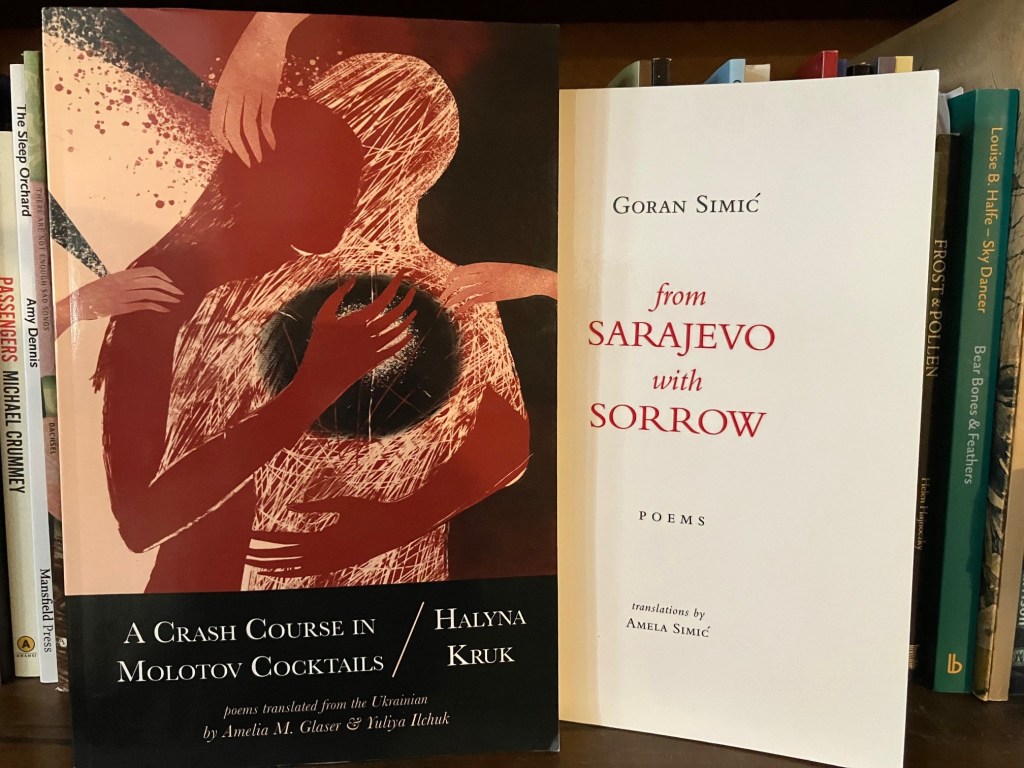
A Crash Course in Molotov Cocktails by Halyna Kruk (trans. by Amelia M. Glaser & Yuliya Ilchuck) – shortlisted for the Griffin Poetry Prize

From Sarajevo with Sorrow by Goran Simić (trans. by Amela Simić)

Halyna Kruk’s book is new and currently shortlisted for the Griffin Poetry Prize, it reminded me of Goram Simić’s collection that I have read and reread many times. They each offer accessibility and insight on the horror of war, Kruk’s Ukraine and Simić’s Bosnia.

In a poem titled “war,” Kruk writes: “… a human walks in the woods like an echo, / lost in thought, distracted // some bullet moves with its own trajectory, let loose / in a right or left hemisphere. somebody’s. the earth’s.” In another poem titled “we act like children with our dead,” Kruk writes, “… as if none of us knew until now / how easy it is to die / everyone still hopes they’ll lie there for a while and rise again ….”

In the introduction, Kruk is quoted as saying that her“poems have changed since the outbreak of war.” She says they no long pay attention to “form and style, now my poems are almost entirely focused on content — they document the reality of war, literally, emotionally, and sensually….” They are intense. I can read only three or four at a time. They are beautiful. They are horrific. And something about them made me go to my bookshelves and take Goram Simić’s Sarajevo collection down to read alongside Kruk’s poems.

Simić says of his poems: “In Sarajevo hell I wrote these poems as epitaph and testimony.” One poem I always search for among the many “flags” stuck to the pages of his book is “Love Story.” It describes a scene on a bridge that seems to me more chilling than the rest. I quote from that poem in a book review that I previously posted. You can read it here.

Available through your local bookstore or online:

A Crash Course in Molotov Cocktails by Halyna Kruk, trans. by Amerlia M. Glaser & Yuliya Ilchuk (Arrowsmith Press, 2023), ISBN: 9798986340197.

From Sarajevo with Sorrow by Goran Simić, trans. by Amela Simić (Biblioasis, 2005), ISBN: 978-0-9735971-5-8.

UPDATE: I’ve just come across this Youtube post: Amelia M. Glaser, Yuliya Ilchuk, and Halyna Kruk interviewed by Griffin Trustee Aleš Šteger. You can view it here.

Beowulf: an illustrated edition, translated by Seamus Heaney: Book Review

I had a fixed purpose when I put to sea (line 632).

This post is more impression and thoughts about translation than it is book review. Beowulf – we likely read it at some point during our education – Anglo Saxon / Old English and all that. Seamus Heaney gives us a “modern” translation and it is beautiful to read, vivid, alive. I’m afraid that I won’t do either Beowulf or Seamus Heaney justice, although I loved the book and read cover-to-cover (3182 poetic lines / 260 pages of text and illustration) in only three sittings (and then read it again, and then skimmed it this morning). What I really love even more than the poem is Heaney’s introduction.

Although written by an early English Christian between the middle 7th and the 10th century (about 1,500 years ago) the action took place (if it actually took place) before the arrival of the Anglo Saxons and it wasn’t even an “English” story. The oral story took place during the pagan period before the King Author legends that we’re familiar with through various books and films.

Beowulf, the poem, describes the life of a Nordic prince, a warrior, an honourable man who fights monsters and a dragon. It is the re-telling of an heroic narrative that seems to have taken place in what we know as Scandinavia. It’s important book, Beowulf being the first written in English and is, therefore, historically significant. The original is kept in the British Library. But besides being the first, Heaney calls Beowulf, “a work of great imaginative vitality.” (An aside: J.R.R. Tolkien also translated Beowulf, and the poem’s influence can be seen in Tolkien’s writing.)

Heaney tells us the context of Beowulf is within “a pagan Germanic society governed by a heroic code of …conduct….” He says, “the poem possesses a mythic potency” (ix). I wished, as I was reading the book, to see a copy without the Christian overlay, see it as the bards of old might have told the tale.

One thing that clung to me as I read the epic, was Heaney’s introduction that reflects on the experience of translating (which took Heaney 35 years from the initial contract – he put it aside for long periods). Heaney writes: “I noticed that without any conscious intent on my part certain lines in the first poem in my first book conformed to the requirements of Anglo-Saxon metrics. These poems were made up of two balancing halves, each half containing two stressed syllables – the spade sinks     into gravelly ground: / My father, digging.     I look down’ – and ‘down’ across the caesura. Part of me, in other words, had been writing Anglo-Saxon from the start (xviii).

In the process of translating, Heaney writes:

In one area, my own labours have been less than thorough-going. I have not followed the strict metrical rules that bound the Anglo-Saxon scop. I have been guided by the fundamental pattern of four stresses to the line, but I allow myself several transgressions. For example, I don’t always employ alliteration, and sometimes I alliterate only one half of the line. When these breaches occur, it is because I prefer to let the natural “sound of sense” prevail over the demands of the convention: I have been reluctant to force an artificial shape or an unusual word choice just for the sake of correctness (xxii-xxiii).

What poet wouldn’t love Seamus Heaney?

Before we meet Beowulf, we meet Grendel, the monster who is attacking the Danes: Then a powerful demon, a prowler through the dark, / nursed a hard grievance. I harrowed him / … (lines 86-87), and we begin by seeing the story through the monster’s eyes before we learn what Beowulf and the Danes’ experienced. The story, as you might imagine, takes twists and turns until Beowulf meets the dragon and the climax is reached. You might call Beowulf fantasy; you might call it metaphor.

Seamus Heaney’s Beowulf is a very good read, even in the 21st century.

Available through your local bookstore or online: ISBN: X003XQKRA7

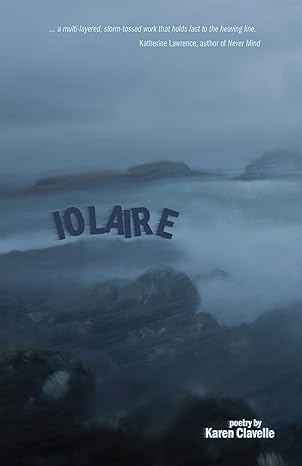
Iolaire by Karen Clavelle: Book Review

Something small and dark was rolling in the waves, in and out it went, what’s that, what’s that. And then stayed a sailor’s hat come right to my feet (18).

Iolaire is a hybrid telling of one of Scotland’s worse maritime disasters, a story of an island’s grief, a woman’s loss, and by the end, a new (though haunted) beginning.

***

The sailor’s hat (of the initial quote, above), echoes throughout Iolaire by Karen Clavelle. The hat, washed up on the shore, becomes a haunting reminder for Is (short for the Gaelic Iseabail) that her love has gone missing in the waters off the Beasts of Holm. He was lost in the early hours of 1919 when the HMS Iolaire broke apart on the Beasts, the rocks at the approach to Stornoway. New Year’s Day was to have been the joyful homecoming of sailors to the Long Island (Lewis and Harris) at the end of WWI; instead, it is the saddest day.

The bride, Is, becomes a widow, a woman who writes letters to her missing love, letters that she bundles and puts away in a drawer. But the book-long narrative is told not only in the epistolary form, which allows readers to access the thoughts and emotions of Is, but the lyric also includes actual excerpts from newspapers, and transcripts from the navy’s inquiry, folkloric prophecies, the poet’s interjections, and poetry.

The first time we’re given a look at the poignant folklore is shortly before the disaster:

Now, at that time of year it gets dusk in the afternoon, and if you’re going to be seeing anything, that’s when you’ll be seeing it — at dusk. And that’s when he did — he saw the stag, him and his sisters. Standing in the path in front of them, it was, and it turned its head and it looked right at them, and then it was gone.

… And sure enough, the boat wrecked that very night. The sister’s husband, he was lost…
(50).

Clavelle also uses her voice to interject observations and insights about the village where she lives during her research, and we readers time travel between then of the shipwreck and now. For example,

In the dream or out of it, I am absorbed in a village that boasts a school, a ceilidh house, a historical society, churches, a cemetery, and a tiny community shop, (the) Bùth, that besides offering groceries and hardware, houses the post office where Dorothy franks the mail with a date-stamp she changes daily by hand, and in the windows posts funeral announcements and community events (46).

Besides the village, Clavelle comments on the ship’s Gaelic name — iolaire sùil na grèine — sea eagle, a name in which irony brims: the boat named for the bird that foreshadowed war and disaster. Haliaeetus albicilla, its Gaelic name in the Seann-sgeulachdan (mythology): fior eun, the eagle, ‘the true bird’… (47).

Besides creative, lyrical, and factual prose, untitled poems also flow through Iolaire. One of my favourites is:

the tide bell rings

and I call for you in the heather and the thrift by An Cùl Beag
in the low tide from the caves from the
shadows of the stacks at Cala Ghearraidh

I call along the endless length of the Tràigh Mhòir.
beneath the slopes of the sand-cliffs, the scarred hills,
the tide pools; from the red seaweed I call
from black-sinewed strand where in grace in death gannets lie
feathers spread as though in flight, their eyes and bones picked clean
                                                  and burying beetles labour their days

I call from the blanket bogs, through the mists and the wind
from the shelter of the marram grass
where summer blues the forget-me-nots on the machair
     where the greylag geese and hoodie crows, and
          the ewes call in their own
         
  so strong the pain of separation (98)

Iolaire is a poetic narrative weaving fictional letters, nonfiction articles, as well as documentary notes into a lyrical tale of love, agony, and grief. Cavelle uses many strategies to unravel the heartbreaking tale of the ship’s break-up on the rocks, the desperate attempts the sailor’s made to reach shore, the lingering anguish of the people from over 60 villages mourning 205 deaths (only 82 sailors survived).

This New Year’s Day (2024) marks the 105th anniversary of the sinking of HMS Iolaire. It is a good time to read Iolaire by Karen Clavelle and to remember one of the saddest moments to ever mark a military homecoming.

Available through your local bookstore or online: Iolaire by Karen Clavelle (Turnstone Press, ISBN 978-0-88801-611-9)

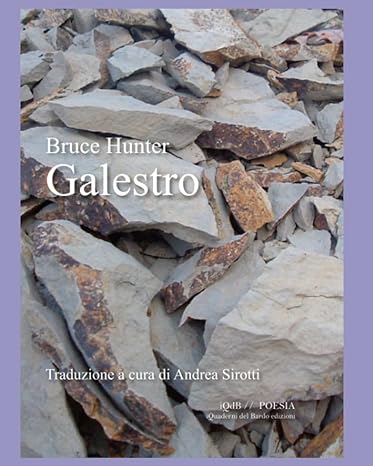
Galestro by Bruce Hunter: Book Review

In this life, we are visitors no matter where we go / on this earth, the headstones remind us.

— “The Rooks in the Sycamores at the Tomb at Dunn” (98-107)

Galestro, of the book’s title, is the name of the mineral-rich and stony soil of Tuscany. It’s the hard till that nurtures the Sangiovese vines and the Chianti that flows through poems like love. Smooth-flowing Chianti and stony hard till are wonderful metaphors that thread throughout the collection. Perhaps it is for this “flow” that Bruce Hunter has arranged the poems without distinct sections. However, the poems have been carefully organized. In the initial poems, Hunter reflects on his youth and working years; the middle section celebrates Tuscany and love; and the last poem circles back, exploring a theme introduced early on. Individual poems are constructed on a framework of details, which of course creates the pull of authenticity, but we also find allusion, together engaging both our love of facts and our love of fancy.

One poem that reflects on Hunter’s young years in and around Calgary surprised me with the flavour of a Patrick Lane poem. In no way does the poem mimic Lane, which makes it hard to put my finger on what exactly made me sit up in my chair when I read “Skyhooks” (30-33). In the poem, Hunter begins by describing kites:

Each of them angling for light, 
strung between existence and dream
trolling for skyfish or errant angels
lost in the lure of clouds.

But then he quickly moves to a tough work scene, the stuff of early Lane (and of Tom Wayman, too), before he brings humour into the poem. A complex juggle of tone, beauty, and grit.

The primary subject of the first sixty-five pages is the geography and people of Hunter’s childhood in Calgary and his adult life in Toronto, although there’s a wide range of themes and metaphors layering the poetry.  Then, to celebrate his actual retirement, Hunter travels with his wife to Italy. It is here we gain the benefit of Hunter’s apprenticeship as a gardener and arborist (as he tells us in “Lost and Found in Cortona,” p 90-93). This deep knowledge creates the details that make the Italian poems so fascinating. It is also here, in these Tuscany poems that we see Lisa as lover-muse. For example, in the title poem “Galestro” (p 76-83):

I learned to read soil in my apprenticeship,
and sky and wind, on the highest point of land,
where rain is made, and wine,
somewhere between alchemy and prayer,
reverence and ritual….

Hunter is sensitivo in his knowledge of gardening, but there’s been a subtle switch and suddenly Lisa, his wife, is sensitiva:

…the woman who teaches the heart,
who reads my eyes, who calms the animals, heals the beloved.

This is Bruce Hunter’s tenth book. His writing apprenticeship has led to multi-layered poems that offer at once a clear, straightforward read and, if you sit with them, a complex understanding of life, love, and endings. Much of my recent reading has included single-theme collections and book-length poems. Reading Galestro has forced a re-think. Hunter’s voice, as you can see, is wide-ranging. I’m breaking free of my mold.

For another example of Hunter’s versatility, “Ligurian Poppies” introduces the poet as witness:

Bomb cracks in the University of Bologna.
The missing towers of the Castello.
Neptune can hold back the sea
but not the vile will of hard men.

The collection is all metaphor.

In “The Rooks in the Sycamores at the Tomb at Dunn” (98-107), the final poem in the collection, Hunter reflects on a visit to the far northeastern edge of Scotland, Caithness, the Tomb of Dunn and of Hunter’s forebearers:

The tomb’s open now, pillaged.
The plank lid torn off and left where it landed.
Vines cover the chapel’s window-less walls.
The roof long ago gone….

//

And there’s an alder sapling between their graves.
Seeds from the ancient forest brought up by gravediggers.
One day the alder will crack the stone.
Trees stronger than stone in their kinetic lift.

When we search for the ancestors, for what are we searching? Hunter takes us on a journey through language and naming, through mythic and physical places, concluding the poem and collection with: and if I had one wish: / I be that tree, / stronger than stone in its lift. / And that my friends, is the gist.

What is there to say after that?

Galestro is a big book (8 x 10 inches, 122 pages) of poetry by Bruce Hunter, translated from English (on the left page) into Italian by Andrea Sirotti (on the right). It is a pleasure for word-lovers to see how the words fall and follow, a treat to compare and imagine how they sound and what they evoke in the second language.

Galestro, Quaderni del Bardo (2023) by Bruce Hunter

Available through your local bookstore or online: ISBN 9798376256602

Frost & Pollen by Helen Hajnoczky: Book Review

My bloom and martyr, your marrow, my morrow.

These “eclectic” book reviews of mine don’t follow the standard form: they include only books that I’ve liked, which means they have intrigued, inspired, and allowed me to enter the world they create. I appreciate craft — the basket of skills that poets employ to achieve their goals (see writing tips) — in both individual poems and in collections that hold together like smoky single malt Scotch. Frost & Pollen by Helen Hajnoczky does all of that.

Over the last six weeks, I’ve read and re-read Frost & Pollen, a most unusual poetry collection. The first long poem, “Bloom & Martyr,” leads me deep into a medieval garden, much as Alice leads me into Wonderland, plus there’s more than a suggestion of the bawdiness that flows through Canterbury Tales, subtle though it is (or perhaps subtle depends on the mood of the reader). In “Foliage,” the second and final long poem, readers enter a magical wood to become a bewildered Sir Gawain as we take on the persona of the Green Knight of Arthurian legend. Hajnoczky takes us on a wild romp, and we eagerly keep turning pages to match the flow of her tumbling words.

The prose poems of “Bloom & Martyr” almost demand to be read aloud. They blossom on the tongue. Their movement ever forward.

Your blush, my chrysanthemum. Your winter frost, dahlia and molten. My shoulder blades, raspberry and tarnish. Your breath, bloom and hemlock. Your frost, your flush, cold blossom, my mouth. (7)

Maybe you read this excerpt as being as nonsensical as Jabberwocky. It has that sense about it. But when I can let the words carry me as if floating down a stream, I slip into a dreamlike place. I do suggest you set time aside to read the entire poem in one sitting…then read it again.

“Foliage” is a hybrid poem (or perhaps a kind of tanka), since each prose poem is followed by a short lyric. “Foliage” begins in a more pristine world: “And so the boughs burgeoned and blossomed, flourished and failed, / And I dozed—drowsed by the harmonies of life’s rhythms.” With the “arrival of men” desecration begins and the tension is created as we side with the Green Man who wakes “to restore tranquility.” You can see how impossible it is to paraphrase Hajnoczky’s words, how tampering with them loses her headlong momentum. It’s better to read the book.

So, if you’d like to be enchanted by a very skillful poet who will guide you through a garden and then a wood, I suggest you find a copy of Frost & Pollen.

Helen Hajnoczky. Frost & Pollen, Invisible Publishing, 2021 (ISBN 978-1-988784-80-9)

The Sleep Orchard: A Response to Arshile Gorky by Amy Dennis – Book Review

I know // I know / nothing // of Armenia 1915 – “Admission”

In The Sleep Orchard, Amy Dennis reaches deep inside the life and myth of Arshile Gorky. She enters his paintings and photographs, reaches into the Armenian genocide’s impact on one man. She explores Gorky’s place in the history of art. And in attempting to understand Gorky, Dennis crosses borders of time and place.

In “On Waking,” the first poem in the collection, it is clear that Dennis has absorbed Gorky into her life. She writes: My lover says I have called out….

… I don’t remember.
But know after waking I’ve scavenged

old papers to find antique recipes for ink, hungry
for a hallowed liquid to write about Gorky. In dreams
he is tall and looks into me.

Every morning his paint rattles my thin grasp
on language.

In the second poem, “Greenware,” Dennis writes: …I’ve never before slit / my fingernails into this // wild apple and pistachio / where his mother wipes her hands. Gorky’s mother, who died in his arms when he was a boy of about fifteen years, becomes the monumental loss that haunts his paintings – and Dennis’s poems. In my reading of the collection, mother is at the root of the art connecting artist and author like the mycorrhizal network of tree roots. The theme begins with Gorky’s mother (Shushan der Marderosian), continues with his wife (Agnes Magruder, called Mougouch) who is mother of his children and, woven into the collection, is Dennis’s impending motherhood. Mother: a threaded root. Evocation: Mother. Armenia.

Arshile Gorky was a man who reinvented himself (his birthname was Vosdanik Adoian). In “Marny George at 36 Union Square,” Dennis writes: You were a Russian portraitist // Georgian prince, nephew to Maxim Gorky. Prodigy / who once studied in Paris. Gorky also reinvented art. Dennis traces his artistic lineage. For example, in “Shards,” she writes: he locates / shapes in these famous canyons:

Matisse’s Red
Studio, Miro’s Still Life
with Old Shoe, Picasso’s Plaster
Head, The City by Léger.

Gorky penetrates / where these artists end / and he began…. He became known as the father of abstract expressionism, paving the way for Pollock and Rothko and Gottlieb and de Kooning (“Ambiguous Spaces, Seemingly Random Angles”).

Although Dennis’s poems place Gorky in the spectrum of art history, it is context, neither art history nor art criticism. Although Dennis describes paintings and photographs, the ekphrastic nature of the poetry is not the only technique Dennis applies to reach the heart of her subject: “A Response to Arshile Gorky.” The Sleep Orchard contains poems in which Dennis writes of his mother, where she inhabits Mougouch, and where she writes to his daughters. But this collection is not a biography. Dennis writes of her own experiences during the writing of The Sleep Orchard, but it is not memoir. She claims to know nothing about Armenia – I know // I know / nothing // of Armenia 1915 (“Admission,” the third poem), but the collection bears witness to the impact of that genocide. The Sleep Orchard is all of this and more. The collection is tapestry, the colours of Armenia, a search for Arshile Gorky.

Dennis’s collection is sensuous, passionate, lyrical. Her skillful writing draws readers inside, always evocative. My favourite poem in the collection happens to have one of the longest titles: “Meditation on White (traced Backwards), Response, to Charred Beloved /, 1946.” You can see her skill, hear her poetic voice:

Named after lilies, his mother Shushan warmed
her infants in cradles lined with sand, grew daughters
to face east and hail Mary. Each November, string-tied
from ceilings, she dried pears, their skins distilled
with rippled sugar and the deathly

look of withdrawal, the fruits
parched as embalmed songbirds or small raptors
swathed in Egypt. Her once son, his voice-

box drowned with balsam, would not speak
until he was six, until six spoke only with birds. This,
a small sacrifice for the close studies of such wings, white
doves he let roost in his breaking.

You do not need to know a thing about Gorky’s art or ekphrastic poetry to be drawn inside the emotion of the poems. Dennis brings Gorky and his work to life, opening a door for readers to enter his world – and hers – whether or not you are an art afficionado. Art is the vehicle, but there is much more to The Sleep Orchard.

The Sleep Orchard (Mansfield Press, 2022) is available through your local bookstore, the publisher, or online (ISBN 978-1-77126-280-4).

You may also be interested in my review of Mechanics of a Gaze, Branka Petrovic’s poetry collection about Gustav Klimpt and Emile Flöge. (Mansfield Press, 2017). If this interests you, please also see The Painted Kiss (Washington Square Press, 2005) for my thoughts on Elizabeth Hickey’s fictionalized novel about Gustav Klimpt and Emile Flöge.

Everchild by Gwynn Scheltema: Book Review

This clementine skin is thin / clings fast, is old. — “Naartjies”

Everchild by Gwynn Scheltema. Aeolus House, 2023

Everchild by Gwynn Scheltema is a collection of poems by a practiced writer. It has earned the praise of Louise Bernice Halfe – Sky Dancer who writes, “Compelling and heartbreaking. The poems filled with longing, pain, a sensuous observation of a journey looking to repair itself.” Antony Di Nardo says, “[She takes] us into the heartland of Zimbabwe. There’s a lifetime in these poems, stories to be told about people and places and the state of the human heart, whether grieving or skipping to the beat of its own music.” E. Alex Pierce writes “Gwynn Scheltema writes from every aspect of her wide-lived life with every facet of her bold, courageous, female voice.”

Scheltema’s poems explore absence, loss without nostalgia, in their search for home and identity. They ring with authenticity, a truth richly lived. We find ourselves within the Zimbabwean child-heart that remains alive within the woman she has become. Flowing throughout the collection this thread is strong and constant.

The collection is laid out in four sections: Breathe, Ignite, Ebb, and Be. The prologue poem, “Moongate,” establishes what will follow:

            she breathes
            treads lightly

            on what was

            what will be—

From the first poem, called “The Old Swing,” the reader is placed in time looking back: “After layers of years / the tall metal swing frame stands /                  still.” And we understand that a kind of resolution if not acceptance will be found in the poems, despite the pain that inhabits them. The swing’s chains may be too rusty to achieve the sky of childhood, but it will rise in “song-birthed words.”

One of my favourite poems celebrates Nomvula, the woman of the cover art (a painting by the poet) in whose care the child lives:

Whimpers wend like wind spirals
from the child swaddled on her back who whispers
with spirits she does not want to know
a mother gone that no one speaks of
thula, thula, hush hush.

The song, almost anthem, stirs.

Nomvula…

removes the sandals with brass buckles
removes the dress with itchy white lace
gathers her to her breast
skin to skin
white to black
thula, thula, hush hush
ngilapha, I am here.

The mother is absent, an unspoken presence.

In the third section we meet the stepmother, and who wouldn’t think of fairy tales?     

the only hug
my mother ever gave me
I was six

I wonder
if I had hugged her back—

While I have omitted the crux of the poem, these words convey the sense of longing for what might have been, as well as a lingering self-doubt that haunts the collection. But do not misunderstand; there is no blame of self or other.

The final section, Be, brings poet and reader to what is, the place past memory, a place of now, a place secure. Scheltema writes, “What matters

            flies home right now from Saskatoon
            warm, wanting flesh inside cold steel
            ornery no doubt from his knees cramped to chin
            airless heat and stiff sandwiches
            but his heart still soft

            …

            our quiet walk in the blossoming.

While Everchild is a first full-length collection, Gwynn Scheltema’s fiction and poetry have been published in journals, magazines and anthologies. In 2021, Glentula Press released her chapbook, Ten of Diamonds, a “constraint” collection of ten poems. She has earned many accolades over the years, all culminating in this exquisite collection, a collection that at its heart is one poem.

***

For more about Everchild and its author, visit https://gwynnscheltema.com/.  A Kindle edition is available through Amazon.ca. For the print edition, order from your local independent bookstore, from the publisher  or get a signed copy by contacting the author.

“Poetry of Witness,” from Sarajevo with Sorrow and Poetry is Blood: Book Review

For whom were these poems intended at the time I wrote them, during the shameless Bosnia war and the siege of Sarajevo? …The lines I wrote were written in the belief that, when compared with the cold newspaper reports which would be forgotten with the start of a new war elsewhere, only poetry could be a true and decent witness to war. — Goran Simić, Preface to from Sarajevo with Sorrow.

from Sarajevo with Sorrow by Goran Simić, translated by Amela Simić. Windsor (ON, Canada): Biblioasis, 2005.
Poetry is Blood by Keith Garebian. Toronto (ON, Canada): Guernica Editions, 2018.


Poetry of Witness

What is “poetry of witness?” you might be asking. Philippe Lacoue-Labarthe looks at the Latin root of the word experience: “ex-periri, a crossing through danger.” In her essay, “Reading the Living Archives: The Witness of Literary Art: To hell and back, with poetry,” Carolyn Forché writes:

In the poetry of witness, the poem makes present to us the experience of the other, the poem is the experience, rather than a symbolic representation. When we read the poem as witness, we are marked by it and become ourselves witnesses to what it has made present before us. Language incises the page, wounding it with testimonial presence, and the reader is marked by encounter with that presence. Witness begets witness. The text we read becomes a living archive.

The horror and the dead can live on, carried by survivors, across generations. This is the way that I’ve come to think about poetry of witness, and this has informed my reading of from Sarajevo with Sorrow and Poetry is Blood.

In these two collections, Goran Simić and Keith Garebina share the experience of war: Simić bears witness to the siege of Sarajevo (1992-1995 Bosnian War), Garebian bears witness to the generational trauma of the Armenian genocide (1915-1920).

from Sarajevo with Sorrow

77 from Sarajevo with Sorrow

Simić’s “The Face of Sorrow” begins with a metaphor and an image:

I have seen the face of sorrow. It is the face of
the Sarajevo wind leafing through newspapers
glued to the street by a puddle of blood…

In “A Common Story,” the images intensify: When they brought him to the hospital, half his / body missing….  By the time we get to “Love Story,” we’ve travelled from the particular and immediate experience of the poet to the political reality of murder and the mythologizing of journalism and war. The poem brings us back from romanticized news to the ugly experience itself, as well as the unaccountability inherent in war:

Love Story

The story of Bosko and Amira was a major
media event that Spring. They tried to cross the
bridge out of Sarajevo, believing their future was
on the other side, where the bloody past had
already gone. Death caught them, in the middle
of the bridge. The one who pulled the trigger
wore a uniform and was never called a murderer.

[…]

My friend Prsíc, a Bosnian soldier who guarded
the bridge, watched each day as maggots, flies,
and crows finished off their swollen bodies.

 […]

This is a story that you may recall, but a different story than the one splashed across news channels, this witnessing elicits repellent emotion in the reader, removing all remnants of romance, and we are “marked by the encounter.”

Finally, in the last stanza of “Spring is Coming,” Simić addresses what remains after the siege:

Spring is coming. On crutches.
The time of medals is coming,
when children from freshly whitewashed orphanages start
       searching for family albums,
the time when big flags cover this landscape of horror
in which my neighbour, in the basement,
holds a child’s winter glove in his hand. And weeps.

This haunting aftermath is where we enter the poetry of Keith Garebian.

Poetry is Blood

77 Poetry is Blood

Keith Garebian did not experience the Armenian genocide of 1915-1920, but he bears witness to the continuing trauma left in its wake. (There is a relatively new psychology that supports the idea of historical or inter-generational trauma. (Please see “The Legacy of Trauma by Tori DeAngelis, American Psychological Association, February 2019, Vol 50, No 2.) Garebian is the son of a survivor and, along with his father, carries the scars, scars that find expression and witness in Poetry is Blood.

The collection begins with an image that echoes throughout, and the poem sets an emotional tone that reverberates across individual poems:

April

A month bequeathing poppies,
compact red explosions.

 Insomniacs found bones
in meadows of ordinary light.

In addition to the echo of “poppies,” the father is embedded in the collection. We come to feel the distance between father and son, the incapacity of the father to touch or be touched. The father is more shadow than flesh and blood.

In one of the early poems, “Okra,” Garebian writes: Did he know the leaves were heart-shaped? / I was searching for his heart but he never knew. In “Songs of Nagash the Ghareeb,” he writes: How long, how long / the song of exile leaping from his mouth? And in “Tell Me Why,” he begins with the plea: Tell me why you are drawn to sad music, / old dull pains, scars that linger generations. / Why your sleep is a struggle deep in a cave. It ends with the pain of the distanced child, now man: Tell me why cruelty gets in the way of love, / like wind knocking the heads off flowers, / like time bruising your shattered heart.

In a long poem, “The Pilgrimage,” the poet visits the lost homeland, the site of genocide and he writes: I walk in my orphaned / father’s shoes, their footfall / imprinting his voicelessness. The poet, like his father is essentially orphaned, lost, seeking.

We become steeped in the lasting impact of genocide, see blood in the explosions of poppies, witness the vacuum where love should reside, and experience almost more loss than can be borne. But Garebian continues to search for resolution. Near the end of the collection, in “Elegy” he laments the father and so much more:

My father’s ancient tribe writhes
on my written page,
groaning under a sullen sun
in a landscape of cadavers
so ghostly real
I can count their groans,
even in this harsh north
w
here introspection freezes
w
hile birds flee on strong wings,
t
heir cries waning in geometric wake.

[and by the conclusion we learn]

The earth moves on
and light dances
as I shelter the dead,
give them refuge in my words
so they may dream of themselves
preying on us as we once did on them.

Conclusion

These poems by Goran Simić and Keith Garebian are not anecdotal, neither are they confessional. The poems in these two collections bare experience of the collective, of cultures so harmed that the weight of destruction seeks voice, seeks listeners to hear and to also experience the trauma. Like the Latin from which experience derives, they cross through danger. from Sarajevo with Sorrow and Poetry is Blood are among the best contemporary examples of poetry of witness.

For readers who want to explore further into the genre, read Anna Akhmatova, as well as the Nobel Prize winners Wisława Szymborska and Czeslaw Milosz.

We have come through a century of war but seem to have learned little. Newspaper headlines come and go and now false news clutters our minds. The poets, however, write words that not only sit on the surface of the page, but they write words between the lines, words that resonate psychological and emotional truth, the truth that lingers both individually and collectively. The truth that invites us into ex-periri.


Available through your local bookstore or online: from Sarajevo with Sorrow and Poetry is Blood.


River of Hidden Dreams by Connie May Fowler: Book Review

This island is far more full of life than I had thought. Animals I cannot name are beginning to make themselves known. I hear twigs snap, and cries filter now and again from woods to sky. I wrap up tighter and try to concentrate on Mama and Mima. I think of that day Mr. Sammy decided he had turned old. His sudden despair and Miss Raison’s drowning weren’t the only life-changing events in the forest hideaway that stormy afternoon. Mima conceived my mother in the middle of all that lightning and rain (186-7).

I often buy used books from volunteers staffing “Friends of the Library” shop at the entrance to Belleville’s library. This is where I found River of Hidden Dreams by Connie May Fowler. (Purchases support our public library and often great finds can be made.)

I picked the book up because of the cover – a photograph that I might have been smitten to take – an egret in long, marshy grasses. The narrative, which identifies as fiction, is dedicated to two women who seem very much like two characters in the story. However, the blurb on the dust jacket almost put me off – romance (the romantic, not the historic variety). Nevertheless, I was drawn in.

Fowler’s book reminds me a little of Everything Under by Daisy Johnson, which was shortlisted for the Booker Prize (2018). What the two books share is a boat on a river, water that hides mysteries and danger, and consciousness more surreal than real. Johnson’s story is far more complex and more beautifully executed…and much more surreal and daring. But Fowler’s story was published 24 years earlier. Johnson’s story centres on the intricate relations of a mother and daughter; Fowler’s focuses on a woman’s memories of her mother, grandmother and grandfather who tell their own stories. To my mind, the intervention of Carlos and a mummified baby spoil what might have been a much more interesting tale.

River of Hidden Dreams fought with me (or I with it). I threatened to toss it aside. Then I turned the page again. The orneriness of the grandmother and granddaughter parallel became a bit too much…but then I continued reading. The handsome, perfect, prince-charming Carlos is polar-opposite of his miserable, mean Mamacita/Saidie. Perhaps someone told the author, “you’d better include a love object and sex.” Still, the pages kept turning.

What works: Mr. Sammy, the trawler, the river, the Everglades, and the ancestors speaking their own stories for the eerie, jarring, sensuous impact. Fowler’s descriptions held me enchanted. I slipped into her river-world where time became untethered. The story may have happened last century or last year; it doesn’t matter. I felt its immediacy, its reality in a surreal kind of way.

River of Hidden Dreams by Connie May Fowler has earned my toughest review. Now that it’s written, I’ve checked what others have said…and everyone loved everything about it. Now you might want to read the novel and make up your own mind. Do let me know…please.

71 River of Hidden Dreams

Available through your local bookstore or online: River of Hidden Dreams

(The hardcover is listed for Cdn $248.72 – you may want to visit your library to borrow a copy.)

The Wrecking Light by Robin Robertson: Book Review

I find a kind of hope here, in this / homelessness, in this place / where no one knows me – / where I’ll be gone, like some / over-wintering bird, / before they even notice. (Beginning to Green)

The poet searches: for his shadow-self, for grief and guilt, and for life and meaning. In The Wrecking Light, Robin Robertson moves into the past, sheds light onto the present, and shape-shifts between reality and the surreal.

In the first section, Silvered Water, the first poem, “Album,” sets a tone that echoes throughout the collection. It begins:

I am almost never there, in these
old photographs: a hand
or shoulder, out of focus; a figure
in the background,
stepping from the frame.

(…)

A ghost is there; the ghost gets up to go.

The Wrecking Light is full of memories that include memories of others: the girl / with the hare lip / down by Clachan Bridge (“By Clachan Bridge”). And the collection ends with the personal memory of “Hammersmith Winter” when through the drawn curtain / shines the snowlight I remember as a boy, / sitting up at the window watching it fall. Mixed with memories is a sense of grieving, as in “Fall From Grace:”

My life a mix of dull disgraces
and watery acclaim, my daughters know
I cannot look into their clear faces;
what shines back at me is shame.

The theme continues. In “Tinsel,” in the woods: If you’re very quiet, you might pick up loss: or rather / the thin noise that losing makes – perdition. / If you’re absolutely silent. And with loss comes leaving. The very next poem, “Leaving St. Kilda,” takes us on a sea journey brimming with geographic details and clear images cut clean by departure. In this geographical catalogue: sea rhythm; progression.

But don’t get the wrong idea, these poems are neither nostalgic nor maudlin. In the skillful hands of this visionary, we are taken on a raucous ride with unexpected twists and turns.

In the second section called Broken Water, the first poem’s horror and the brutal honesty of rough island life and penance is laid bare. In “Law of the Island” Robertson paints a vivid description of island punishment and the casualness of its deployment. In this section, he gives us a back-and-forth of short poems with punch and longer, exploratory ones where he writes after Ovid, Neruda, Baudelaire, and myth to understand humanity’s weaknesses. Here, “Grave Goods,” is beyond surreal; it enters magic.

In the third section, Unspoken Water, the woods and forests of childhood again dominate. In “The Wood of Lost Things,” the vision is clearer and in its clarity, more haunting. Robertson writes: I have found the place I wasn’t meant to find (…)

Hung on a silver birch, my school cap
and satchel; next to them, the docken suit,
and next to that, pinned to a branch,
my lost comforter –
a piece of blanket worn to the size of my hand.

 You can see how he leads us. Like Narcissus he sees a face I seem to know. But unlike Narcissus, he isn’t struck by his beauty. Of course not. But he does give us a resolution (of sorts).

In The Wrecking Light, there is much of the sea, of woods, of love and loss, of searching. I return to the final poem, “Hammersmith Winter,” and the poet’s final plea: Look at the snow, / I said, to whoever might be near, I’m cold, / would you hold me. Hold me. Let me go.

Robin Robertson has written an intense, lyrical collection with movement as through dreams bordering on nightmare (I dare not use the word haunting again, although that is the effect his writing creates). This is Robertson’s forth book of poetry; I recommend you enter his world.

70 The Wrecking Light

Available through your local bookstore or online: The Wrecking Light