Review of The Dialogues: The Song of Francis Pegahmagabow by Armand Garnet Ruffo

Here is a story that does not end, but continues today in those who believe in a country where justice will prevail, as new generations rise up to fill the footsteps of warriors who have fallen long ago, whose sacrifices and legacies we continue to remember and honour….
(133)

Armand Garnet Ruffo has published poetry and prose, made films, and created anthologies in addition to his academic credentials. The various skills required for these successes come together in The Dialogues: The Song of Francis Pegahmagabow, creating a literature that is extraordinary.

The Dialogues breaks the boundaries of what we think of as poetry. In poetry, we expect “density of meaning, felicity of language, authenticity of feeling.” It should also “deliver to us…the sense of urgency,” and Ruffo gives us all this and more. We don’t expect the weaving of documentation through the book-length poem, but here it is, smoothly echoing the poetic voice of Pegahmagabow and that of the poet-narrator who occasionally intervenes. And as suggested by the title, this overlays the idea of musical performance. The demands of staying true to an historical life, while working within the constraints of the musical, has resulted in the unique the structure of The Dialogues.

The poetry, as we’re accustomed to think of it, is on the lefthand page. On the facing page are facts substantiating the poetics: sometimes it is in the form of the poet’s memory; sometimes in the form of a government or military document; sometimes a background statement as is “An Interlude to Discuss Francis’s Encounter” (35). As well, this collection weaves an actual musical score from the production that inspired this book (21). 

The Dialogues is innovative in its narrative and story-telling, not only in its voice and in its structure but also in its immense impact. Reading it, I thought of Omeros by Derek Walcott. Ruffo’s scaffolding may not be created on a myth, but The Dialogues is mythic. Francis Pegahmagabow is a hero: in his soldiering; in his life after the Great War; and in his legacy. The Dialogues takes us on a time-journey, a culture-journey, a life-journey, from which I came away bruised but better understanding a life, a time, and a People in a “felt” way beyond intellectual knowledge alone. 

To read the entire review, click here.

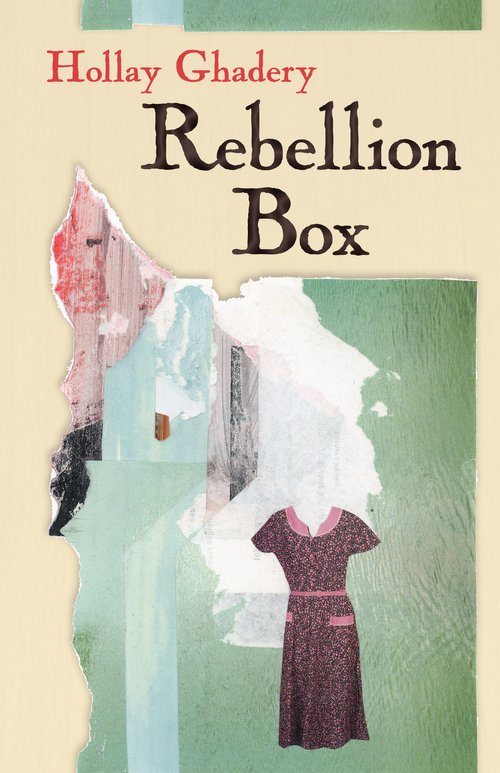
Review of Hollay Ghadery’s Rebellion Box

Perhaps one shouldn’t judge a book by its cover, but the cover of Rebellion Box is revealing. The illustration is dominated by a housedress trimmed in pink upon a paint-peeling background exposing an opaque scene that leads the eye to another and another. This, in a way, is what the poems do in Ghadery’s debut collection.

Opening to the first poem, “Postcard, Santa Maria,” we meet a girl, sensuous beside a pool, but then, a disclaimer: “I’m not that girl / anymore.” This, followed by the surprise “the cervix / of a fifteen-year-old, / my doctor says. / Not bad / for four kids” (1-2). And so, we are introduced to the speaker of many of the poems that follow, and a dominant theme of the collection is identified. Who is this woman who once lay by a pool in sunshine, who is a mother, who we will learn is biracial and bicultural, who attends historical talks, who writes poetry “to get [her] thoughts straight,” as suggested in an article Ghadery published in The New Quarterly.

In that article, Ghadery refers specifically to the title poem (45-46), a sestina, in which form controls and shapes the poem – a box as it were, for sharing the 1837 love story of Joseph, prisoner of the rebellion, and his love, Mary. The form disciplines Ghadery, allowing her to reveal the “mores and values” of the time in a tight, coherent way. Those mores and values are a constraint for the protagonist who cannot approach Mary directly, and I wonder, as I read through the collection time and again, if the Rebellion Box hasn’t become a metaphor for the constraints experienced by the poet herself. 

To read the entire review that is published by FreeFall Magazine, please click here.

Review of Erina Harris’ “Trading Beauty Secrets with the Dead”

This review has been published by FreeFall Magazine (December 2024)

Trading Beauty Secrets with the Dead
by Erina Harris
Wolsak & Wynn (2024)

Academic and poet, Erina Harris, has several interests and concerns, many find their way into the subjects and themes of her second poetry collection, Trading Beauty Secrets with the Dead.

According to Harris’ profile on the University of Alberta website, where she teaches, her research interests include fairy tales, rhyme and nonsense verse, gender and women’s writing, subjectivity and relationality, experimentalism and more. Given this array, Harris meets the organizational challenge of creating a cohesive collection by structuring the poems into an abecedarium. But the complex weaving of varied subjects and themes into a whole is not the only thing that readers will notice. As in her first book, The Stag Head Spoke, the poetry here is highly original and experimental.

Readers are treated to rhyme and nonsense verse, word-play and music, a taste of Dadaism and Surrealism among other isms. The poems are subversive. They inform, create context for her research interests, while shifting perspective in unusual ways. They play with form, structure, ideas – and in the case of “Letter B: Bestiary Rondo” with sound.

… in the breath, in the breeze, that the breathing beasts
breathe in, the breaths of the bees breathing trees’ breaths, the
breeze breathes the bee-breaths with trees breathing beast-
breaths, breath breezes in beast-breathing bees breathe the
bee-breath-ing trees in the breath-tree will be in the breeze of
the bee in the tree-bees will breathe with breeze-breaths will
beasts bleed …

[Da Capo] (3)

Harris is a skillful weaver of words.

Please go to FreeFall‘s website by clicking on this link to read the rest of the review.