
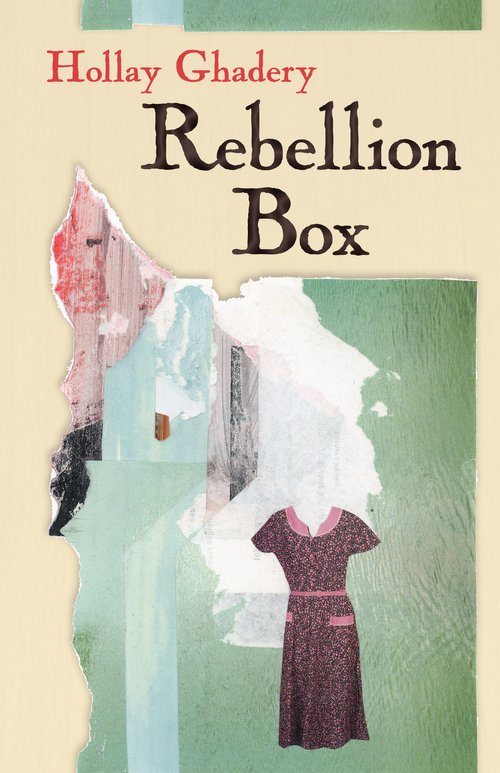
Perhaps one shouldn’t judge a book by its cover, but the cover of Rebellion Box is revealing. The illustration is dominated by a housedress trimmed in pink upon a paint-peeling background exposing an opaque scene that leads the eye to another and another. This, in a way, is what the poems do in Ghadery’s debut collection.
Opening to the first poem, “Postcard, Santa Maria,” we meet a girl, sensuous beside a pool, but then, a disclaimer: “I’m not that girl / anymore.” This, followed by the surprise “the cervix / of a fifteen-year-old, / my doctor says. / Not bad / for four kids” (1-2). And so, we are introduced to the speaker of many of the poems that follow, and a dominant theme of the collection is identified. Who is this woman who once lay by a pool in sunshine, who is a mother, who we will learn is biracial and bicultural, who attends historical talks, who writes poetry “to get [her] thoughts straight,” as suggested in an article Ghadery published in The New Quarterly.
In that article, Ghadery refers specifically to the title poem (45-46), a sestina, in which form controls and shapes the poem – a box as it were, for sharing the 1837 love story of Joseph, prisoner of the rebellion, and his love, Mary. The form disciplines Ghadery, allowing her to reveal the “mores and values” of the time in a tight, coherent way. Those mores and values are a constraint for the protagonist who cannot approach Mary directly, and I wonder, as I read through the collection time and again, if the Rebellion Box hasn’t become a metaphor for the constraints experienced by the poet herself.
To read the entire review that is published by FreeFall Magazine, please click here.
 Kathryn MacDonald