
What I’m rereading: the book-length poem

I love a long poem and the collections that follow the narrative thread of a journey from page one to the end – whether it flows, as a novel, or whether it’s more of a sequence of shorter poems that unravel the story.

Ottawa poet Monty Reid says that “the sequence accommodates interruptions more readily, it stops and starts, tries to hold it together, begins again…. (interview by rob mclennan, above-ground press).

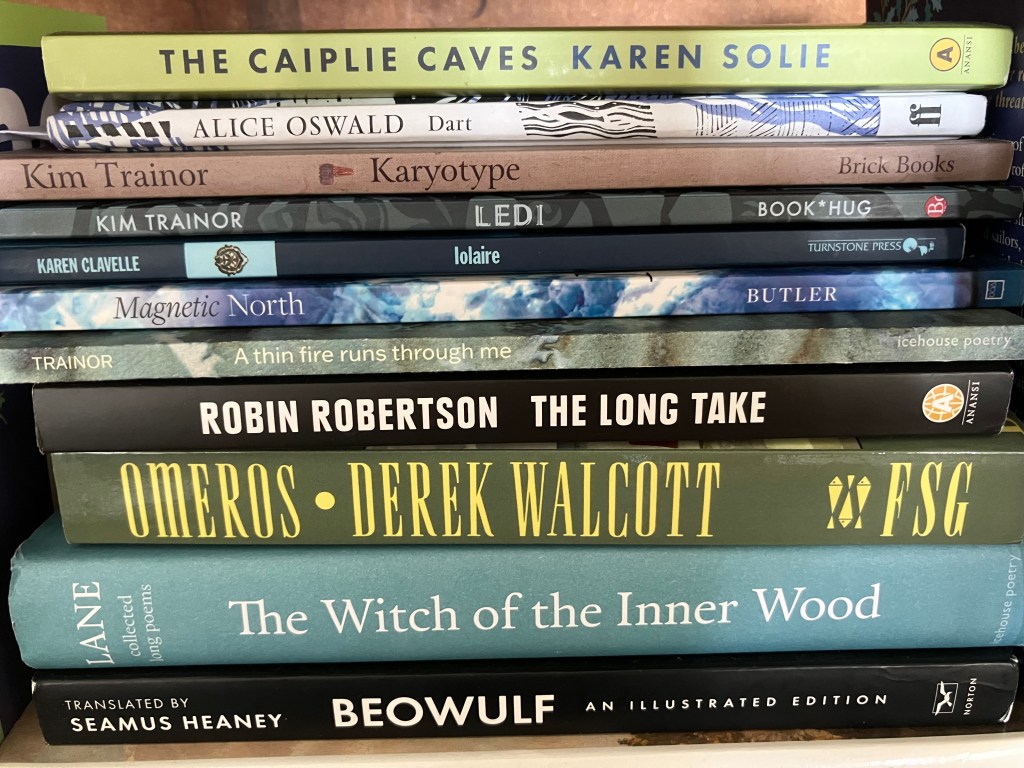
The books that I’ve selected to highlight today include both flowing book-length poems and sequence collections.

I’ve reviewed only two of the long-poem collections that have been sitting in my “to write about” stack. But it’s summer reading time, and I’m not going to get the job done. So here is a reading list to take you through August and beyond.

Two that I’ve reviewed:

  • Beowulf translated by Seamus Heaney: an illustrated edition “is beautiful to read, vivid, alive,” to quote from my review (W.W. Norton, 2008). Click here.
  • Iolaire by Karen Clavelle “is a hybrid telling of one of Scotland’s worse maritime disasters, a story of an island’s grief, a woman’s loss, and by the end, a new (though haunted) beginning” (Turnstone Press, 2017). Click here.

Others of the book-length form that I recommend as good summer reading include:

  • Magnetic North: Sea Voyage to Svalbard by Jenna Butler (University of Alberta Press, 2018)
  • Dart by Alice Oswald (Faber and Faber, 2002)
  • The Long Take by Robin Robertson (Anansi, 2018)
  • The Caiplie Caves by Karen Solie (Anansi, 2019)
  • Three books by Kim Trainor: Karyotype (Brick Books, 2015), Ledi (Book*Hug, 2018), and a fragmented narrative, A thin fire runs through me (icehouse poetry, 2023)
  • Omeros by Derek Walcott (Farrar, Straus, and Geroux, 1990)

And finally, a collection by M. Travis Lane titled The Witch of the Inner Wood. Like novellas, these poems celebrate the long poem format. Lane’s book marks the consistent achievement of one of Canada’s leading poets (icehouse poetry, 2016).
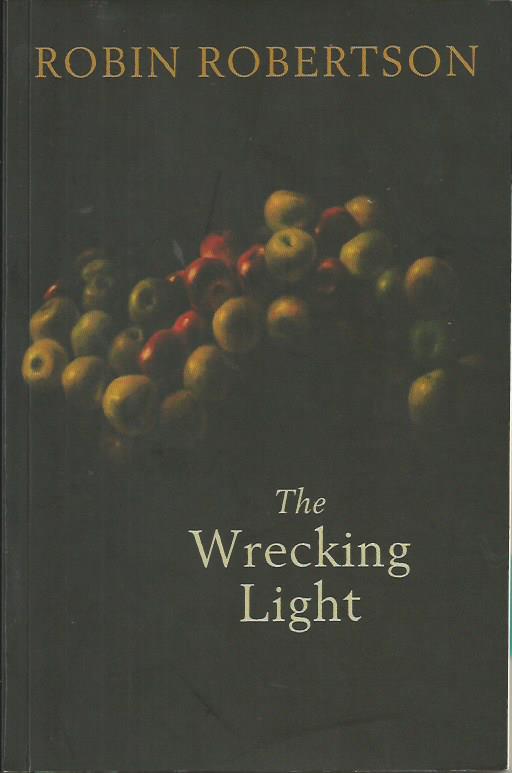
The Wrecking Light by Robin Robertson: Book Review

I find a kind of hope here, in this / homelessness, in this place / where no one knows me – / where I’ll be gone, like some / over-wintering bird, / before they even notice. (Beginning to Green)

The poet searches: for his shadow-self, for grief and guilt, and for life and meaning. In The Wrecking Light, Robin Robertson moves into the past, sheds light onto the present, and shape-shifts between reality and the surreal.

In the first section, Silvered Water, the first poem, “Album,” sets a tone that echoes throughout the collection. It begins:

I am almost never there, in these
old photographs: a hand
or shoulder, out of focus; a figure
in the background,
stepping from the frame.

(…)

A ghost is there; the ghost gets up to go.

The Wrecking Light is full of memories that include memories of others: the girl / with the hare lip / down by Clachan Bridge (“By Clachan Bridge”). And the collection ends with the personal memory of “Hammersmith Winter” when through the drawn curtain / shines the snowlight I remember as a boy, / sitting up at the window watching it fall. Mixed with memories is a sense of grieving, as in “Fall From Grace:”

My life a mix of dull disgraces
and watery acclaim, my daughters know
I cannot look into their clear faces;
what shines back at me is shame.

The theme continues. In “Tinsel,” in the woods: If you’re very quiet, you might pick up loss: or rather / the thin noise that losing makes – perdition. / If you’re absolutely silent. And with loss comes leaving. The very next poem, “Leaving St. Kilda,” takes us on a sea journey brimming with geographic details and clear images cut clean by departure. In this geographical catalogue: sea rhythm; progression.

But don’t get the wrong idea, these poems are neither nostalgic nor maudlin. In the skillful hands of this visionary, we are taken on a raucous ride with unexpected twists and turns.

In the second section called Broken Water, the first poem’s horror and the brutal honesty of rough island life and penance is laid bare. In “Law of the Island” Robertson paints a vivid description of island punishment and the casualness of its deployment. In this section, he gives us a back-and-forth of short poems with punch and longer, exploratory ones where he writes after Ovid, Neruda, Baudelaire, and myth to understand humanity’s weaknesses. Here, “Grave Goods,” is beyond surreal; it enters magic.

In the third section, Unspoken Water, the woods and forests of childhood again dominate. In “The Wood of Lost Things,” the vision is clearer and in its clarity, more haunting. Robertson writes: I have found the place I wasn’t meant to find (…)

Hung on a silver birch, my school cap
and satchel; next to them, the docken suit,
and next to that, pinned to a branch,
my lost comforter –
a piece of blanket worn to the size of my hand.

 You can see how he leads us. Like Narcissus he sees a face I seem to know. But unlike Narcissus, he isn’t struck by his beauty. Of course not. But he does give us a resolution (of sorts).

In The Wrecking Light, there is much of the sea, of woods, of love and loss, of searching. I return to the final poem, “Hammersmith Winter,” and the poet’s final plea: Look at the snow, / I said, to whoever might be near, I’m cold, / would you hold me. Hold me. Let me go.

Robin Robertson has written an intense, lyrical collection with movement as through dreams bordering on nightmare (I dare not use the word haunting again, although that is the effect his writing creates). This is Robertson’s forth book of poetry; I recommend you enter his world.

70 The Wrecking Light

Available through your local bookstore or online: The Wrecking Light