Iolaire by Karen Clavelle: Book Review

Something small and dark was rolling in the waves, in and out it went, what’s that, what’s that. And then stayed a sailor’s hat come right to my feet (18).

Iolaire is a hybrid telling of one of Scotland’s worse maritime disasters, a story of an island’s grief, a woman’s loss, and by the end, a new (though haunted) beginning.

***

The sailor’s hat (of the initial quote, above), echoes throughout Iolaire by Karen Clavelle. The hat, washed up on the shore, becomes a haunting reminder for Is (short for the Gaelic Iseabail) that her love has gone missing in the waters off the Beasts of Holm. He was lost in the early hours of 1919 when the HMS Iolaire broke apart on the Beasts, the rocks at the approach to Stornoway. New Year’s Day was to have been the joyful homecoming of sailors to the Long Island (Lewis and Harris) at the end of WWI; instead, it is the saddest day.

The bride, Is, becomes a widow, a woman who writes letters to her missing love, letters that she bundles and puts away in a drawer. But the book-long narrative is told not only in the epistolary form, which allows readers to access the thoughts and emotions of Is, but the lyric also includes actual excerpts from newspapers, and transcripts from the navy’s inquiry, folkloric prophecies, the poet’s interjections, and poetry.

The first time we’re given a look at the poignant folklore is shortly before the disaster:

Now, at that time of year it gets dusk in the afternoon, and if you’re going to be seeing anything, that’s when you’ll be seeing it — at dusk. And that’s when he did — he saw the stag, him and his sisters. Standing in the path in front of them, it was, and it turned its head and it looked right at them, and then it was gone.

… And sure enough, the boat wrecked that very night. The sister’s husband, he was lost…
(50).

Clavelle also uses her voice to interject observations and insights about the village where she lives during her research, and we readers time travel between then of the shipwreck and now. For example,

In the dream or out of it, I am absorbed in a village that boasts a school, a ceilidh house, a historical society, churches, a cemetery, and a tiny community shop, (the) Bùth, that besides offering groceries and hardware, houses the post office where Dorothy franks the mail with a date-stamp she changes daily by hand, and in the windows posts funeral announcements and community events (46).

Besides the village, Clavelle comments on the ship’s Gaelic name — iolaire sùil na grèine — sea eagle, a name in which irony brims: the boat named for the bird that foreshadowed war and disaster. Haliaeetus albicilla, its Gaelic name in the Seann-sgeulachdan (mythology): fior eun, the eagle, ‘the true bird’… (47).

Besides creative, lyrical, and factual prose, untitled poems also flow through Iolaire. One of my favourites is:

the tide bell rings

and I call for you in the heather and the thrift by An Cùl Beag
in the low tide from the caves from the
shadows of the stacks at Cala Ghearraidh

I call along the endless length of the Tràigh Mhòir.
beneath the slopes of the sand-cliffs, the scarred hills,
the tide pools; from the red seaweed I call
from black-sinewed strand where in grace in death gannets lie
feathers spread as though in flight, their eyes and bones picked clean
                                                  and burying beetles labour their days

I call from the blanket bogs, through the mists and the wind
from the shelter of the marram grass
where summer blues the forget-me-nots on the machair
     where the greylag geese and hoodie crows, and
          the ewes call in their own
         
  so strong the pain of separation (98)

Iolaire is a poetic narrative weaving fictional letters, nonfiction articles, as well as documentary notes into a lyrical tale of love, agony, and grief. Cavelle uses many strategies to unravel the heartbreaking tale of the ship’s break-up on the rocks, the desperate attempts the sailor’s made to reach shore, the lingering anguish of the people from over 60 villages mourning 205 deaths (only 82 sailors survived).

This New Year’s Day (2024) marks the 105th anniversary of the sinking of HMS Iolaire. It is a good time to read Iolaire by Karen Clavelle and to remember one of the saddest moments to ever mark a military homecoming.
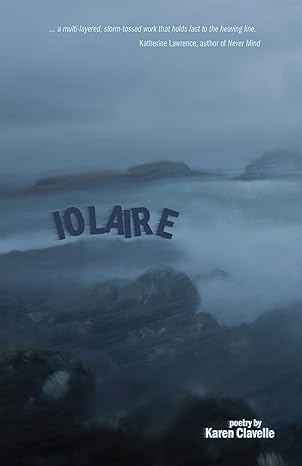
Available through your local bookstore or online: Iolaire by Karen Clavelle (Turnstone Press, ISBN 978-0-88801-611-9)
Galestro by Bruce Hunter: Book Review

In this life, we are visitors no matter where we go / on this earth, the headstones remind us.

— “The Rooks in the Sycamores at the Tomb at Dunn” (98-107)

Galestro, of the book’s title, is the name of the mineral-rich and stony soil of Tuscany. It’s the hard till that nurtures the Sangiovese vines and the Chianti that flows through poems like love. Smooth-flowing Chianti and stony hard till are wonderful metaphors that thread throughout the collection. Perhaps it is for this “flow” that Bruce Hunter has arranged the poems without distinct sections. However, the poems have been carefully organized. In the initial poems, Hunter reflects on his youth and working years; the middle section celebrates Tuscany and love; and the last poem circles back, exploring a theme introduced early on. Individual poems are constructed on a framework of details, which of course creates the pull of authenticity, but we also find allusion, together engaging both our love of facts and our love of fancy.

One poem that reflects on Hunter’s young years in and around Calgary surprised me with the flavour of a Patrick Lane poem. In no way does the poem mimic Lane, which makes it hard to put my finger on what exactly made me sit up in my chair when I read “Skyhooks” (30-33). In the poem, Hunter begins by describing kites:

Each of them angling for light, 
strung between existence and dream
trolling for skyfish or errant angels
lost in the lure of clouds.

But then he quickly moves to a tough work scene, the stuff of early Lane (and of Tom Wayman, too), before he brings humour into the poem. A complex juggle of tone, beauty, and grit.

The primary subject of the first sixty-five pages is the geography and people of Hunter’s childhood in Calgary and his adult life in Toronto, although there’s a wide range of themes and metaphors layering the poetry.  Then, to celebrate his actual retirement, Hunter travels with his wife to Italy. It is here we gain the benefit of Hunter’s apprenticeship as a gardener and arborist (as he tells us in “Lost and Found in Cortona,” p 90-93). This deep knowledge creates the details that make the Italian poems so fascinating. It is also here, in these Tuscany poems that we see Lisa as lover-muse. For example, in the title poem “Galestro” (p 76-83):

I learned to read soil in my apprenticeship,
and sky and wind, on the highest point of land,
where rain is made, and wine,
somewhere between alchemy and prayer,
reverence and ritual….

Hunter is sensitivo in his knowledge of gardening, but there’s been a subtle switch and suddenly Lisa, his wife, is sensitiva:

…the woman who teaches the heart,
who reads my eyes, who calms the animals, heals the beloved.

This is Bruce Hunter’s tenth book. His writing apprenticeship has led to multi-layered poems that offer at once a clear, straightforward read and, if you sit with them, a complex understanding of life, love, and endings. Much of my recent reading has included single-theme collections and book-length poems. Reading Galestro has forced a re-think. Hunter’s voice, as you can see, is wide-ranging. I’m breaking free of my mold.

For another example of Hunter’s versatility, “Ligurian Poppies” introduces the poet as witness:

Bomb cracks in the University of Bologna.
The missing towers of the Castello.
Neptune can hold back the sea
but not the vile will of hard men.

The collection is all metaphor.

In “The Rooks in the Sycamores at the Tomb at Dunn” (98-107), the final poem in the collection, Hunter reflects on a visit to the far northeastern edge of Scotland, Caithness, the Tomb of Dunn and of Hunter’s forebearers:

The tomb’s open now, pillaged.
The plank lid torn off and left where it landed.
Vines cover the chapel’s window-less walls.
The roof long ago gone….

//

And there’s an alder sapling between their graves.
Seeds from the ancient forest brought up by gravediggers.
One day the alder will crack the stone.
Trees stronger than stone in their kinetic lift.

When we search for the ancestors, for what are we searching? Hunter takes us on a journey through language and naming, through mythic and physical places, concluding the poem and collection with: and if I had one wish: / I be that tree, / stronger than stone in its lift. / And that my friends, is the gist.

What is there to say after that?

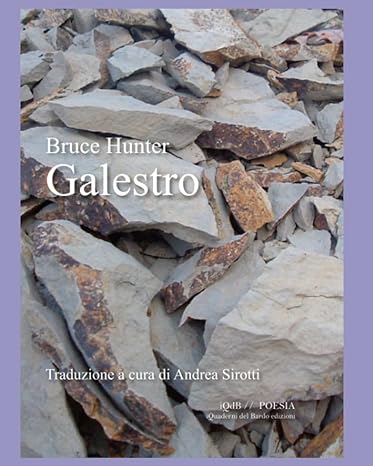
Galestro is a big book (8 x 10 inches, 122 pages) of poetry by Bruce Hunter, translated from English (on the left page) into Italian by Andrea Sirotti (on the right). It is a pleasure for word-lovers to see how the words fall and follow, a treat to compare and imagine how they sound and what they evoke in the second language.

Galestro, Quaderni del Bardo (2023) by Bruce Hunter

Available through your local bookstore or online: ISBN 9798376256602

Away by Andrea MacPherson: Book Review and Writing Tip

Before, there might have been children playing in the street, / the rumbling of cars and feet, / but now there is nothing. Taut, stretched stillness. Waiting.

“Walking Shankill Road” (29)

Andrea MacPherson travels in Away — and we travel with her through the magic of her poetry. The journey begins in Ireland, a personal quest where sites and family are sought.

This is the one place you insisted I come,
this place where limestone weeps
and children once played between execution sites
and burial grounds.

So begins “here’s to the wings of a bird” (12) and with it an elusive you, someone who has planted the seed of return, a return instead of, as if MacPherson is visiting the memories of another. Throughout, the time of the “Troubles” persists. In “boundaries” (16), she writes:

We anticipated a stop here,
men with guns and strict faces
(tightropes of unsmiling mouths,
eyes that have seen marchers falling)
a checkpoint at least, with flashlights
turning our faces to ghosts.

Instead there is nothing but seamless conversation;
rapeseed fields.
Trading prayer for something even quieter.

With the poet, we ride through countryside, lulled, until Belfast and RUC men… their guns and tanks.

Somehow we have forgotten about the strife
we had prepared to see, more content
with wavering fields a thousand shades of yellow
and ancient schoolhouses.

These places where people once sat.

The “Troubles” are old; the people we meet are old. It is as if all love and youth have left Ireland. MacPherson captures a poignancy that is haunting. In “the backyard faerie circle” (20), we visit an old man, alone:

A grey cardigan coming apart at the seams,
smelling of sheep and skin and age.
A threadbare chair,
imprinted with the memory of the body
thighs and shoulders and hip bones.
This is what his life has become:
wool and paisley just there.

We learn something of him, his youth and love, but now the small patch of wild roses / left untended, / forgotten in the shade.

The family journey of remembrance crosses the Irish Sea and continues in Scotland where we learn MacPherson’s mother’s mother left with only a rose-gold / wedding band, a few porcelain figurines (“blue salt,” 41). In “Caldrum Street,” MacPherson writes: I take photos to enter a past that is not mine (48); yet the poems lack nostalgia. They are immediate, felt, experienced. History – political and personal – continues to dig deep, becoming, as she says in one poem, fable.

MacPherson’s travels continue to France and Greece. In Paris: A streak of blue paint / thick / across a painter’s cheek (“sketches of Paris, 71). Allusions to artists and their art continue. In “La Goulue & Jane Avril” (77).

You write to me from Toulouse
and I think not of you and the red
city you describe, but of the small
deformed man with miniature legs
(childhood breaks that never quite healed)
who drew cabaret dancers
and whores and faceless men.
Smell the absinthe on his stale breath,
the unwashed quality of his hair.
Dark, dense in the spring sun.

Toulouse is nowhere in those photos,
only the possibility of his compressed figure in the corner,
black coat tails, shriveled leg
fleeting.

In “National Archaeological Museum” (85), Greece, archeology replaces the art trope of France:

[The statues] have all been saved from watery graves,
a shipwreck hundreds of years ago in the Aegean.
They might have been home for minnows,
crustaceous prawns, octopuses;
seaweed might have covered the boy’s eyes,
letting him forget he once had limbs.

As the trip comes to an end, she writes: I dream of the places I will go once home: / thick rainforests, yards of lilac and rose bushes…relearn the taste of green (“the geography of bougainvillea” 89).

Away describes a circle, a going out and a return – to place, to self – and it does so with keen observation and insight. This is Andrea MacPherson’s second book of poetry. It is now one of my favourites to be read and reread.

Hints for Writers 

  1. For writers on personal journeys to places of emigration, Away shows how the quest can embrace the stories of generations, the return (almost) on behalf of parents and grandparents but also open doors to others curious minds. MacPherson travels with purpose, but her list of places and people to see does not blind her. She finds ways to draw readers into her poems; she bridges the personal : universal divide. If this is your journey, read MacPherson with an eye and ear as to how she accomplishes the magic.
  2. The author’s voice is consistent throughout the collection, creating cohesion between poems and sections of the book. MacPherson’s voice is intimate/personal but also knowledgeable. We trust her. We also remain open to the surprises and insights that happen along the journey. Think about how she uses the first person to control what we see and feel and then how she inserts the twist that makes us pause and contemplate the awareness or insight or question revealed.

67 Away.jpg

Available through your local bookstore or online: Away