Reading/Presentation/Workshop Descriptions

Kathryn is available for readings of her poetry and fiction, welcoming opportunities to meet with readers and writers at all levels. She facilitates workshops and especially enjoys meeting with writing groups.

Journal-Pen image LR-1

Participatory presentations and workshops include topics such as:

  • Writing Your Passion: Writing Place (Part 1); Writing Character (Part 2)
    • These two workshops are each facilitated over four Monday evening this fall (Part 1 begins September 11, 2017; Part II begins October 16) at the Belleville Public Library. Check out previous posts on “Workshops and Events” (scroll down) for details.
  • Telling Our Stories: Offered as a two-hour presentation, or a weekend-long writing workshop. Participants are provided a handout or workbook of ideas, strategies, and encouragement that lead to inspiration or, for workshop people, a short creative memoir and a skill-set to carry forward. Besides group work and sharing, writers receive individual feedback to guide and direct.
  • Writing Foreign: in this travel writing workshop – a brief two-hour overview to a weekend of trying your hand, to a 10-day travel experience – participants will explore such topics as:

o Finding Your Voice
o Capturing Place
o Writing People and Culture
o Nitty Gritty (from research to the literary toolbox)
o Movement (from the known world into the unknown and back again)

Relevant here is the work Kathryn did in a Canadian International Development Agency (CIDA)-Queen’s University program in development education (1986-1992).

  • Kathryn offers schools and groups two-to-four hour participatory workshop/presentations with “Talking Fantasy Literature” topics such as:

o Fantasy in our Lives
o Portals we Cross
o Through the Unknown
o Magic of Change

This could be followed by a Tapping Your Fantasy writing workshop.

Kathryn taught 14-week-long fantasy literature for credit (through Loyalist College and Ontario Learn online, 15 years). She has also taught fantasy writing at the college level.

Kathryn enjoys traveling, sailing, hiking, photography, and sketching. Born in Southwestern Ontario, Kathryn has lived in Ottawa, Winnipeg, and rural Eastern Ontario. Her home is now in Belleville on the Bay of Quinte. Kathryn holds a B.A. from the University of Windsor and an MPA from Queen’s University, Kingston.

For information about these topics and to discuss others, please contact Kathryn…

email: whiteoakstudio21@gmail.com

Grief’s Response (After You’ve Gone by Jeffrey Lent)

“If love had a language, he’d realized it would be this, not words or gestures but the mellifluous richness he’d heard that summer evening, anchored between the pair of violins and the bass. The musician seated with his cello tucked between his knees, bent in concentration and intensity of focus that swept and fled, stroked and drew upon man, instrument and bow.”

Thirteen years separate the publication of After You’ve Gone and Doris Lessing’s Love, Again. Surely other novels exist about the discovery of love in later life, but these are  two that stand out for me. When Doris Lessing’s book came out in 1996, it seemed bold. Told in the voice of a sixty-five year old woman who didn’t imagine loving again but who became swept up in not one but two affairs of the heart, the story suggested hope and insight for baby-boomers heading into the seniors’ curve. Recently, I came across Jeffrey Lent’s novel told from a male perspective.

Henry Dorn’s son (Robert) and wife (Olivia) die in a car crash. He is bereft. His two grown daughters (Alice and Polly) try to comfort him but they have their own families and cannot fill the void in his heart. He begins a quest, first travelling to his birth-home in Nova Scotia seeking answers to family questions; then back in New York, he takes a steamer to Amsterdam hoping to discover older Dorn roots and to start life anew. He is lost in the way Rebecca Solnit describes in A Field Guide to Getting Lost: “Love, wisdom, grace, inspiration—how do you go about finding these things that are in some ways about extending the boundaries of the self into unknown territory, about becoming someone else?” In her book, Solnit explores the question philosophically. In After You’ve Gone, Lent explores it through fiction.

Ultimately, like Love, Again, After You’ve Gone is a later-life love story that plunges into deep waters where discoveries of the self are made. His journey is poignant. There’s the emotional journey of the first year:

The worst moment has not been the anniversary of the deaths, which was a peculiarly quiet afternoon of gentle spring rain, the day so long anticipated that its arrival brought no sudden thrust of grief but rather was almost consolation—in that year he’d passed all number of possible anniversaries that were unmarked and this was another he was helpless against, and the world went on raining….Ten days later he disembarked at Penn Station and porter and trunks in tow hailed a cab and set off for the pier and the Veendam II.

That first year slips by quickly enough. It’s aboard the steamer that he spots Lydia Pearce and where renewal begins:

A woman in the tight knee-length and sleeveless calisthenics outfit suddenly came upon him, loping in a steady slapping of bare feet….She glanced at him as she passed but the glance was empty as if she were looking toward some far distance greater even than the horizon. He…watched her go.

You know where this is going (and it does lead there). While love affairs are as old as the novel itself, Lent avoids clichéd traps. He gives us a beautiful read with a few twists and surprises. This is not a novel for the bereft alone, it offers insight and perhaps even wisdom for each of us into the very human ways of the heart.

17 After You've Gone

Available through your local bookstore or online: After You’ve Gone

Writing Character: Overview

This is Part 2 of the “Writing Your Passion” workshops offered this fall (2017) at the Belleville Public Library. Writing Character follows Writing Place — each workshop facilitated over four weeks (scroll down for dates and prices). During both workshops our focus is on the important connection between place-character-action.

When characters come alive on the page, magic happens – characters become people brought to life by writers’ skills and their art. In “Writing Character,” participants will explore the link between place-character-action. With the help of literary techniques, participants will create characters that “fit” naturally into their stories’ settings. Whether you are a beginning writer or advanced, interested in memoir, fiction or another genre, this workshop will provide skills that will lift your stories – and the people who inhabit them – to the next level.

The overview:

Writing Character -Overview


If you’d like to get more out of the places of your stories. Think about joining me at the Belleville Public Library. Time is short: sign up now ((613-968-6731 Ext #2239) or drop in at 254 Pinnacle Street, Belleville, Ontario K8N 3B1.

Writing Place: Overview page

For four days, we’ll talk and write place.

Wtg Place - Overview

If you’d like to get more out of the places of your stories. Think about joining me at the Belleville Public Library. Time is short: sign up now ((613-968-6731 Ext #2239) or drop in at 254 Pinnacle Street, Belleville, Ontario K8N 3B1.

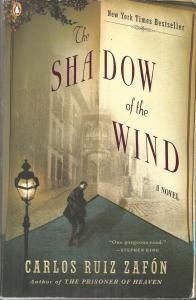
Chasing the Author (The Shadow of the Wind by Carlos Ruiz Zafón, translated from Spanish by Lucia Graves)

“I still remember the day my father took me to the Cemetery of Forgotten Books for the first time. It was the early summer of 1945, and we walked through the streets of a Barcelona trapped beneath ashen skies as dawn poured over Rambla de Santa Mónica in a wreath of liquid copper.”

A tumultuous story of intrigue, The Shadow of the Wind leads us on an ever-deepening mystery much like the unpacking of Russian stacking dolls. At times, the novel feels like a gothic thriller, at others like magic realism. Like Gabriel García Márques’s One Hundred Years of Solitude, in Carlos Ruiz Zafón’s novel we find the fabulous mixed with the mundane of everyday. In some ways, the story’s twists and turns reminds me of A.S. Byatt’s Possession (previously reviewed). Zafón reveals Barcelona as Charles Dickens reveals London. His labyrinthine plot winds through the post-war city and through a boy’s curiosity over a writer whose work is systematically being destroyed. The story unfolds in often surreal and soul-wrenching ways.

On Daniel’s fourth birthday, his mother is buried, a victim of cholera. At ten, he still misses her but cannot remember her face. Perhaps to distract him or simply to celebrate the first double-digit birthday, his father (a bookseller himself) takes Daniel to the Cemetery of Forgotten Books:

“This is a place of mystery, Daniel, a sanctuary. Every book, every volume you see here, has a soul. The soul of the person who wrote it and of those who read it and lived d dreamed with it. Every time a book changes hands, every time someone runs his eyes down its pages, its spirit grows and strengthens….In this place, books no longer remembered by anyone, books that are lost in time, live forever, waiting for the day when they will reach a new reader’s hands. In the shop we buy and sell them, but in truth books have no owner. Every book you see here has been somebody’s best friend. Now they have only us, Daniel. Do you think you’ll be able to keep such a secret?”

My gaze was lost in the immensity of the place and its sorcery of light. I nodded, and my father smiled.

Daniel chooses a book, The Shadow of the Wind by Julián Carax, a book and its author cloaked in mystery.

As Daniel grows up he is surrounded by books in his father’s bookshop, but obsessed by one. He meets Bea and is smitten. He wants her to understand that Carax’s book is a true story and to know what it means to him:

I began my story with that distant dawn when I awoke and could not remember my mother’s face, and I didn’t stop until I paused to recall the world of shadows…. I told her about my first visit to the Cemetery of Forgotten Books and about the night I spend reading The Shadow of the Wind. I told her about my meeting with the faceless man and about the letter signed by Penélope Aldaya that I always carried with me without knowing why…. I told her how…this was a story about lonely people, about absence and loss, and that that was why I had taken refuge in it until it became confused with my own life, like someone who has escaped into the pages of a novel because those whom he needs to love seem nothing more than ghosts inhabiting the mind of a stranger.

The Shadow of the Wind weaves through Barcelona to Paris and back to Barcelona. It is a detective story: Daniel in search of Carax; Daniel in search of ghosts. But it is far more than mystery; Zafón takes us into the heart of yearning where Daniel eventually becomes aware that “In Carax’s lost footsteps, I now recognized my own, irretrievable.” This is a story of love and betrayal, of despair and hope.

This is the first book I’ve read by Carlos Ruiz Zafón and loved this post-war glimpse into Barcelona, magic realism, and of course the ode to literature and writers that runs throughout. I echo Entertainment Weekly’s claim that the novel “is ultimately a love letter to literature, intended for readers as passionate about storytelling as its young hero.” It is a book to become lost in and ultimately to come away from enriched.


16 The Shadow of the Wind

Available through your local bookstore or online: The Shadow of the Wind

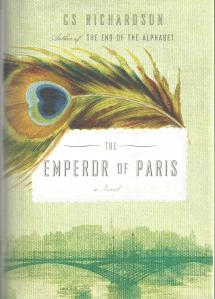
Magic of the 8e Paris (The Emperor of Paris by CS Richardson)

Reading The Emperor of Paris is a bit like picking up puzzle pieces one-by-one and slowly discovering the picture they create. In each short chapter, we peek into the lives of the people of the eighth arrondissement, Paris. It’s a particularly innocent era before World War I when the neighbourhood was a place disconnected from the larger city and world. And after the war we witness transformations – some difficult, others freeing.

A bakery – Boulangerie Notre-Dame – stands at the centre of the 8e neighbourhood. Here we meet many of the book’s characters and glimpse their personalities, challenges, and their moods. In living quarters above the bakery we share an intimacy between Monsieur (which everyone calls the baker) and little Octavio:

Sitting in the attic window with his son nestled in his lap, Monsieur Notre-Dame would slowly turn the pages of the Arabian Nights. When he reached an illustration, Octavio would laugh and point.

A beginning then, Monsieur would say.

He told the boy his stories. They were conjured out of his head, tales that had little to do with the pictures in the book, the flying horses or the thieves in their treasure caves or the scruffy boy with his magic lamp. Monsieur told them not as the book might have, but as he saw them, jumping to life before his eyes.

This passage hints, or foreshadows, something of the man Octavio becomes. The imaginative “reading” instills Octavio’s passion for books and offers a glimpse into an affliction that eventually brings Isabeau Normande into his life.

The immigrant artist becomes one of my favourite characters. Even after being dismissed from studying, he draws obsessively, mostly in the park in all kinds of weather. CS Richardson paints pictures with words, and as this scene his sparse words show us what Kalb sketches:

Jacob Kalb, a stuffed carpetbag under his feet and his knees under his chin, hurried a last sketch of the old woman across the aisle. Since crossing into France he had managed a passable likeness of the woman’s pocked cheeks, the creases around her puffy mouth. In small vignettes he had made studies of her hands and their bouquets of arthritic fingers. On the page her hair looked like lengths of wire exploding from under her hat.

 Richardson creates scene after scene that unveil the community, allowing us to see inside the hearts and actions of his characters. For example, the Fournier family run a bookstall that reflects both the bookstall and, in many ways, the neighbourhood:

The Fournier bookstall held too much poetry, mixed its philosophies with its mechanics and its travelogues among its fictions.

But the eclectic bookstall is more than a metaphor for the varied personalities of the community. It provides the pivot that creates change involving both Octavio and the scarred Isabeau Normande. In subtle ways, by the end of the novel Richardson seamlessly places all the puzzle pieces together, creating a unified whole.

The Emperor of Paris is like a fable brimming with magical, imaginative images not unlike the Arabian Nights except for the specificity of place and time. Richardson’s tale created a movie that ran across the screen of my mind, an ultimately satisfying movie made with perfect words.

15 The Emperor of Paris

Available through your local bookstore or online: The Emperor of Paris

Book Review: Fictional Fact – Imagining Klimt (The Painted Kiss by Elizabeth Hickey)

In this imagined look at the life of the Gustav Klimt, we glimpse Vienna and the bohemian lives of artists in the city during the turn of the 20th century. In The Painted Kiss by Elizabeth Hickey, we meet Klimt through the eyes of Emilie Flöge, a young, upper class bourgeois girl attending a parade with her father and sisters:

 “…our father was talking to a man we didn’t know. The man was wearing a threadbare sack suit and a pink daisy in his buttonhole. We had never seen a man wearing anything like that. He was not tall, but broad-shouldered and strong-looking. He was tan like the woman selling ices. He was carrying a leather case in one hand and what looked like a toolbox in the other.”

Emilie sneaks away to watch Klimt paint. Later he comes to the house to paint the daughters and Emilie convinces her father to allow her to take painting classes. Emilie grows into a young woman. One thing – as you can imagine – leads to another, and eventually to “The Kiss.” Emilie is believed to be the woman in the painting. The man is purported to be the artist Klimt himself. But Hickey’s story ventures past Klimt’s death, taking Emilie as far as the Russian invasion of Vienna near the end of the Second World War. Emilie and her niece have taken refuge at an old summer home that abounds with memories of Klimt’s visits. Emilie toys with the idea of travelling back to Vienna to see her city house, but resists:

“I am not ready for the accounting, not yet, the tally of buildings lost and buildings saved, paintings burned and paintings not. In my mind Vienna is still whole, I can see it. When I am stronger I can go back and face the losses. When the war ends I will go back.”

Hickey feeds the images we have in our minds about Vienna, about the sub-culture of artists, about the war and how it changed the lives of countless people. Despite the obvious research required to write creatively about such a well-known figure and period, Hickey keeps the story lively, not letting it droop into art-history mode for which I give her kudos. However, the book in many ways is a light romance, an easy read, which may be the perfect book for a lazy holiday weekend for those of us who like to snoop into artists’ (imagined) lives.

Notes about Klimt:

Most readers will recognize the art of Gustav Klimt (1862-1918), since images from his “gold period” pop up everywhere on greeting cards and posters. One of these, the “Portrait of Adele Bloch-Bauer,” was confiscated by the Nazis during WWII. In 2006, a movie called “The Woman in Gold,” starring Helen Mirren, takes the point-of-view of Maria Altmann who reclaims the painting from the contemporary Austrian establishment.

While talking with an artist friend about Klimt’s style, she asked if I’m familiar with the work of Margaret Macdonald Macintosh. Macintosh’s work was shown in Vienna in 1900 at the “Vienna Secession.” Klimt was also one of the exhibitors. Some believe that her influence created the famous shift in Klimt’s style that occurred after the show. Others suggest Klimt “stole” the style. Don’t you love when serendipity and a bit of artsy gossip slip into your life?

13 The Painted Kiss

The novel is available through your local bookstore or online: The Painted Kiss

Review: In a Landscape of Sand & Stone (The Painter of Birds by Lídia Jorge)

“I dread to think what they’ve told you about me!” He laughed, he was always laughing. “I bet they told you I was a wastrel, a soldier, and about a blanket I used to lie down on when I went off drawing birds. I dread to think what they told you about that blanket and those birds… They probably described me as a con man, a globe-trotter and an adventurer. I bet they poisoned your mind against me.”

In provincial Portugal not far from the Atlantic a family lives together in a dilapidated rambling house under the thumb of a tyrant father, Francisco Dias. Sons, daughters, in-laws, and grandchildren call the house home. The men provide the back-breaking labour on the farm. All, that is, except for the youngest son, Walter, who is The Painter of Birds. Walter is as free and migratory as the birds he paints. As you can imagine, this creates some trouble for his father and brothers. But this isn’t the only cause for distress in the house. The house and its inhabitants are all rife with the collusion of secrets.

Without giving too much away, in his youth Walter was a charmer of young women. When the parents of one of the girls discovers the rounding of their daughter’s belly, they take her to the doorstep of Francisco Dias. Walter’s brother Custódio marries Maria Ema and in due course gives birth to a daughter. It is through Walter’s daughter that the story unfolds.

This may sound like a hokey soap opera or melodrama, but it is not. The Painter of Birds is literary and lyrical. Lídia Jorge subtly reveals psychological and emotional insights into a time and place when families were held together by custom, poverty, and relative isolation from the larger world. It is a story of pent-up jealousies and resentments. And it is the story of a daughter’s quest for love and understanding. At the same time, Jorge’s story is metaphor.

Early in the book, Francisco Dias is called to the school where the teacher tells him:

…what extraordinary hands Walter had, hands that drew as if the memory of nature were concealed beneath their fingertips. A truly remarkable talent. …Walter used to lie down on the ground and wait for the birds to land, sometimes he would catch them in baskets and cages from which he would subsequently release them, but first, he would reproduce them on paper, copying their feathers and their shapes, giving their eyes in particular a special life. It was as if the wretched sparrows could speak, as it the thrushes were laughing, all because of those lines he added to their eyes or because of the way he drew their raised tails and their spread wings.

Much later, birds adorn the letters that arrive at the house. Birds. Well-travelled birds. But it is not only birds and Walter that will travel during the changing world of mid-twentieth-century-rural Portugal. This complex story explores timeless themes of family, dependence, and independence wrapped in a daughter’s yearning for truth. I particularly enjoyed the metaphors of travel and birds and would love to hear from other readers of The Painter of Birds.

14 The Painter of Birds

Available through your local bookstore or online: The Painter of Birds

Review: Lighten Up…& Not Just Your Suitcase (Here & There by A. A. Gill)

Many travel writing collections are “precious,” but not Here & There by A. A. Gill.  He writes with acerbic wit and irreverence. At the same time, he manages to share his fascination with people and places.

Gill, writing in “Spice of life” for example, acknowledges the poverty of Calcutta (he doesn’t use the city’s newer name, Mumbai) but raves about India’s post-Mogul culture and “an embarrassment of world-class universities.” Then, he goes on to note that “Calcutta was invented by the English on the banks of the Hooghly, the last stretch of the Ganges. It was a stupid place to build a city, but that never stopped the English.” After a number of suggestions to experience during your visit, he turns the tables: “I loved Calcutta because it’s a city on the way down…Cities that have been something and seen stuff have stories to tell. Places can be trippers or tourists or, like Calcutta, they can be travellers.” What a recommendation!

In an article called “Dawn of a new era,” Gill twigged memories from my Kenya-Tanzania trip, and he made me want to visit South Africa. He puzzles out how and why South Africa managed truth and reconciliation and elections, while avoiding civil war. Quirky, as always, Gill begins with a tokoloshe, which is a “Zulu demon, a nightstalker, a sprite goblin…a real five-star terror. He describes Jo’burg before and after apartheid. Gill also highlights a few things not to be missed: “Not just the apartheid museum,” (which he claims to be “the most thoughtful and emotional couple of hours I’ve spent in a museum for years”) but “the townships and the markets and cafés, the music and jacarandas, and the high, dry veldt, but you should go because this is the luckiest place in the unluckiest continent.” After musing about the cause of such luck, Gill concludes:

Personally, I think it was the tokoloshe that made South Africa hold back, divert the consequences of the past. South Africans lay awake in the hot night and heard the panting and the muffled sharpening of little goblin pangas and knew what the fears made flesh would bring. The tokoloshe still lurks under the bed, but the longer this normalcy goes on, the smaller the fears that feed him.

From Iceland to Vietnam, from the U.S. to Europe (East and West), Gill covers the map offering surprise discoveries and often wonky bits of information gleaned from the streets.

Here & There is a collection of 58 brief articles from all over the map, plus two introductory pieces. Without exception, the travel writing is sharp and insightful, written with empathy and humour, and it is thought-provoking. Gill also raises questions about traveling and travellers, and about travel writing. He also affirms something I believe (don’t we love when that happens?):

One of the things that fascinates me about travelling is how places make people. The received travel writing wisdom is always the other way round: it’s people who make places….But over and over I’m aware that the characteristics and beliefs of nations seem to flow from the land, seep up from the earth.

 Gill explains a bit about the norms of the travel industry, suggesting how and why the PR people are able to pique our interest and loosen the savings nested away during our work-a-day lives. About “Why go?” he shares a few ideas while debunking the notion that travels “broadens the mind” and emphatically that “the dumbest reasons for travel, the most thoughtless expectation of a holiday is to relax.”  He claims, “Travelling to do nothing is the great holiday oxymoron….” He’s less clear about the positive outcome, except it isn’t to know thyself (to borrow the cliché). It is about the people you meet and experiencing the places out of which they’ve grown. I think he’s urging us to travel curiously. About travel writing, Gill says, “The pleasure of the craft of journalism is that you start to work for money, but end up working with friends, and collaborating….” It is about the people and about experience (again).

My bookshelf should be drooping, given the weight of the travel books stacked on it. Here & There differs from all of them.

12 Here & There

Available through your local bookstore or online: Here & There


Review (Poetry): With the Keenness of Time (Bicycle Thieves by Mary di Michele)

…Maybe time is not / an arrow after all but a whirling / storm about to touch down (“The Possibility of Time Travel”)

Mary di Michele’s consistent search through place and time continues in her latest collection, Bicycle Thieves, as do particular images.

Thirty-seven years ago, di Michele’s Bread and Chocolate (1980) was published, and in it a poem called “1952.” The poem lyrically describes the photograph we see on the cover of Bicycle Thieves. The poem and her current book’s cover attest to the desire to know what shaped her parents, her self. “1952” tracks a migration and in it we glimpse a man and a woman and hints of a puzzle. This puzzle is further explored in her latest collection.

In “The Bicycle Thief,” di Michele shares birth-place images and vivid sketches of her father – in youth and old age. She captures a return visit to Lanciano and regrets that she cannot go back in time as well as place, to a time “before / the World War, seen the boy my father was / before his father betrayed / a barefoot son / and sold his bicycle.” A patina of love and loss and change loosely covers section one – The Montreal Book of the Dead – like a sheer veil lifted in a breeze.

The middle section – Life Sentences (An Autobiography in Verse) – is comprised of 100 three-line stanzas. In them, a life passes by, nuanced with detail, yet like an illusion. Whereas in section one, the emigration is physical – place to place – in section two it is the lived past:

The past is that far
country you emigrated from
as a child.

It is the past of the poet under a sharply focused magnifying glass where she peers intently at that small enlarged circle, moving the magnifier across memories and through time. The cautionary voice warns: “Mary, you can’t go / back to yesterday, you were / a different person then” (#90). But Socrates suggests that an unexamined life is not worth living.

Di Michele, like Lorna Crozier (What the Soul Doesn’t Want, reviewed July 21 2017), poignantly holds a lens to the past, focusing it on both joys and sorrows in a search for its essence, for meaning. Di Michele’s poems explore the particulars of her life (of an immigrant child, of the mystery of parents, of the curious mind). They create a portal, a bridge that gives voice to universal experiences recognized by her readers.

In the final section – After – we find influences of di Michele’s reading, but even here, she takes us to a specific place and time that is hers. My favourite poem in Bicycle Thieves is “Evening Light” (After Umberto Saba); she tells us:

Moon rise.

                             In the street it’s still
day though dusk’s rapidly descending.
The young don’t notice, they’re busy
texting, faces lit up
by the screens. They have no idea
about death, how in the end, it’s

what helps you live.

And here we have it all: the observation and insight, the sense of time’s movement, the lyrically perfect words and flow.

Since Mary di Michele’s first book (Tree of Life, 1978), she has been honing her poetic skills, the writing becoming sharper, the insights keener. It’s hard to imagine what will come next – after Bicycle Thieves – but already I want it.

11a Bicycle Thieves cover LR-1

Available through your local bookstore or online: Bicycle Thieves