The Sleep Orchard: A Response to Arshile Gorky by Amy Dennis – Book Review

I know // I know / nothing // of Armenia 1915 – “Admission”

In The Sleep Orchard, Amy Dennis reaches deep inside the life and myth of Arshile Gorky. She enters his paintings and photographs, reaches into the Armenian genocide’s impact on one man. She explores Gorky’s place in the history of art. And in attempting to understand Gorky, Dennis crosses borders of time and place.

In “On Waking,” the first poem in the collection, it is clear that Dennis has absorbed Gorky into her life. She writes: My lover says I have called out….

… I don’t remember.
But know after waking I’ve scavenged

old papers to find antique recipes for ink, hungry
for a hallowed liquid to write about Gorky. In dreams
he is tall and looks into me.

Every morning his paint rattles my thin grasp
on language.

In the second poem, “Greenware,” Dennis writes: …I’ve never before slit / my fingernails into this // wild apple and pistachio / where his mother wipes her hands. Gorky’s mother, who died in his arms when he was a boy of about fifteen years, becomes the monumental loss that haunts his paintings – and Dennis’s poems. In my reading of the collection, mother is at the root of the art connecting artist and author like the mycorrhizal network of tree roots. The theme begins with Gorky’s mother (Shushan der Marderosian), continues with his wife (Agnes Magruder, called Mougouch) who is mother of his children and, woven into the collection, is Dennis’s impending motherhood. Mother: a threaded root. Evocation: Mother. Armenia.

Arshile Gorky was a man who reinvented himself (his birthname was Vosdanik Adoian). In “Marny George at 36 Union Square,” Dennis writes: You were a Russian portraitist // Georgian prince, nephew to Maxim Gorky. Prodigy / who once studied in Paris. Gorky also reinvented art. Dennis traces his artistic lineage. For example, in “Shards,” she writes: he locates / shapes in these famous canyons:

Matisse’s Red
Studio, Miro’s Still Life
with Old Shoe, Picasso’s Plaster
Head, The City by Léger.

Gorky penetrates / where these artists end / and he began…. He became known as the father of abstract expressionism, paving the way for Pollock and Rothko and Gottlieb and de Kooning (“Ambiguous Spaces, Seemingly Random Angles”).

Although Dennis’s poems place Gorky in the spectrum of art history, it is context, neither art history nor art criticism. Although Dennis describes paintings and photographs, the ekphrastic nature of the poetry is not the only technique Dennis applies to reach the heart of her subject: “A Response to Arshile Gorky.” The Sleep Orchard contains poems in which Dennis writes of his mother, where she inhabits Mougouch, and where she writes to his daughters. But this collection is not a biography. Dennis writes of her own experiences during the writing of The Sleep Orchard, but it is not memoir. She claims to know nothing about Armenia – I know // I know / nothing // of Armenia 1915 (“Admission,” the third poem), but the collection bears witness to the impact of that genocide. The Sleep Orchard is all of this and more. The collection is tapestry, the colours of Armenia, a search for Arshile Gorky.

Dennis’s collection is sensuous, passionate, lyrical. Her skillful writing draws readers inside, always evocative. My favourite poem in the collection happens to have one of the longest titles: “Meditation on White (traced Backwards), Response, to Charred Beloved /, 1946.” You can see her skill, hear her poetic voice:

Named after lilies, his mother Shushan warmed
her infants in cradles lined with sand, grew daughters
to face east and hail Mary. Each November, string-tied
from ceilings, she dried pears, their skins distilled
with rippled sugar and the deathly

look of withdrawal, the fruits
parched as embalmed songbirds or small raptors
swathed in Egypt. Her once son, his voice-

box drowned with balsam, would not speak
until he was six, until six spoke only with birds. This,
a small sacrifice for the close studies of such wings, white
doves he let roost in his breaking.

You do not need to know a thing about Gorky’s art or ekphrastic poetry to be drawn inside the emotion of the poems. Dennis brings Gorky and his work to life, opening a door for readers to enter his world – and hers – whether or not you are an art afficionado. Art is the vehicle, but there is much more to The Sleep Orchard.

The Sleep Orchard (Mansfield Press, 2022) is available through your local bookstore, the publisher, or online (ISBN 978-1-77126-280-4).

You may also be interested in my review of Mechanics of a Gaze, Branka Petrovic’s poetry collection about Gustav Klimpt and Emile Flöge. (Mansfield Press, 2017). If this interests you, please also see The Painted Kiss (Washington Square Press, 2005) for my thoughts on Elizabeth Hickey’s fictionalized novel about Gustav Klimpt and Emile Flöge.

Everchild by Gwynn Scheltema: Book Review

This clementine skin is thin / clings fast, is old. — “Naartjies”

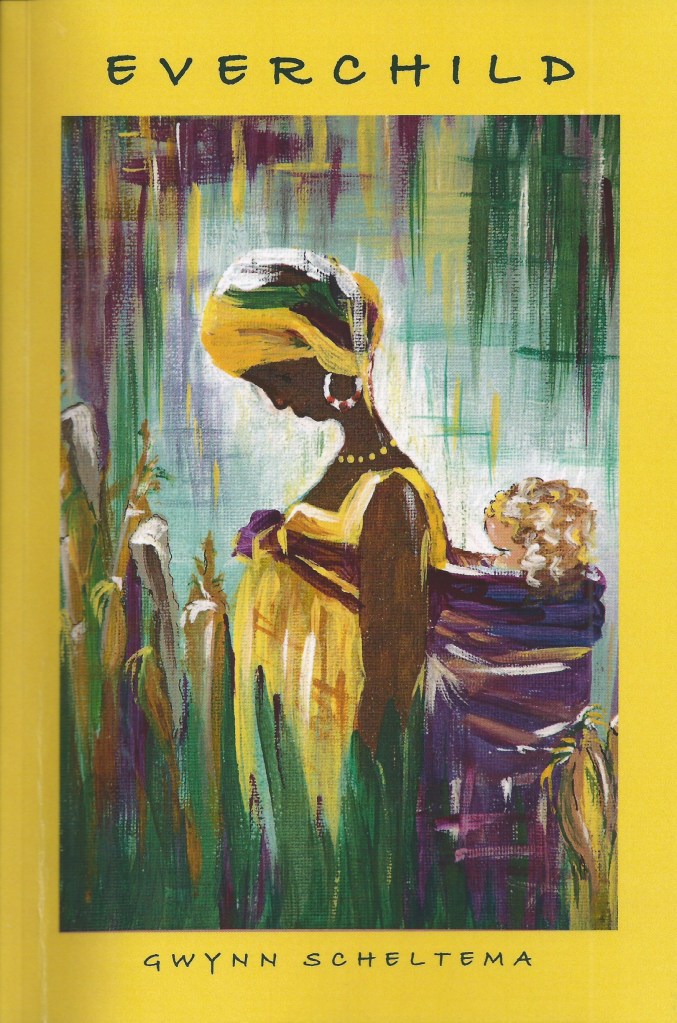
Everchild by Gwynn Scheltema. Aeolus House, 2023

Everchild by Gwynn Scheltema is a collection of poems by a practiced writer. It has earned the praise of Louise Bernice Halfe – Sky Dancer who writes, “Compelling and heartbreaking. The poems filled with longing, pain, a sensuous observation of a journey looking to repair itself.” Antony Di Nardo says, “[She takes] us into the heartland of Zimbabwe. There’s a lifetime in these poems, stories to be told about people and places and the state of the human heart, whether grieving or skipping to the beat of its own music.” E. Alex Pierce writes “Gwynn Scheltema writes from every aspect of her wide-lived life with every facet of her bold, courageous, female voice.”

Scheltema’s poems explore absence, loss without nostalgia, in their search for home and identity. They ring with authenticity, a truth richly lived. We find ourselves within the Zimbabwean child-heart that remains alive within the woman she has become. Flowing throughout the collection this thread is strong and constant.

The collection is laid out in four sections: Breathe, Ignite, Ebb, and Be. The prologue poem, “Moongate,” establishes what will follow:

            she breathes
            treads lightly

            on what was

            what will be—

From the first poem, called “The Old Swing,” the reader is placed in time looking back: “After layers of years / the tall metal swing frame stands /                  still.” And we understand that a kind of resolution if not acceptance will be found in the poems, despite the pain that inhabits them. The swing’s chains may be too rusty to achieve the sky of childhood, but it will rise in “song-birthed words.”

One of my favourite poems celebrates Nomvula, the woman of the cover art (a painting by the poet) in whose care the child lives:

Whimpers wend like wind spirals
from the child swaddled on her back who whispers
with spirits she does not want to know
a mother gone that no one speaks of
thula, thula, hush hush.

The song, almost anthem, stirs.

Nomvula…

removes the sandals with brass buckles
removes the dress with itchy white lace
gathers her to her breast
skin to skin
white to black
thula, thula, hush hush
ngilapha, I am here.

The mother is absent, an unspoken presence.

In the third section we meet the stepmother, and who wouldn’t think of fairy tales?     

the only hug
my mother ever gave me
I was six

I wonder
if I had hugged her back—

While I have omitted the crux of the poem, these words convey the sense of longing for what might have been, as well as a lingering self-doubt that haunts the collection. But do not misunderstand; there is no blame of self or other.

The final section, Be, brings poet and reader to what is, the place past memory, a place of now, a place secure. Scheltema writes, “What matters

            flies home right now from Saskatoon
            warm, wanting flesh inside cold steel
            ornery no doubt from his knees cramped to chin
            airless heat and stiff sandwiches
            but his heart still soft

            …

            our quiet walk in the blossoming.

While Everchild is a first full-length collection, Gwynn Scheltema’s fiction and poetry have been published in journals, magazines and anthologies. In 2021, Glentula Press released her chapbook, Ten of Diamonds, a “constraint” collection of ten poems. She has earned many accolades over the years, all culminating in this exquisite collection, a collection that at its heart is one poem.

***

For more about Everchild and its author, visit https://gwynnscheltema.com/.  A Kindle edition is available through Amazon.ca. For the print edition, order from your local independent bookstore, from the publisher  or get a signed copy by contacting the author.

Kevin Mulqueen: Le Mot juste

The High Window Review's avatarThe High Window

flaubert

*****

Kevin Mulqueen was born in Reading, UK, but his blood is pure Irish. He has been teaching English for 48 years – in England, Egypt, Tanzania, Argentina, Venezuela, Ghana and now Vietnam. At 70, He’s still going strong. He is married to a Vietnamese woman and lives in Ho Chi Minh City. He is a chess fanatic (Tanzanian National Champion in 1991), devotee of blues and jazz music, bibliophile (Shakespeare, Thomas Hardy, Brian Moore, Philip Larkin, Dick Francis, M.R. James and Jonathan Raban are among his favourites), vulcanophile (He’s climbed Tambora and Mt Mayon), traveller, writer (mainly of travel and nostalgia essays) and armchair sportsman (He loves football, cricket, tennis and boxing).

*****

LE MOT JUSTE

I first came across the phrase le mot juste at secondary school, when our French teacher, Mr Evans, used it in class. He said something along the lines of: ‘Il faut chercher le…

View original post 2,097 more words

Why Write a Chapbook? Plus Red Alders in an Island Dream by Christopher Howell

“What they say is / change / can bring you here.” (“Beyond the Dream Hatch”)

Fellow poet, friend, and blogger, Gwynn Scheltema, has recently written a piece about chapbooks — what they are and why we might consider publishing one. Here’s a short excerpt from Gwynn’s Writescape blog (with permission; thank you Gwynn):

Why publish a chapbook?

  • For the unpublished poet, it’s a chance to get publishing creds.
  • The process will prepare you for putting together a full collection.
  • A chapbook is a “safe” way to publish, because the work is not lost. You can publish it again in your collection.
  • You can take risks with a chapbook – give a chance to a new publisher, publish it yourself, create an artpiece.
  • A chapbook can keep you in the public eye in the time between publishing full poetry collections.
  • You need a home for perfectly good orphan poems that didn’t make it into a collection.

(To read Gwynn’s entire blog on Writescape, just click here: https://writescape.ca/site/2021/02/on-chapbooks/.)

***

This started me thinking about chapbooks slipped between full collections on my poetry shelves and to Red Alders in an Island Dream.

RED ALDERS IN AN ISLAND DREAM

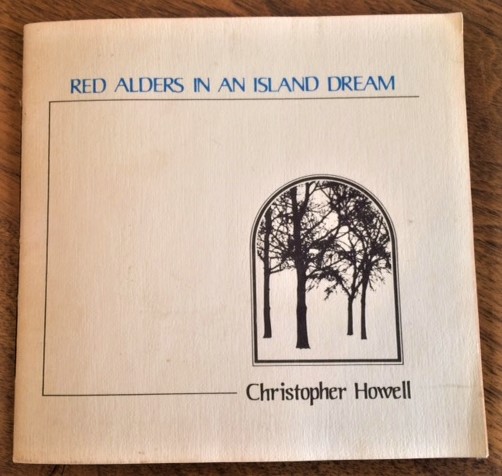
… is an example of a 7-inch square, hand-stitched chapbook by Christopher Howell (Trask House Books, Portland, 1980). It was given to me recently by a friend who gifted it from his library. Howell has now published 11 books of poetry and won three Pushcart prizes among other awards.

This little treasure has been read many times. Just because it is small — home to only seven poems (one is in four parts, which sort of makes it eleven poems) — does not decrease its value. Actually, I like Red Alders in an Island Dream better than many full collections on my shelves. Don’t approach chapbooks in a condescending way. Sometimes the best things come in small packages.

The collection ends with the four-part poem “In Grey Water: The Day,” and these are the last four lines of “IV,” the final lines in Red Alders in an Island Dream:

Membranous and steady, like wind
moving in the darkening neighborhoods,
we seek the far shore. And window light
breaks from us
like the sound of oars.

***

For an interesting interview with Christopher Howell: http://true.proximitymagazine.org/2018/11/08/a-conversation-with-christopher-howell/, or just “Google” Christopher Howell poet.

Thanks for reading to the end. Please share your thoughts and this blog. Kate

WHAT MAKES A GOOD POEM?

What to look for when reading and what to aim for when writing:

This is the briefest of summaries, mere definitions of key elements in poems. It might be a good exercise to play with each one and then try combining them as your skill develops.

  1. Details: naming; seeing, hearing – all the senses; every word working and, conversely, subtlety: a balance of specific and mystery / known and unknowable / sayable and unsayable. Is the monarch butterfly pinned to a board or does it fly free?

  2. Engagement: poet’s presence, not only intellectually (ideas/abstractions/metaphors), but physical presence/immediacy; an invitation to readers to enter the poem, to be stirred, to connect.

  3. Intimacy: the voice of the poet comes through; expressive words, perspective, insight – the surface narrative/lyric, but something written between the lines that speaks in the poet’s voice but that also touches me unearthing something that connects us (something beyond personal/universal/ah ha moment).

  4. Movement: outward and inward.

  5. Portal: the word, phrase, or stanza that shifts the poem from the surface theme into the deeper, more subtle one, the poem written between the lines.

  6. Sound and rhythm: music; echoes in the language.

  7. Twist: surprise, but also coherence, and subtlety: room for the unknown/unknowable.

  8. Question: I want insight, but not a definitive answer (not overly generalized; respect for the individual); I want to be left with something to think about beyond the poet’s skill with structure and words, rhythm and other “tools” in the writer’s toolbox.

  9. Wow factor: awe moment; not just by poet’s craft/skill/talent, but by the mind and heart of the poet.

Every poem does not have all of these things, but they are what I look for when reading and what I aim for when writing.

You may also be interested in reading How to Write a Good Poem? 6 Writing Tips. The blog looks at the advice of Jane Hirshfield, Robyn Sarah and Tony Hoagland. For more tips scroll through the category “Writing Tips & Workshops.”

Please share your thoughts and share this post. Thanks,
Kathryn

Continue reading “WHAT MAKES A GOOD POEM?”

“Poetry of Witness,” from Sarajevo with Sorrow and Poetry is Blood: Book Review

For whom were these poems intended at the time I wrote them, during the shameless Bosnia war and the siege of Sarajevo? …The lines I wrote were written in the belief that, when compared with the cold newspaper reports which would be forgotten with the start of a new war elsewhere, only poetry could be a true and decent witness to war. — Goran Simić, Preface to from Sarajevo with Sorrow.

from Sarajevo with Sorrow by Goran Simić, translated by Amela Simić. Windsor (ON, Canada): Biblioasis, 2005.
Poetry is Blood by Keith Garebian. Toronto (ON, Canada): Guernica Editions, 2018.


Poetry of Witness

What is “poetry of witness?” you might be asking. Philippe Lacoue-Labarthe looks at the Latin root of the word experience: “ex-periri, a crossing through danger.” In her essay, “Reading the Living Archives: The Witness of Literary Art: To hell and back, with poetry,” Carolyn Forché writes:

In the poetry of witness, the poem makes present to us the experience of the other, the poem is the experience, rather than a symbolic representation. When we read the poem as witness, we are marked by it and become ourselves witnesses to what it has made present before us. Language incises the page, wounding it with testimonial presence, and the reader is marked by encounter with that presence. Witness begets witness. The text we read becomes a living archive.

The horror and the dead can live on, carried by survivors, across generations. This is the way that I’ve come to think about poetry of witness, and this has informed my reading of from Sarajevo with Sorrow and Poetry is Blood.

In these two collections, Goran Simić and Keith Garebina share the experience of war: Simić bears witness to the siege of Sarajevo (1992-1995 Bosnian War), Garebian bears witness to the generational trauma of the Armenian genocide (1915-1920).

from Sarajevo with Sorrow

77 from Sarajevo with Sorrow

Simić’s “The Face of Sorrow” begins with a metaphor and an image:

I have seen the face of sorrow. It is the face of
the Sarajevo wind leafing through newspapers
glued to the street by a puddle of blood…

In “A Common Story,” the images intensify: When they brought him to the hospital, half his / body missing….  By the time we get to “Love Story,” we’ve travelled from the particular and immediate experience of the poet to the political reality of murder and the mythologizing of journalism and war. The poem brings us back from romanticized news to the ugly experience itself, as well as the unaccountability inherent in war:

Love Story

The story of Bosko and Amira was a major
media event that Spring. They tried to cross the
bridge out of Sarajevo, believing their future was
on the other side, where the bloody past had
already gone. Death caught them, in the middle
of the bridge. The one who pulled the trigger
wore a uniform and was never called a murderer.

[…]

My friend Prsíc, a Bosnian soldier who guarded
the bridge, watched each day as maggots, flies,
and crows finished off their swollen bodies.

 […]

This is a story that you may recall, but a different story than the one splashed across news channels, this witnessing elicits repellent emotion in the reader, removing all remnants of romance, and we are “marked by the encounter.”

Finally, in the last stanza of “Spring is Coming,” Simić addresses what remains after the siege:

Spring is coming. On crutches.
The time of medals is coming,
when children from freshly whitewashed orphanages start
       searching for family albums,
the time when big flags cover this landscape of horror
in which my neighbour, in the basement,
holds a child’s winter glove in his hand. And weeps.

This haunting aftermath is where we enter the poetry of Keith Garebian.

Poetry is Blood

77 Poetry is Blood

Keith Garebian did not experience the Armenian genocide of 1915-1920, but he bears witness to the continuing trauma left in its wake. (There is a relatively new psychology that supports the idea of historical or inter-generational trauma. (Please see “The Legacy of Trauma by Tori DeAngelis, American Psychological Association, February 2019, Vol 50, No 2.) Garebian is the son of a survivor and, along with his father, carries the scars, scars that find expression and witness in Poetry is Blood.

The collection begins with an image that echoes throughout, and the poem sets an emotional tone that reverberates across individual poems:

April

A month bequeathing poppies,
compact red explosions.

 Insomniacs found bones
in meadows of ordinary light.

In addition to the echo of “poppies,” the father is embedded in the collection. We come to feel the distance between father and son, the incapacity of the father to touch or be touched. The father is more shadow than flesh and blood.

In one of the early poems, “Okra,” Garebian writes: Did he know the leaves were heart-shaped? / I was searching for his heart but he never knew. In “Songs of Nagash the Ghareeb,” he writes: How long, how long / the song of exile leaping from his mouth? And in “Tell Me Why,” he begins with the plea: Tell me why you are drawn to sad music, / old dull pains, scars that linger generations. / Why your sleep is a struggle deep in a cave. It ends with the pain of the distanced child, now man: Tell me why cruelty gets in the way of love, / like wind knocking the heads off flowers, / like time bruising your shattered heart.

In a long poem, “The Pilgrimage,” the poet visits the lost homeland, the site of genocide and he writes: I walk in my orphaned / father’s shoes, their footfall / imprinting his voicelessness. The poet, like his father is essentially orphaned, lost, seeking.

We become steeped in the lasting impact of genocide, see blood in the explosions of poppies, witness the vacuum where love should reside, and experience almost more loss than can be borne. But Garebian continues to search for resolution. Near the end of the collection, in “Elegy” he laments the father and so much more:

My father’s ancient tribe writhes
on my written page,
groaning under a sullen sun
in a landscape of cadavers
so ghostly real
I can count their groans,
even in this harsh north
w
here introspection freezes
w
hile birds flee on strong wings,
t
heir cries waning in geometric wake.

[and by the conclusion we learn]

The earth moves on
and light dances
as I shelter the dead,
give them refuge in my words
so they may dream of themselves
preying on us as we once did on them.

Conclusion

These poems by Goran Simić and Keith Garebian are not anecdotal, neither are they confessional. The poems in these two collections bare experience of the collective, of cultures so harmed that the weight of destruction seeks voice, seeks listeners to hear and to also experience the trauma. Like the Latin from which experience derives, they cross through danger. from Sarajevo with Sorrow and Poetry is Blood are among the best contemporary examples of poetry of witness.

For readers who want to explore further into the genre, read Anna Akhmatova, as well as the Nobel Prize winners Wisława Szymborska and Czeslaw Milosz.

We have come through a century of war but seem to have learned little. Newspaper headlines come and go and now false news clutters our minds. The poets, however, write words that not only sit on the surface of the page, but they write words between the lines, words that resonate psychological and emotional truth, the truth that lingers both individually and collectively. The truth that invites us into ex-periri.


Available through your local bookstore or online: from Sarajevo with Sorrow and Poetry is Blood.


How to Write a Good Poem? 6 Writing Tips

How beautiful / The usually hateful crow, / This morn of snow! (Bashō)

To paraphrase the literary critic Northrop Frye, poets deal with the “imaginative aspect” of environment. Frye was speaking about the physical environment, but I would stretch that to include any context in which the poem exists – which might be physical (explored and revealed through the senses), intellectual (the world of ideas and/or abstractions), or psychological (internal journey). This subject is the “thing” that stirs the poet to look deeply and with carefully chosen words, “voice,” and “music” (lineation, rhythm, rhyme) create the poem. What is “looked at deeply” becomes the theme, the thing written between the lines that moves the poem toward a new perspective, a new way of seeing and understanding the “thing” described. All gobbledygook? Let’s have an example.

Jane Hirshfield (Ten Windows) provides an haiku by Kobayahsi Issa to demonstrate the change that occurs in a good poem:

We wander
the roof of hell,
choosing blossoms.

Despite the grief and compassion we feel at the initial statement, we learn that life’s journey is made liveable by what is chosen. The pain is stated without sentimentality. The twist comes simply and effectively with the choice made, as Hirshfield says, the “bending down to pick flowers.”

In Issa’s eight words, we have all that is required of a good poem: subject, theme, carefully chosen words (even in translation), a twist/movement leading to a change of perspective, an opening toward seeing the subject differently. Hauntingly beautiful. One of the elements that sets poetry apart from prose is the emotional sub-text that exists in good poetry.

To quote Jane Hirshfield, “A good poem is a through-passage, words that leave poet, reader, and themselves ineradicably changed. Having read a poem that matters, the person who holds the page is different than he or she was before.” Wouldn’t we all like to leave our readers changed and feeling deeply, as well as thinking about what we have written?

Poet and editor Robyn Sarah (“Poetries Bottom Line,” Little Eurekas) says it another way:

I believe that a true poem, whatever its subject or style, has a density of meaning, a felicity of language and an authenticity of feeling that cannot be faked – a mysterious synthesis that doesn’t happen every time a poet picks up a pen, but is born of some urgency of the moment.… A true poem has a voice one can trust – a distinctive voice, utterly its own, one that is unaware of audience. It is a voice less heard than overheard [author’s emphasis], and this is partly what moves us.

Finally, Tony Hoagland has written an entire book about voice. In The Art of Voice, he concludes:

The role of voice in poetry is to deliver the paradoxical facts of life with warmth and élan, humor, intelligence, and wildness. Such art requires a particular spirit and a particular set of skills…. In the end, perhaps, each good poem is a kind of miracle birth, possessing a different ingenuity and metabolism. But poetry is a craft as well as an art, and the insights and techniques of craft, like carpentry, can be taught, learned, practiced, and relished.

When I studied writing with the late Alistair MacLeod, he was best known as a short story author. This was before he published No Great Mischief, winner of the prestigious International Dublin Literary Award (2001). Professor MacLeod maintained that the shorter the writing, the more difficult and challenging it is for the writer. Poetry, in part because of its brevity, demands that every word count and be chosen with nuanced care. A poem is condensed, dense, operating on multiple levels at once. And yet the job of the poet is to make the poem accessible, to take the everyday commonplace and  to open a window onto a new way of seeing. I believe that poetry is revolutionary in that at its heart lays the key to new awareness and change.

So, what is the “take away” for poets: 6 writing tips

  1. A subject that demands the poet dwell with it, explore it using the senses to get at its inherent multiple levels to find what exists beneath the obvious;
  2. A theme that resonates between the “thing” of the subject, the creative core that shifts writer and reader to a new awareness;
  3. A twist or shift that takes writer and reader into new ways of seeing what was initially commonplace or a problem unresolved;
  4. How this is done is complex, but voice is a key, an authentic voice, an honest voice, a voice that uses all the tools in the writer’s toolbox (metaphor, music, etc.) to connect with the reader eliciting in him or her the emotion that lingers after reading a good poem, the thing that haunts;
  5. My best advice is to read the best poetry – the poetic oeuvre of one’s culture and international poetry – study it and figure out how the poet manages to capture your mind and heart (because poetry is an emotive art).
  6. When you think your poem is finished read it aloud, again. Feel the words on your tongue. Listen with ears, head, and heart.


I welcome your comments – whether you agree or disagree. What makes a good poem, and how do we go about achieving one?

Thank you, Kathryn


References:

Hirshfield, Jane. Ten Windows: How Great Poems Transform the World. NY: Alfred A. Knopf, 2017.

Hoagland, Tony with Kay Cosgrove. The Art of Voice: Poetic Principles and Practice. NY: W. W. Norton & Company, 2019.

Sarah, Robyn. Little Eurekas: A Decade’s Thoughts on Poetry. Windsor, ON: Biblioasis, 2007.

Also see: Book review: Ten Windows: How Great Poems Transform the World (by Jane Hirshfield)

Review of A Breeze You Whisper in In A Fragile Moment: A Landscape of Canadian Poetry

Whispers and Flames in Kathryn MacDonald. A review of some poems by Kathryn MacDonald in A Breeze You Whisper (Poetry) (2011) Hidden Brook Press. Canada – p. 131-134

Surprises are wonderful, especially when they involve a review of your book in a collection with poets such as Milton Acorn, Margaret Atwood, and Al Purdy among others. I’ve received the publication notice by email and the book is on its way. More about the collection to come. In the meantime, here is a bit of blatant self-promotion of my collection, A Breeze You Whisper.

51yj9Pt49nL._SX348_BO1,204,203,200_

First, from the press release:

In a Fragile Moment: A Landscape of Canadian Poetry is an insightful collection of essays and reviews, written from the poetic heart of Professor Olivé. The authors covered in this astute critical study are treated with heart felt respect:

Milton Acorn, Merle Amodeo, Margaret Atwood, Katharine Beeman, Allan Briesmaster, Patrick Connors, James Deahl, Antony Di Nardo, J. Graham Ducker, Kate Marshall Flaherty, Katherine L. Gordon, Kimberley Grove, Richard M. Grove, Don Gutteridge, Lala Heine-Koehn, Keith Inman, Bruce Kauffman, Donna Langevin, John B. Lee, Norma West Linder, Kathryn MacDonald, Lisa Makarchuk, Bruce Meyer, Colin Morton, Marvin Orbach, Deborah Panko, Al Purdy, Sarah Richardson, Linda Rogers, Glen Sorestad, Anna Yin.

The review:

“Whispers and Flames”

My nights are good ones. Besides friends, family, sharing and joy, poetry books flood my bed and my mind before I go to sleep. It is a wealth found nowhere else. Last night it was not The Voice of the Land, or the People´s Poet. Last night it was a whisper in my ears, a dance of words and flames before my eyes: Kathryn MacDonald.

If I had to choose one word for her poetry, I´d say “sensuality.” It overflows the book´s margins shipping fruit and fire that crackles in its pages as I hold my breath caught in the delicacy of her phrases or gaspingly sigh marveled at their attractiveness.

I went through some of her poems. “A Breeze You Whisper” entwines, with simplicity and smoothness, two major themes at the core of poetry: nature and love. Neither the book´s title nor the poem´s has a comma, but its single stanza includes it in the first two lines (“A breeze, you whisper. A bird, you soar and hover”). These pauses are dictated, and intended, by the poet as a mindful pointer of serene procession towards something – provoking, soul-diving, engaging – prompted by the nature-sent, photo-like proposal.

The “You” mentioned in the poem is sensitively attached to nature; but in a quiet association – as if paving the lovers´ way to intimacy – that is set free, no punctuation in lines three and four, to yield the lover to her: “… into the nest hidden within my tossing limbs.” It is a pas de deux from contextual meanings (lines one and two) to figurative meanings (end of line two through three and four). “The nest” strikes a euphemistic chord, which empowers the sentence with sky´s-the-limit interpretations by the reader.

“Blueberry Picking” is play with meanings in cross-contextual insinuations only to be perceived by the mind. Fruit – flavor, colour and look – is the main star in a poem that creates allegories of berry-blue sensuality. The reader climbs – rung by rung – down the poem from “Lake of the Woods, round and placid like the heavy rocks from which the prickly bushes seemed to grow” to “… the sweet berries with my tongue.” Mind-blowing juggling with “I fondled the sweet berries with my tongue” as a prelude to a suggestive “mood.” Situations and characters´ status dribble sensually. The coda modifies the tempo of the poem, its atmosphere.

Kathryn can´t and won´t give up her incursions to nature in “One Woman” for describing/comparing: “Your laughter… geyser filling me with love” or “Exuberant you… deep in life´s river…” She uses metaphors to depict setbacks too: … “welcoming flotsam tossed up in turmoil…,” and optimism again: “glowing like sunrise.” The three lines before the last one (“a surprise hug manifesting joy and rampant passion”) lead to the poem´s essence: “all wrapped up in one woman.” Uncomplicated words, deftly chosen, concise: expressive love and admiration.

“Avatar”  is a proverbial narration of the creative act, its tumultuous process preceding the ultimate phase of artistic conception until the time “to brush across canvas.” It starts explaining somehow the artist-poet strings and the urges/feelings rifling through them, binding them, nurturing them: “her soul tremoring through fingertips / her tears creating rainbows of release.” The image “rainbows of release” confers both painting-related chromatic breadth and cathartic burst to the stanza and the poem.

Stanza two is the vertex pulling in the cosmos and maelstrom of art (“She turns through her nights / courting images / and exaggerations / that revolve / like the moon / through her / seasons and / from the pinnacle of her / rotation / she spirals / like / the dream shattering”), which culminates in “the dream shattering.” This shattering is laden with meanings beyond the notion of shatter that we have, a shattering that creates. Stanza three is the ultimate stage, the artist´s “big bang.” It lays down “across canvas” all of the furnace´s burning embers of the artistic produce.

Read these lines from the poem “Pleasure”: “Your fingers touch the buttons pushing them through each hole creating a V in my white nightgown.” Notably, the poem is homage to the person who has given the poet transcendent moments of pleasure, her companion, her lover: “You pleasure me and more.” The repetition of “and more” as a stylistic device is a key for readers to open divergent doors into their comprehension of the poem: a sensuality bordering eroticism, which is competently molded by the poet. We also feel the defining balance found in the rare gift of companionship, understood as closeness of two beings: the unfailing, necessary presence (“Have done so for half my life and more”).

Finally, “Winter Storm” poses a question to the reader: Why this title? I can only guess. This poem is an erotically wrought piece sublimely elaborated on by the poet. She kneads structure and the way stanzas are set on the page, which contributes to the poem´s mood and atmosphere. It tells of a lover´s subterfuge to win back a woman´s favors (“while he tugs at her memory”). A mind-poking, “blackmailish” foreplay that screens graphic memories: “when motion was joy when their bodies easily skimmed white powder”). The woman “marks distance with care measuring her path” while “he tugs” and she gives “slowly” in.

There is no doubt she has been re-conquered. Now I could explain the title gathering from here and there words, details, under and overtones, and tessitura. One clue is “now she inches slowly downward feeling sleet on her forehead…” Sleet says it all, watery snow, and the fact that it is on her forehead is a sign, for me, of mental “weakening.” A storm is approaching her winter, a storm that spells anticipation, desire, straightforward, concrete come-ons: “She sees his blue eyes his hand reach feels it cup her small breast.” She seems to be awakening from her wintery slumber, defrosted by “his blue eyes.” While the first poem commented here in my review was a breeze and a whisper; this is a latently raging storm of words and love-making. I melted.

Six poems and lots of sparkles in whispers and flames is what I surmised from this tender, sensual author. I am glad her book came to me. Thank you, Kathryn.


Miguel Ángel Olivé Iglesias is an Associate Professor at the University of Holguín, with a Bachelor’s Degree in Education, Major in English, and a Master’s Degree in Pedagogical Sciences. He is also Head of the English Language Discipline and a member of the Canadian Studies Department of the Holguín University in Cuba. Miguel Olivé is also a member of the Mexican Association of Language and Literature Professors, VP of the William Shakespeare Studies Center. Professor Olivé is Editor-in-chief of the Canada Cuba Literary Alliance (CCLA) magazine The Ambassador, also Assistant Editor of The Envoy newsletter, and CCLA President in Cuba.

Professor Olivé has been teaching for over thirty years and writing reviews, poems and stories in Spanish and in English. He has written and published numerous academic papers in Cuba, Mexico, Spain and Canada.

Hidden Brook Press is about to publish his first solo full-length book of poems, in English and Spanish, Forge of Words (2019). SandCrab books will also publish These Voices Beating in our Hearts: Poems from the Valley (Spanish-English) in ebook format, of which he is Editor, but also features poems of his together with other eleven Holguín poets. His themes are about women, people, life, family, love, nature, and human values.

Available from your local bookseller or online: In A Fragile Moment: A Landscape of Canadian Poetry

For more about A Breeze You Whisper, please go to this blog: Three poems: excerpts from A Breeze You Whisper, to purchase visit your local bookseller or online: A Breeze You Whisper (in Canada: A Breeze You Whisper).

Calla & Édourd by Kathryn MacDonald, an excerpt

This novella, set in Eastern Ontario, bubbles with the details of everyday life. The cycle of the season is reflected in the lives of the central characters. It is a hymn/lament for that which is passing and that which is past. (Alistair MacLeod, author of two collections of short stories: The Lost Salt Gift of Blood and Island; and the award-winning novel: No Great Mischief, cover copy)

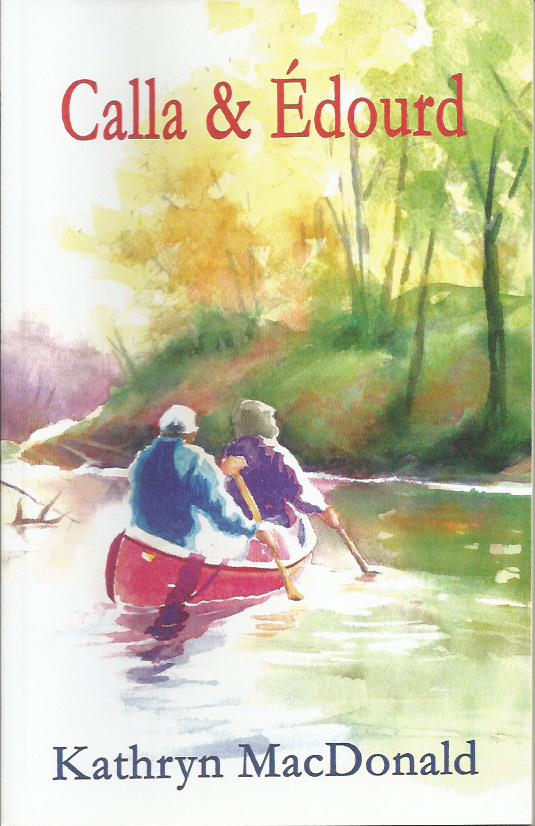
Calla & Édourd cover
Hidden Brook Press (HBP); ISBN 978-1-897475-39-3; 2009

It is a sad day when a book goes out of print. After ten years, this is the fate of my novella, all 23,000+ words, 129 pages.

From readers, Calla & Édourd garnered comments such as, “I was hooked after having read only the preface (as well as the entire book that same evening) [L.S.]. “I could see everything like a movie running through my head” [P.C.]. “I loved the explanation of perfection for Édourd on page 96 and the stories ‘…steeped in the tea of superstition and Catholicism’” [G.M.].

Chapter 1 begins:

Calla moves like a wave, from tree to tree, down the steep incline toward the water’s edge. Her left arm wrapping itself around rough-barked trunks. Her feet, beneath deep snow, searching for secure footing. Downward. Down to a spot where the water bubbles every day of the year from a silent, hidden spring.

Overhead, the sound of squabbling breaks the quiet. Lifting her face to the sky, Calla’s eyes find two black-capped chickadees. They slip from the sky to a tree branch where they hop over each other, reminding Calla of childhood games of leapfrog. The birds move along the branch away from the trunk before flying westward, their voices becoming lost in the distance. The momentary stillness soon fills with the rapid rat-tat-tatting of a downy woodpecker. It circles a birch tree; its head bobbing rhythmically; its black and white feathers blending into the birch. Without the movement, it would seem invisible.

Calla continues carefully downward, testing with her feet for buried rocks and broken branches beneath the snow. Slowly, she moves toward the white-crusted marsh. The red-winged blackbirds, that months ago perched on cattails, had now flown south, leaving the brown expanse of stalks and tails deserted.

The story begins when Calla is in the early throws of dementia. Then the backstory unfolds with innocence and love, the birth of children and their growing up and leaving home. But the unraveling of Calla’s mind cannot be avoided and takes a toll.

If you’re curious about the reference made by G.M. to the “perfection” passage:

Ah, but expectations of perfection was not something that plagued Édourd. He had grown in the shadow of Papa, a man shaped by the realities of the seasons and he knew that perfection came only masked as miracles. Perfection came with dark-bottomed cumulus clouds carrying rain in spring and with a clear dawn during haying season. It presented itself in the shifting colours as goldfinch feathers changed from drab olive to sunshine yellow, also in spring. Similar magic arrived with the return of the mallards, and shortly afterward, the arrival of ducklings in the marsh. Whether a miracle appeared to satisfy survival or to cause his spirit to leap, Édourd welcomed them like he had welcomed Papa’s stories.

In addition to Alistair MacLeod, Evelyn Bowering wrote cover copy: “Drawing their sustenance from past generations, Calla and Édourd’s love endures when traumatic loss gives way to fragmentation of memory, and past, present and future merge into one. MacDonald creates word paintings of nature and domestic life that linger after the last word is read. This is a beautiful story.”

I blush at the praise and thank everyone who bought books and a special thank you to those who sent their thoughts to me.

I am grateful to my publisher, Richard (Tai) Grove, Hidden Brook Press for taking the risk of publishing my first fiction. At that time, Tai was a new publisher and I was largely untried. We’ve both learned a lot in the intervening ten years.

Thank you for indulging my journey down memory lane.

Please share your experiences of publishing your first fiction and your thoughts if your book, like mine, has slipped out of print.


River of Hidden Dreams by Connie May Fowler: Book Review

This island is far more full of life than I had thought. Animals I cannot name are beginning to make themselves known. I hear twigs snap, and cries filter now and again from woods to sky. I wrap up tighter and try to concentrate on Mama and Mima. I think of that day Mr. Sammy decided he had turned old. His sudden despair and Miss Raison’s drowning weren’t the only life-changing events in the forest hideaway that stormy afternoon. Mima conceived my mother in the middle of all that lightning and rain (186-7).

I often buy used books from volunteers staffing “Friends of the Library” shop at the entrance to Belleville’s library. This is where I found River of Hidden Dreams by Connie May Fowler. (Purchases support our public library and often great finds can be made.)

I picked the book up because of the cover – a photograph that I might have been smitten to take – an egret in long, marshy grasses. The narrative, which identifies as fiction, is dedicated to two women who seem very much like two characters in the story. However, the blurb on the dust jacket almost put me off – romance (the romantic, not the historic variety). Nevertheless, I was drawn in.

Fowler’s book reminds me a little of Everything Under by Daisy Johnson, which was shortlisted for the Booker Prize (2018). What the two books share is a boat on a river, water that hides mysteries and danger, and consciousness more surreal than real. Johnson’s story is far more complex and more beautifully executed…and much more surreal and daring. But Fowler’s story was published 24 years earlier. Johnson’s story centres on the intricate relations of a mother and daughter; Fowler’s focuses on a woman’s memories of her mother, grandmother and grandfather who tell their own stories. To my mind, the intervention of Carlos and a mummified baby spoil what might have been a much more interesting tale.

River of Hidden Dreams fought with me (or I with it). I threatened to toss it aside. Then I turned the page again. The orneriness of the grandmother and granddaughter parallel became a bit too much…but then I continued reading. The handsome, perfect, prince-charming Carlos is polar-opposite of his miserable, mean Mamacita/Saidie. Perhaps someone told the author, “you’d better include a love object and sex.” Still, the pages kept turning.

What works: Mr. Sammy, the trawler, the river, the Everglades, and the ancestors speaking their own stories for the eerie, jarring, sensuous impact. Fowler’s descriptions held me enchanted. I slipped into her river-world where time became untethered. The story may have happened last century or last year; it doesn’t matter. I felt its immediacy, its reality in a surreal kind of way.

River of Hidden Dreams by Connie May Fowler has earned my toughest review. Now that it’s written, I’ve checked what others have said…and everyone loved everything about it. Now you might want to read the novel and make up your own mind. Do let me know…please.

71 River of Hidden Dreams

Available through your local bookstore or online: River of Hidden Dreams

(The hardcover is listed for Cdn $248.72 – you may want to visit your library to borrow a copy.)