Bus & Mind Travels (Oaxaca Journal 2002 and The River of Consciousness 2017 by Oliver Sacks)

“[W]e deceive ourselves if we imagine that we can ever be passive, impartial observers. Every perception, every scene, is shaped by us, whether we intend it or know it, or not. We are the directors of the film we are making – but we are its subjects too: every frame, every moment, is us, is ours.”

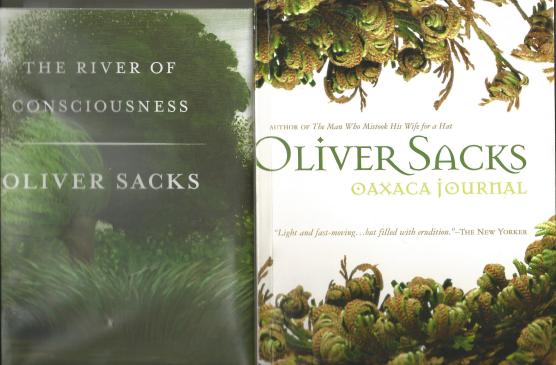
Oaxaca Journal documents physical travel, a trip taken, a journal kept. The River of Consicousness time travels across ideas that are wide-ranging and far-reaching toward an understanding of systems both physical and of the mind. A truly renaissance man, Sacks seems always to be looking simultaneously at details and the big picture of our understanding and of what makes us human, a holistic approach to physical science, neuroscience, creativity, and consciousness.

Oaxaca Journal:

Many of you will know Dr. Oliver Sacks from his book, Awakenings, or the movie starring Robert de Niro and Robin Williams. He was a prolific writer, often writing out of his observations and experiences from his medical practice, but not always.

The first book by Sacks’ that I read, Oaxaca Journal, is an adventure story, detailing his travels with the American Fern Society. The trip was “an introduction to a people, a country, a culture, a history, of which [he] knew almost nothing – this was wonderful, an adventure in itself… .” Sacks was a serious amateur biologist, an enthusiastic traveller, and also a lifelong journal-keeper. He had a keen eye for detail, was exceptionally curious, and he had an ability to weave a tale that keeps readers turning pages. He was anything but “a passive, impartial, observer.” For example, on this trip, he skips a bus tour to sit in the plaza, sees and analyses:

Tourists, pale-faced, awkward, uncouthly dressed, instantly stand out from the graceful indigenes… .
Writing, like this, at a café table, in a sweet outdoor square…this is la dolce vita. It evokes images of Hemingway and Joyce, expatriate writers at tables in Havana and Paris… . I love to write in an open sunny place, the windows admitting every sight and sound and smell of the outside world. I like to write at café tables, where I can see (though at a distance) society before me.

Oaxaca takes us on treacherous bus rides, roadside stops to examine ferns, inside a chocolate factory, and into plazas where children call “Peso, peso… .” We discover with him.


The River of Consciousness

We are also with him as he travels across eras – from Darwin’s ideas about evolution and his garden experiments in biology to the philosophy of the ancients right up to modern science and neuroscience on systems of the body and the mind.

Sacks is a weaver who could create a tapestry from disparate sciences and make sense of them, not just for scientists. One of my favourite chapters in the book is called “The Creative Self,” in which he explores play, mimicry, and imitation. “All of us,” he writes, “to some extent, borrow from others, from the culture around us. Ideas are in the air, and we may appropriate, often without realizing, the phrases and language of the times. We borrow language itself; we did not invent it.” And he also writes of the importance of incubation, “the hugely complex problems performed by an entire hidden, creative self,” often that come to us in the moments just before or just after sleep. And he says of creativity:

…that state when ideas seem to organize themselves into a swift, tightly woven flow, with a feeling of gorgeous clarity and meaning emerging – seems to me physiologically distinctive, and I think that if we had the ability to make fine enough brain images, these would show an unusual and widespread activity with innumerable connections and synchronizations occurring.

This, I suspect, is what the whole book might be about: the “innumerable connections an synchronizations” that occur across disciplines – arts and sciences.

For creative connections, playful curiosity, and a world of original ideas, one of Oliver Sacks’ fourteen books might be exactly where to turn. Oaxaca and The River of Consciousness provide just a glimpse.

26 River of Consciousness-Oaxaca J

Available through your local bookstore or online: Oaxaca Journal and River of Consciousness

Wanderlust (Birds Art Life by Kyo Maclear)

“Day after day we are brave in our persistence”.

Wanderlust can occur at the most inopportune times.

When Kyo Maclear’s responsibilities make demands that keep her near home – her dad’s failing health, the experience of raising two young sons, and other of life’s challenges – she finds a unique way to address a kind of solitude that stymies her creativity.

She happens across a bit of film featuring a musician who has struggled and been lost. Summarizing the clip, she writes:

After years of wallowing in creative depression, he had quit drinking and found peace by birding in the inner city. “I didn’t even have to think about it. I just felt easier. I felt easy-hearted,” he said.

He had discovered his joy was bird-shaped.

….

“I made contact with the musician and arranged to meet him for a bird walk. I wanted to feel enraptured and inspirable.”

And so, a year’s traipsing begins. Slowly, she enters the world of birds, an observer, a thinker. On one of their jaunts, Maclear “follows the musician along the boardwalk to a wooded area of the lake.” She struggles…

to become one with the rock. And then, just like that, [she] settled in. The minutes and hours passed. A trumpeter swan retracted its neck and made a funny trumpet sound. Three tundra swans paddled up and down the shoreline, a reflection of my own inner drift.

She explores within the city’s confines, learning its nooks and crannies, its parks and waterways. Maclear often finds the outings challenging but also deeply rewarding. The musician does not lead her far geographically, but through their birding, she comes to understand some things beyond time and space. The excursions are as much inner journeys for Maclear as they are external, and she begins to find creative ways to express what had been lost to her.

On its surface, this is a small book in which little happens. We are nowhere and everywhere. But volumes happen within a prose that verges on poetry. Maclear’s awarenesses quietly stack upon one another. And this growing insight is sprinkled with bird and other stray facts that add substance for trivia aficionados. One such time, she ponders the name of her city:

As night fell, we stood together at the edge of a city named after the Mohawk word tkaronto meaning “where there are trees standing in water.” I tried to picture the area covered in aspen and poplar forests. Then I went back further and pictured the former shoreline as it would have existed 12,500 years ago, well to the north of where we now stood. I pictured us submerged in glacial lake water.

Throughout the year of bird-watching, Maclear searches to make sense of life in this world. And she becomes fascinated not only with the birds themselves but with the path they led her down. Maclear’s peregrine falcons also nudged a sleeping memory within me.

A few years ago, a peregrine built her nest directly outside my back door on a deck under construction. I couldn’t imagine a more inappropriate site with my constant coming and going. Nonetheless, the peregrines managed, and it was an amazing experience for me to watch the eggs hatch and to witness the dutiful feeding and, eventually, the fledglings’ evacuation.

The peregrines also nudge a memory for Maclear and she goes on a small search:

…I found the navy blue Oxford dictionary [my father] had given me for my seventh birthday. I confirmed the word peregrine means “having a tendency to wander.”

It clearly fit the peregrine falcon, which is known to travel vast distances, but maybe it also fit me and this book I was writing about being a little lost, this book of inward and outward travelling to the verge of life.

Birds Art Life lives up to its title. It is a lyrical and philosophical exploration of nature, love, and anticipated loss with lots and lots of life.

It’s amazing how much travelling can be done within a city’s limits (or your armchair).

25 Birds Art Life

Available through your local bookstore or online: Birds Art Life

Time Travel: Culture Clash (Obasan by Joy Kogawa)

“There is silence that cannot speak.”

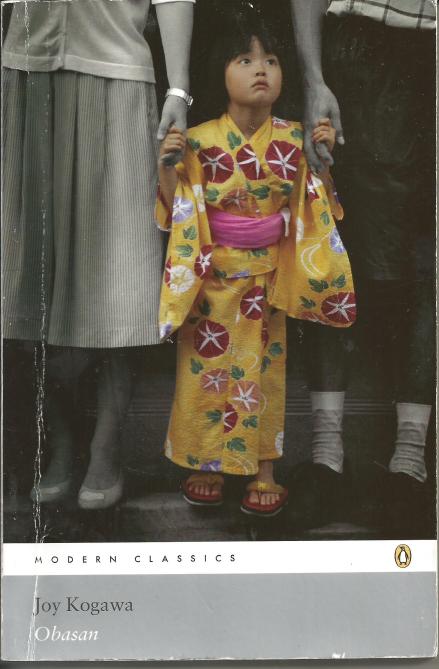
Sometimes we come to a book late. For me, Obasan, published in 1981, is one of those books. It is historically based fiction that reads like memoir – a hybrid, better than either genre. I’m reminded of a line from Yann Martel’s Beatrice and Virgil: “A work of art works because it is true, not because it is real.” Obasan is a work of art, a hard-as-stone story beautifully told.

Through Obasan, I travelled to another time, another culture, another horror of war and misguided political decisions. But Obasan is not a diatribe on political incorrectness; it is an intimate glimpse into people’s lives, love and loss, what was endured. In the end, insight and something that lurks between acceptance and forgiveness, a moving forward.

The narrator, Naomi Nakane, knows that “All our ordinary stories are changed in time, altered as much by the present as the present is shaped by the past.” She struggles to understand her childhood from her adult view and to grasp what it all means now. Her childhood was protected to a great degree, but Aunt Emily’s life was altered, split-away, and she knew the depth of loss and fought it with letters, but to no avail. When Naomi is grown, she receives a package from her aunt. “The fact is,” she thinks, jarred by Aunt Emily’s clippings and notes, “I never got used to it and I cannot, I cannot bear the memory. There are some nightmares from which there is no waking, only deeper and deeper sleep.” Perhaps it is easier to leave the blinders on and to not remember.

Despite the story’s dark theme, Joy Kogawa’s writing is sprinkled with light and lyrical passages. In one passage that particularly touched me, Naomi recalls a walk with her uncle: “The laughter in my arms is quiet as the moon, quiet as snow falling, quiet as the white light from the stars.”

Obasan is an important story: culturally, politically, and artistically. It is a beautifully told story that takes readers into the heart of experience. It neither shies away from, nor dwells upon, the hard historical reality that tore people’s lives apart. Canada’s story, without Obasan, would be incomplete. It is hard to face political wrongs, but they must be faced in order to be whole, complete – for all parties. As Yann Martel wrote in Beatrice and Virgil: “Stories – individual stories, family stories, national stories – are what stitch together the disparate elements of human existence into a coherent whole.”

Please read Obasan and think about the “silence that cannot speak.” Kerri Sakamoto, in the preface to my edition of the book, writes: “It was the authenticity of those words that so shocked me; the distillation of shame and muted fury….In the wake of the Pearl Harbor bombing, families – including my own – were taken from their homes, separated, and interned in camps simply because they looked like the enemy.” These words should haunt us all and make us think of their relevancy today as with others who come to make our country their own.

24 Obasan

Available through your local bookstore or online: Obasan


Post script: for lovers of Japanese-themed stories

Two other “Japanese” books that have survived weeding from my crowded bookshelves that I recommend are Epitaph for a peach by David Mas Masumoto, an American-Japanese story (HarperSanFrancisco, 1995) and Snow by Maxence Fermine, translated by Chris Mulhern (Atria Books/Simon & Schuster, Inc, 1999).

Epitaph for a peach tells the story of an ending in California – the end of the peach farm – by a “third-generation Japanese American farmer [whose] lineage in agriculture dates back centuries. The Masumotos are from a solid peasant stock out of Kumamoto, Japan, rice farmers with not even a hint of samuri blood.” The U.S. experience of Japanese-Americans living on the west coast during WWII differed from the Canadian; there may have been hardship, but not the expulsion nor the confiscating of property.

Snow is a seeker’s story. It takes us on a lyrical search by Yuko through snow-covered mountains to find enlightenment…colour…and it is also an exquisitely told love story. If you like haiku, its simplicity and complexity, you will like Snow.

On my “to read” list: The Tale of Genji by Murasaki Shikibu. According to Martin Puchner (The Written Word), Murasaki’s “epic novel, The Tale of Genji, became a foundational text that influenced Japanese aesthetics for centuries to come.” Written about 1,000 years ago by an 11th century Japanese lady-in-waiting, The Tale of Genji is a story Puchner compares to the Iliad and The Epic of Gilgamesh. Puchner says, “Murasaki’s diary felt to me like a turning point in the history of literature—it sounds so recognizable, so intimate, so modern.”

“The fact that someone living in an extremely different time, halfway around the world, a thousand years ago, could whisper in my ear in that way—it’s magical. That experience is part of what draws me to world literature in general, a reminder of the power writing has to transport a voice across time and space.” (Quotes from a January 23, 2018 article by Joe Fassler, “The Technology Shift Behind the World’s First Novel, The Atlantic online.)


The Art of Growing Up (The Great & the Small written and illustrated by A. T. Balsara)

“It’s the story of us. When I read history, I feel connected to people who lived ages ago. I think it’s because for them it wasn’t history. It was life. Just like ours is to us.”

Reminiscent of Ken Oppel’s Sunwing – a story of bats and their misuse in World War II research – A. T. Balsara’s The Great and the Small also features a laboratory, but in this story the misuse is imposed on rats. Neither bats nor rats are puppies or ponies – both are unlikely heroes to the human population – but in the end our empathy is swayed. In part this is accomplished through the whimsical illustrations that run through the text.

Balsara’s storyline develops in a city market and the tunnels running beneath it, and occasionally the setting shifts to a nearby suburban neighbourhood where humans live and the laboratory exists. The underworld of the city is populated by a colony of rats under the thumb of their leader, the “Beloved Chairman,” who convinces them to spread the bubonic plague anew in retaliation for the cruel treatment of rats caught among market stalls. His curious nephew, Fin, develops doubts about the plan and literally falls into a relationship with a young girl named Ananda. She happens to be bullied at school and she’s the daughter of the laboratory researcher. So the stage is set for adventure, a ratty love story, and rebellion.

This book challenges the usual categories with respect to target audience. In some ways it reminds of Sunwing, and it would appeal to middle grade youth. Books for these readers usually feature adolescent protagonists who face their first big choices. There’s a metaphorical dragon to be slain. As challenges are met, they grow in self-acceptance, confidence and wisdom. As they leave childhood behind, they discover how the larger, unknown world works and find ways to understand the human condition. Since these stories are written to elicit empathy of readers for the protagonists, readers usually learn (if only vicariously) about making choices and succeeding against the odds, and they learn important life-lessons. The Great & the Small reveals Ananda’s responses to bullying and idealism, and it also leads to her self-acceptance and more responsible confidence and actions. Elements of the story appeal to the developmental stage of adolescents.

In other ways, this book suits the young adult (YA) category of readers where the problems faced by protagonists are more complex and often enter challenging areas (such as death) and sexual/love explorations, although Balsara delves more deeply into the former. This is also the developmental stage where youth begin to form logical systems and hypotheses, explore abstract ideas, and focus on possibilities rather than realities. In large part, the story runs along a dual plotline: rat Fin’s for peace and Ananda’s for rebellion against cruelty to the rats.  Balsara prefaces chapters with vivid quotes from Stalin’s rule and from the era of the14th century plague.  These sombre quotations introduce another element requiring developmental maturity. However, the numerous, finely wrought illustrations counterbalance the dark quotes.  The Great & the Small bridges the abilities of both middle and YA readers.

In a radio interview, Balsara said The Great & the Small shares messages of  hope, resilience, and perseverance with young people. Its theme – good vs. evil – pits blind obedience against rebellion. And, she suggested she wants to remind readers about dark periods of history from which we can learn.

Balsara has written an ambitious book in which she combines issues relevant to young readers within the larger context of history, a history of cruelty and blind obedience, in which few rebel. From time-to-time, the “lesson” she advances feels too didactic for my taste, but that aside, she has created a moving and heartfelt story in which a young girl stands up for what she believes and a rat who eventually recognizes a painful truth and grows up.

23 The Great and the Small

FYI: Book trailer

Available through your local bookstore or online: The Great & the Small

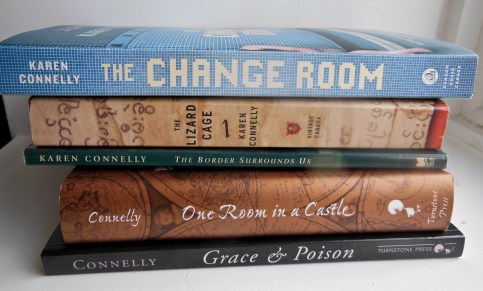
Journeys: a Writer’s (incomplete) Oeuvre (Prose: One Room in a Castle 1995; The Lizard Cage 2005; Burmese Lessons 2009; The Change Room 2017. Poetry: The Border Surrounds Us 2000; and Grace & Poison 1990 by Karen Connelly)

I know this. Our lives begin and end with journeys made alone.
“The Lid Over Europe” (100-101), One Room in a Castle

Karen Connelly makes many journeys. Travel introduces us to strangers and both her poems and prose reveal ways of understanding the other and experiencing ourselves.

In her 2017 novel, The Change Room, she notes two paths toward knowing: listening and storytelling. “Listening,” she writes, “was a way of pulling a stranger toward you without touching.” And so is storytelling: Shar or Shaharzad or Sheherazade – the great storyteller of One Thousand and One Nights – is the siren of enticement in The Change Room and the sensual “amazon” of the story. Listening and storytelling, strangers and borders, are common themes in Connelly’s oeuvre.

Writers’ recurrent themes interest me. I like their unfolding like fans, and their closing tight. I like the way they spread across continents and genres – always surprising, maturing, shifting but remaining, in important ways, the same. In Karen Connelly’s writing, the travellers and lovers among us glimpse ways of knowing ourselves and the other. This holds true from her earliest stories to the most recent novel.

In Connelly’s stories, strangers often become intimate in a variety of ways, sensuality being one. In “Esmeralda, a story” (One Room in a Castle 36-67), readers glimpse insights into what has matured into the novel The Change Room.

From Castle: “Our greatest similarity was our love of water, the freedom of motion it creates. ‘It’s flying,’ Esmé said. ‘It’s the closest we’ll come to being free of our bodies.’ We began to meet in the change-room before swimming….” Esmé swims; she is also a musician. Music, like water, is freeing and sensuous: “She closed her eyes, bent herself over the piano, and laid her hands on its black surface…. Then I leaned forward and kissed her eyelids.” These themes sown in Castle dominate in Room.

In The Change Room, the writing is more complex, layered and mature, but in the early work, we glimpsed seeds that later became mature fruit. (For more on recurring themes of individual writers, please also see my review of Bicycle Thieves by Mary di Michele.)

Connelly writes across genres, which leads me to think about truth in nonfiction and fiction. One Room in a Castle, for example, was published as nonfiction – purportedly as correspondence and travel. The Change Room – 22 years later — as fiction. It begins with an Emily Dickinson quote:

“Ourself, behind ourself, concealed,
should startle most.”

And we are left wondering about the difference between reality and imagination – a conundrum for writers and readers. Connelly does provide hints. For example, in “Extrah-dinary” (Castle 33-35) she writes “It is difficult to get to the truth of one’s self; how much more difficult to create an imaginary world and reveal its truth.” Still…. (For more on this topic of fact and truth, please see my review of Beatrice and Virgil by Yann Martel.)

I was introduced to Connelly’s writing through a book club reading of her mid-1990s memoir, Burmese Lessons, which still pops into consciousness despite the time lapse. But it’s the poetry collection, The Border Surrounds Us, which remains my favourite – especially section II – which I’ve read over-and-over again.  It is only recently that I discovered Grace & Poison, a compilation of Connelly’s first two poetry books. Even in 1990 her themes were clear and her voice strong. From that collection, a prose poem – “A Story for Suradev, In Bangkok” – stands out. In it we find her mature themes of intimacy/compassion, strangers/self. The closeness of her observations stand stark.

Her passion for travel and imagining the experiences of those she meets into story is continuous. Perhaps Connelly’s most intense book is The Lizard Cage, published in 2005, which drew me back to Burmese Lessons. Burmese Lessons is essentially a love story/a political story. The Lizard Cage is darker, taking readers inside a Burmese prison and into the isolation of an ancient man and a small boy, cruelty beyond comprehension, love, and survival. Somehow Connelly manages to maintain dignity, love, compassion, and beauty.

Karen Connelly began her writing career with the idea of borders, journeys from the known into the unknown: “Our lives begin and end with journeys made alone,” she wrote in her early twenties. In between life’s bookends, many other journeys are made and borders crossed: some geographic and cultural; some social and political; most intimate and sensual. They are all crossed personally, alone, and usually with risk of one sort or another. The intimacy with which she crosses borders can challenge us; she touches the heart, the soul, and the body.

22 Connelly Bks LR (1 of 1)

Various publishers have put Karen Connelly’s writing into print. Search her name or the name of one of her books and that will take you to a source. Most are available through your local bookstore or online.

Existential Travel (Beatrice and Virgil by Yann Martel)

“…we thrive or wither depending on how nourishing our environment is.”

The environment of Beatrice and Virgil is anything but nourishing. The landscape is bleak. For the most part, two characters hover around a tree in barren space.

Panned by Michiko Kakutani in the New York Times, I found Yann Martel’s story haunting. It slips into waking moments and has entered my dreams, which is a bit unnerving but says volumes about the power of the story.

Reminiscent of Samuel Beckett’s Waiting for Godot: there’s neither plot nor action to speak of. But unlike Beckett, Martel’s characters are animals, not tramps – the donkey Beatrice and the howler monkey Virgil. Martel also alludes to Animal Farm among other literary references. Perhaps, too, he’s evoking the dark side of his very successful Life of Pi. Yet another aspect toward understanding Beatrice and Virgil is the obvious allusion to Dante’s Inferno wherein Virgil guides Dante through hell and Beatrice accompanies him through Paradise. However, in this story Paradise is absent. Yet, there’s still one more curve: he’s explicit about the Holocaust, making this story an allegory.

Martel is a philosopher and a writer. As he did with Life of Pi, Martel frames his story, creating a story-within-a-story. In the beginning, his protagonist philosophizes: “A work of art works because it is true, not because it is real.” This fictional author proposes two stories to his publisher, each with a front cover, a “flip book.” One side would feature an imaginative novel about the Holocaust, while the other side would provide a factual essay. Readers would have “a choice…when dealing with upsetting matters.” Hold the book one way: creativity; the other: historical fact. Given the subject, the publisher wants only nonfiction. Henry makes a ploy for including the creative story:

Fiction, being closer to the full experience of life, should take precedence over nonfiction. Stories—individual stories, family stories, national stories—are what stitch together the disparate elements of human existence into a coherent whole. We are story animals.

Henry continues to argue for the flip book idea: “But behind serious nonfiction lies the same fact and preoccupation as behind fiction—of being human and what it means—so why should the essay be slotted as an afterword?” He wants two perspectives and two front covers. He loses the argument and slips into writer’s block. Then we get into the longer middle story—the creative interpretation.

An amateur playwright (also called Henry) becomes the antagonist; the setting is his taxidermy shop where he practices his craft and displays dead animals, many in diorama, including the donkey Beatrice and the howler monkey Virgil. Taxidermist Henry has asked author Henry for his help in writing a play and the writer Henry visits and listens to excerpts read by the tall, gruesome taxidermist. It is not a happy experience, yet he’s drawn to the man, his shop, and the “conversation” between Beatrice and Virgil as excerpts from the script are read to him. Their situation is stark and as gruesome as their creator. Near the novel’s end, the author Henry reflects: “Once you’ve been struck by violence, you acquire companions that never leave you entirely: Suspicion, Fear, Anxiety, Despair, Joylessness.”

After more horror and some healing, author Henry muses about the donkey and the monkey and what his lingering memories mean: “All that remained now was their story, that incomplete story of waiting and fearing and hoping and talking. A love story, Henry concluded.”

A bleak love story, but should we ever be faced with the dystopian reality of Beatrice and Virgil, we could hope for the kind of love they shared.

Beatrice and Virgil is not a story for everyone, but for those who like puzzles and allegories and the “theatre of the absurd,” I recommend Martel’s book to you.

21 Beatrice & Virgil

Available through your local bookstore or online: Beatrice and Virgil

Travel Madness (Congo Journey by Redmond O’Hanlon)

“The Western Bantu word for hero comes from the verb meaning to enter oblivion, to be lost, to become a spirit.”

If these are the terms and conditions for becoming a hero, then Redmond O’Hanlon is a hero: he enters oblivion; he becomes lost; and enters dark places of the spirit. O’Hanlon is a traveller, a student of natural history, and a serious risk-taker. In Congo Journey, O’Hanlon searches for a mythical dinosaur – Mokélé-mbembé – that is believed to live in Lake Télé deep in the equatorial swamps and forests of the northern Congo.

The story opens with a visit to a féticheuse who tosses a handful of cowrie shells and forewarns O’Hanlon’s traveling companion – American university professor Lary Shaffer – that he will die if he remains in the Congo for a day more than two months. To O’Hanlon she says, “You don’t speak your desires. You think them.”  It seems observation, complaint, and foretelling. The mood and tone are set for increasingly surreal and nightmarish experiences. At times, I wondered if the book actually relates a traveler’s tale or if it is pure fiction.

O’Hanlon has credentials: as a travel writer and as a naturalist. He did a doctorate at Oxford on Conrad and Darwin, and it is clear that in key ways he’s caught in the era of British exploration. The Guardian calls O’Hanlon a “legendary bonhomie.” He is a throwback, entering the unknown – not as an observer – but as a full participant, an informed participant. The party paddles through rivers, trudges along barely discernable pathways, and take refuge in villages right out of a bygone era. Scattered among these harrowing experiences are fascinating details about the birds that enamour him as:

I was woken at dawn by a loud and discordant chorus of alarm, the ka-ka-ka of a flock of Plumed guineafowl disturbed at their scratching through the leaf-litter, somewhere off to the left. You’re ancient birds, I thought, and you sound like it, you cackling old aunts in a tizzy, you fossils, you date from forty-five million years ago.

One book close by in his pocket is Birds of Tropical West Africa that we learn grows mouldy and mottled (but O’Hanlon provides an extensive bibliography, more than seven pages long.)

Redmond O’Hanlon made an extraordinary journey that took him to his destination. It simultaneously carried him deep within himself, testing him on the deepest levels. All this is shared with bluntness and honesty, blindness and seer-like vision. Readers gain more than glimpses into a man’s determination, more than knowledge about the natural history of the Congo, and more than a superficial snapshot of the people who inhabit the swamps, jungles, and villages. (Speaking of snapshots, Congo Journey includes a section of photographs.)

Highly recommended…especially for armchair travelers who want more than the common gloss of travel articles, and for those dreaming of such an adventure, Congo Journey will inform and also make you stop and think.

20 Congo Journey

Available through your local bookstore or online: Congo Journey

A Young Life: without sentimentality or cynicism (Notes from the Hyena’s Belly by Nega Mezlekia)

“I was born in the year of the paradox, in the labyrinthine city of Jijiga. After a three-year absence, the rains had come, swelling the rivers and streams. The clay desert, as dry as the skin of a drum, became green once more. Queen Menen, wife of King Haile Selassie, lay dying. She was as reluctant to leave this world as I was to leave the womb.”

Nega Mezlekia tells a tale that spell-binds, and he does it with dark humour – an extraordinary feat for the story of Ethiopia’s coup and counter-coup history. The first paragraph sets a tone Mezlekia maintains. In Notes from the Hyena’s Belly we journey into a child’s world of paradox, a world in which innocence and awareness, love and cruelty co-mingle. We glimpse the roots that nourish a precocious, curious and stubbornly confident boy as well as the socio-economic-political reality of Ethiopia – accomplished with lightness (even through life-threatening situations). Mezlekia shows us how deep this complex duality runs: “In Ethiopia,” he writes, “poetry is second only to the achievements of kings. Poets are sought after and treated with great reverence by the ruling class. …The most popular form of poetry, known as the kinae, offers one message to the untrained ear and another to cultured listeners.” Notes carries on the tradition.

Mezlekia is a skilled, insightful poetic writer, one who has mastered nuance and the twist that both informs and surprises. His language and rhythm, his lack of sentimentality and cynicism carry us through Ethiopia’s sad history as we keep turning pages. Mezlekia provides insight into his journey from boyhood shenanigans into manhood within a revolutionary and war-torn context. He has written a powerful story of lost innocence and of survival.

Notes from the Hyena’s Belly goes beyond the personal story; it offers insight into what it is to be human, a connection and an awakening for each reader. On the one hand, this biography is specific to Mezlekia, but it also tells a story that is far too common across the post-colonial African continent and, I’m afraid, even beyond. We can draw parallels to what is happening in the world today.

Given the skilful writing and master storytelling, it is little wonder that Notes from the Hyena’s Belly: An Ethiopian Boyhood won Canada’s prestigious Governor General’s award for literature (2000). (It was published in the U.S. simply as Notes from the Hyena’s Belly.) Highly recommended.

19 Notes From the Hyena's Belly

Available through your local bookstore or online: Notes From the Hyena’s Belly

Of Mothers and Daughters (Tamarind Mem by Anita Rau Badami

“I called my mother every Sunday from the silence of my basement apartment, reluctant to tell her how I yearned to get away from this freezing cold city where even the traffic sounds were muffled by the snow.”

The novel opens with this bit of narrative. Kamini is studying in Calgary (what her mother, still in India, calls “that Calgary North Pole place”), but most of the story unfolds in India, beginning when Kamini is only six years old.

Tamarind Mem (published in the U.S. as Tamarind Woman) is the first of four novels by Anita Rau Badami. The novel languished on my bedside table for a very long time, always being resorted to the bottom of an ever-changing pile of books. Then, I picked it up and didn’t put it down until immersion into a life I can barely imagine was sated. It is the story of women, of mothers and daughters and all the complexities those relationships hold (and bury). It’s a story of horoscopes (iffy ones) and memories (steeped like tea). Our protagonist Kamini says,

I was never sure about Ma’s feelings for me. Her love, I felt sometimes, was like the waves in the sea, the ebb and flow left me reaching out hungrily. A love as uncertain as the year that I was born, when the Chinese had marched across the border into India making a mockery of the slogan “Hindu-Chinee brothers-brothers.” That year the price of rice shot up, a grim famine swept across the north, and nothing was the same again.

Not a great beginning for a girl-child.

Like The Painter of Birds by Lídia Jorge and Birds of Passage by Robert Solé (both previously reviewed), Tamarind Mem is a family saga, although somewhat smaller in its reach. These three novels explore place (Portugal, Egypt, and India) and movement away (migration). They are also stories that seek understanding about a character’s place in the family.

Badami probes memory and cultural heritage – and the experiences and values conflict from time-to-time in the mother-daughter narrative. The women, often at odds, are joined by love, stubbornness, and folly too. Men are scarce: Kamini’s father is a “railroad man” who travels all over India and who is seldom home and there’s also the auto mechanic. The men come and go, leaving bits behind. The father leaves a railroad pass after his death. On it, Kamini’s mother, Saroja, travels across India, retracing her husband’s path. Kamini travels to Calgary to study, her sister, Roopa, marries and moves to Toronto; an old nursemaid Linda Ayah and extended family of aunties are left behind.

This is a book blessed with many reviews. What new can I offer? Little…except to pose the question: what is the value in reading any novel? For me, magic lies in the flow of words, of how each story unfolds. I want my curiosity satisfied, to learn a fact and to gain an insight. The story need not to be “hot off the press,” to borrow a cliché, or on any “10 best” list. It needs to show me something I didn’t know I needed to see, needed to understand. Tamarind Mem provides a glimpse into a distant world, migration, the conflict of generations and of cultures, the universally felt experience of mother-daughter impatience, misunderstandings, and love. This story is sensitively and beautifully told, a first novel worthy of a read.

Available through your local bookstore or online: Tamarind Mem

18 Tamarind Mem

Grief’s Response (After You’ve Gone by Jeffrey Lent)

“If love had a language, he’d realized it would be this, not words or gestures but the mellifluous richness he’d heard that summer evening, anchored between the pair of violins and the bass. The musician seated with his cello tucked between his knees, bent in concentration and intensity of focus that swept and fled, stroked and drew upon man, instrument and bow.”

Thirteen years separate the publication of After You’ve Gone and Doris Lessing’s Love, Again. Surely other novels exist about the discovery of love in later life, but these are  two that stand out for me. When Doris Lessing’s book came out in 1996, it seemed bold. Told in the voice of a sixty-five year old woman who didn’t imagine loving again but who became swept up in not one but two affairs of the heart, the story suggested hope and insight for baby-boomers heading into the seniors’ curve. Recently, I came across Jeffrey Lent’s novel told from a male perspective.

Henry Dorn’s son (Robert) and wife (Olivia) die in a car crash. He is bereft. His two grown daughters (Alice and Polly) try to comfort him but they have their own families and cannot fill the void in his heart. He begins a quest, first travelling to his birth-home in Nova Scotia seeking answers to family questions; then back in New York, he takes a steamer to Amsterdam hoping to discover older Dorn roots and to start life anew. He is lost in the way Rebecca Solnit describes in A Field Guide to Getting Lost: “Love, wisdom, grace, inspiration—how do you go about finding these things that are in some ways about extending the boundaries of the self into unknown territory, about becoming someone else?” In her book, Solnit explores the question philosophically. In After You’ve Gone, Lent explores it through fiction.

Ultimately, like Love, Again, After You’ve Gone is a later-life love story that plunges into deep waters where discoveries of the self are made. His journey is poignant. There’s the emotional journey of the first year:

The worst moment has not been the anniversary of the deaths, which was a peculiarly quiet afternoon of gentle spring rain, the day so long anticipated that its arrival brought no sudden thrust of grief but rather was almost consolation—in that year he’d passed all number of possible anniversaries that were unmarked and this was another he was helpless against, and the world went on raining….Ten days later he disembarked at Penn Station and porter and trunks in tow hailed a cab and set off for the pier and the Veendam II.

That first year slips by quickly enough. It’s aboard the steamer that he spots Lydia Pearce and where renewal begins:

A woman in the tight knee-length and sleeveless calisthenics outfit suddenly came upon him, loping in a steady slapping of bare feet….She glanced at him as she passed but the glance was empty as if she were looking toward some far distance greater even than the horizon. He…watched her go.

You know where this is going (and it does lead there). While love affairs are as old as the novel itself, Lent avoids clichéd traps. He gives us a beautiful read with a few twists and surprises. This is not a novel for the bereft alone, it offers insight and perhaps even wisdom for each of us into the very human ways of the heart.

17 After You've Gone

Available through your local bookstore or online: After You’ve Gone