Eclectic Reader: Read like a writer

A Crash Course in Molotov Cocktails by Halyna Kruk: Book Review / a teaser

Books have collected in piles and so I’m going to post a few “not quite” book reviews, call them teasers. They are about books that I want to share and that I hope will pique your interest so that you check them out at the library or nearest bookstore.

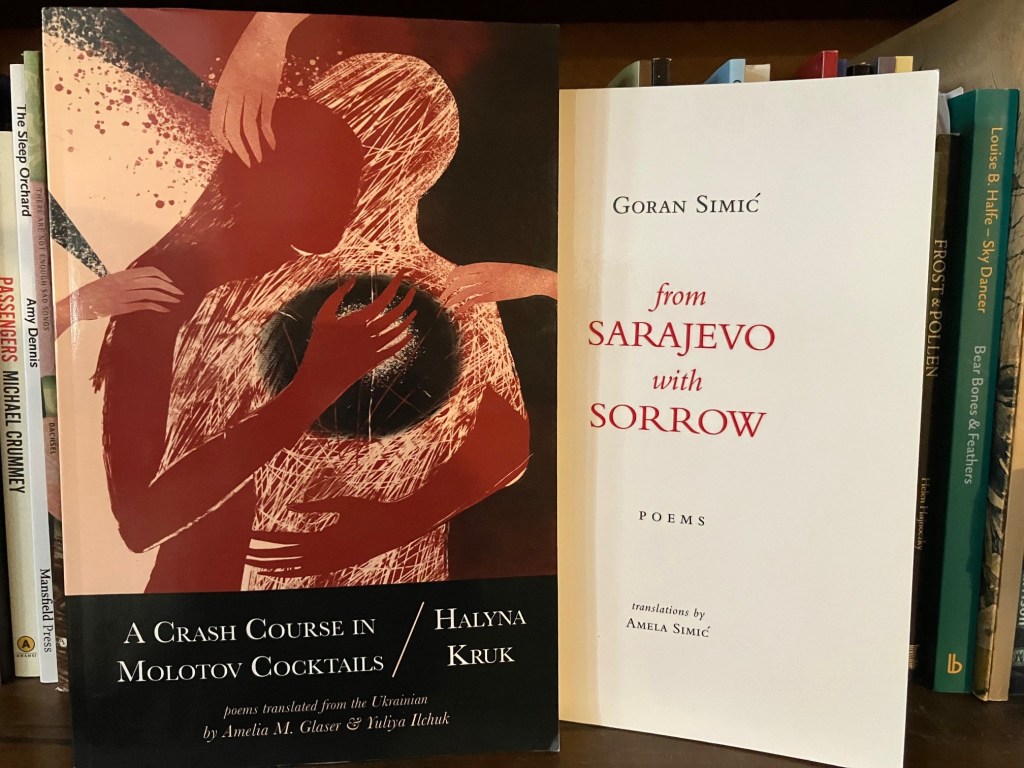
A Crash Course in Molotov Cocktails by Halyna Kruk (trans. by Amelia M. Glaser & Yuliya Ilchuck) – shortlisted for the Griffin Poetry Prize

From Sarajevo with Sorrow by Goran Simić (trans. by Amela Simić)

Halyna Kruk’s book is new and currently shortlisted for the Griffin Poetry Prize, it reminded me of Goram Simić’s collection that I have read and reread many times. They each offer accessibility and insight on the horror of war, Kruk’s Ukraine and Simić’s Bosnia.

In a poem titled “war,” Kruk writes: “… a human walks in the woods like an echo, / lost in thought, distracted // some bullet moves with its own trajectory, let loose / in a right or left hemisphere. somebody’s. the earth’s.” In another poem titled “we act like children with our dead,” Kruk writes, “… as if none of us knew until now / how easy it is to die / everyone still hopes they’ll lie there for a while and rise again ….”

In the introduction, Kruk is quoted as saying that her“poems have changed since the outbreak of war.” She says they no long pay attention to “form and style, now my poems are almost entirely focused on content — they document the reality of war, literally, emotionally, and sensually….” They are intense. I can read only three or four at a time. They are beautiful. They are horrific. And something about them made me go to my bookshelves and take Goram Simić’s Sarajevo collection down to read alongside Kruk’s poems.

Simić says of his poems: “In Sarajevo hell I wrote these poems as epitaph and testimony.” One poem I always search for among the many “flags” stuck to the pages of his book is “Love Story.” It describes a scene on a bridge that seems to me more chilling than the rest. I quote from that poem in a book review that I previously posted. You can read it here.

Available through your local bookstore or online:

A Crash Course in Molotov Cocktails by Halyna Kruk, trans. by Amerlia M. Glaser & Yuliya Ilchuk (Arrowsmith Press, 2023), ISBN: 9798986340197.

From Sarajevo with Sorrow by Goran Simić, trans. by Amela Simić (Biblioasis, 2005), ISBN: 978-0-9735971-5-8.

UPDATE: I’ve just come across this Youtube post: Amelia M. Glaser, Yuliya Ilchuk, and Halyna Kruk interviewed by Griffin Trustee Aleš Šteger. You can view it here.

Books & Poems Published

Books

  • Liminal Spaces (a collaborative ekphrastic chapbook, Glentula Press, 2025)
  • Far Side of the Shadow Moon: Enchantments (chapbook, Glentula Press, 2024)
  • A Breeze You Whisper: Poems (HBP/Hidden Brook Press, 2011). Review excerpt: please see here.
  • Calla & Édourd: Fiction. For an excerpt, please see here. (HBP/Hidden Brook Press, 2009)
  • The Farm & City Cookbook: Essays and recipes co-authored with Mary Lou Morgan. (Second Story Press, 1995)


FORTHCOMING:

  • “On that Forbidden Evening,” “Willow Dream,” and Albinoni’s Adagio,” Live Encounters, forthcoming November-December 2025
  • “Yellow Pottery,” Pinhole Poetry, forthcoming Winter 2026
  • “Wild Horses,” The High Window Press, forthcoming Spring, 2026
  • “Weathering Water-Wave Theory,” Consilience Journal, Columbia University, forthcoming Fall, 2025 — The editors wrote: “Our reviewers enjoyed reading your poem, which highlights moments when opposing forces come together—whether in nature or within ourselves. We also admired the choice of words, the use of enjambment and punctuation, and the masterful use of meter.”
  • “Detroit River Jazz,” “Of Wine & Fire,” “The Sky and the River,” “April 7” have been accepted for the anthology Kinds of Cool: A Collection of Jazz Poetry, Fall 2025
  • “Flâneuse” has been accepted for the anthology Canadian Poets on Music” published by Syncopation, January 2026
  • “Unmarked: A Lament for the Children Buried in the Unmarked Graves of Residential Schools,” Strong Hands Stop Violence poetry anthology, ONWA,Vol. 9


PUBLISHED:

  • “Weathering Water-Wave Theory,” Consilience Journal, Columbia University, (2025-09-22)
  • “Desire,” Spillwords (2025-09-07)
  • “I Could Melt,” Spillwords (2025-03-27)
  • “Blue without a Name,” Spillwords (2024-12-12)
  • “Yellow,” The High Window (Winter 2024)
  • “Actias Luna,” Uproar, Lawrence House Centre for the Arts (2024-11-18)
  • “Awakening” and “Turning,” Hill Spirits VI (2024-ISBN 978-1-998494-07-1)
  • “Cordivae,” and “Yellow: of Horses and Flowers,” Pinhole Poetry (Desire theme, July 2024)
  • “Wild Place,” Juniper (Vol. 8, Issue 1; Summer 2024)
  • “A Half-Golden-Inch,” Jerry Jazz Musician Poetry Collection (Spring-Summer 2024)
  • “Charlie Parker Plays Embraceable You” and “N NE E SE S SW W NW,” Synaeresis: Arts + Poetry, XXIV (June 2024)
  • “Moontreader,” “Follow Birds & Dreamers,” “Of Sages & Seas & Butterfly Wings,” Lothlorien Poetry Journal: Free Spirits, Volume 31 (Print, Spring 2024).
  • “The River Sings a Clear, Deep Song,” Humana Obscura (Spring 2024: print edition on Amazon & digital, page 95).
  • “The Mallard and the Crow” and “The Candle,” The High Window (Poetry, Spring 2024).
  • “Nostalgia,” Jerry Jazz Musician (January 2024).
  • “Moontreader,” “Follow Birds & Dreamers,” “Of Sages & Seas & Butterfly Wings,” Lothlorien Poetry Blog (December 2023) and included in the anthology, Lothlorien Poetry Journal: Free Spirits, Volume 31 (Print, Spring 2024).
  • “Lapedo Child,” and “Love Your Hat,” Stones Beneath the Surface: a poetry anthology (Black Mallard Poetry, November 2023, pp 108-111).
  • “On the Edge,” Dust Poetry Magazine (2023-10-28).
  • “She Sings Only at Twilight,” “Company of Wayfarers,” “A Blizzard Blows,” “Phantasm,” and “Beloved,” Lothlorien Poetry Journal Volume 28 (print and online) Sept. 30, 2023).
  • “Musical Invocation” poem profiled and read/recorded, Jerry Jazz Musician (September 2023).
  • “Foraging,” Pinhole Poetry 2.2, July 2023. 
  • “Beneath the Horse’s Hooves,” Room Literary Magazine, Spring 2023
  • “Skydancing” and “Legacies,” Live Encounters Poetry & Writing May 2023 (p 120-123)
  • “E/mergence,” Juniper, Fall 2022
  • “Sing Praises,” “Slant,” “The Shedding,” Hill Spirits V, Blue Denim Press, 2022
  • “Words are Wet,” “Rainfall,” The Story of Water – 3rd Annual Earth Day eChapbook, April 22 2022
  • “Night Flyer,” “Luna Cat,” Framed & Familiar: 101 Portraits, Wet Ink Books, July 11, 2022
  • “Not an Edward Hopper Painting,” Jerry Jazz Musician (U.S.) Summer 2022 
  • “Don’t Ask this of Me,” “Passage Dreaming,” Jerry Jazz Musician, Winter 2021
  • “Kenya: at the end of the day,” Orbis: Quarterly International Literary Journal (England) #198, Winter 2021
  • “Making Soup,” “Quarantine Wishes,” Our Pandemic Times, Blue Denim Press, 2021
  • “Duty/Deon,” won Arc’s Awesomeness prize, January 2021
  • “Miles Davis Plays: ‘Blue in Green,’” “The Spaces Between: Miles Davis,” Jerry Jazz Musician, May 27 2021
  • “Apparitions,” Devour: Art & Lit Canada, #11, Summer 2021
  • “Willy Nelson Sings Stardust,” “Undersong,” The High Window (England) #23, August 2021
  • “Miles Davis Plays ‘Blue in Green,’” Jerry Jazz Musician (U.S.) Summer 2021
  • “A Dry July,” Amethyst Review (U.S.)
  • “Wild Plums,” Amethyst Review (U.S.)
  • “Of Hunger & Fire,” Amethyst Review (U.S.)
  • “Shadows,” Spirit of the Hills (arts organization) website, November 2020.
  • “Quarantine Wishes,” Between Festivals: A Journal in Time of Pandemic and Lockdown, November 27 2020 
  • “City of Tulum,” Orbis: Quarterly International Literary Journal (England) #191, Spring 2020
  • “10 Panku,” Devour: Special International Edition (58-59) #5 April 2020
  • “Dockside,” “The Failed Search,” The Beauty of Being Elsewhere, anthology ed. by John B. Lee, (Brighton: Hidden Brook Press, 2020
  • “Tartan Lament,” Crossways Literary Magazine (Ireland), #10 June 2020
  • “Seduction,” Freefall, Fall 2020 (shortlisted for Freefall Annual Poetry Contest), ed. by Gary Barwin
  • “The Doves Seem to Croon Tippy Canoe Tippy Canoe,” “Making Soup,” Between Festivals: A Journal in Time of Pandemic and Lockdown, Summer 2020
  • “Honey Light,” Amethyst Review, August 2020 
  • “Daddy,” Devour: Art & Lit Canada, ed. by Bruce Kauffman, #8, Summer 2020, p91
  • “Alone,” “Song,” Jerry Jazz Musician, December 16, 2020 
  • “The Swing,” Jerry Jazz Musician, December 28, 2020
  • “Choreography,” Amethyst Review, 2019-09-24
  • “Past Midnight,” Amethyst Review, 2019-08-29
  • “Casting Off,” Devour: Art & Lit Canada (Issue 03, p. 42).
  • “Journey,” “Ashes,” This Wine into Water, a chapbook anthology (Forward by Lorna Crozier, Wintergreen Studios Press, December 2018.)
  • Earlier writing was published in literary journals including the Fiddlehead (#130 Summer 1981) Descant (#32-33 1981) and Northward Journal (#20 June 1981) as well as anthologies such as The Wisdom of Old Souls (2008), Grandmothers Necklace (2010), Close to Quitting Time (2011). (Some early poems published as Kathryn Deneau.)


Beowulf: an illustrated edition, translated by Seamus Heaney: Book Review

I had a fixed purpose when I put to sea (line 632).

This post is more impression and thoughts about translation than it is book review. Beowulf – we likely read it at some point during our education – Anglo Saxon / Old English and all that. Seamus Heaney gives us a “modern” translation and it is beautiful to read, vivid, alive. I’m afraid that I won’t do either Beowulf or Seamus Heaney justice, although I loved the book and read cover-to-cover (3182 poetic lines / 260 pages of text and illustration) in only three sittings (and then read it again, and then skimmed it this morning). What I really love even more than the poem is Heaney’s introduction.

Although written by an early English Christian between the middle 7th and the 10th century (about 1,500 years ago) the action took place (if it actually took place) before the arrival of the Anglo Saxons and it wasn’t even an “English” story. The oral story took place during the pagan period before the King Author legends that we’re familiar with through various books and films.

Beowulf, the poem, describes the life of a Nordic prince, a warrior, an honourable man who fights monsters and a dragon. It is the re-telling of an heroic narrative that seems to have taken place in what we know as Scandinavia. It’s important book, Beowulf being the first written in English and is, therefore, historically significant. The original is kept in the British Library. But besides being the first, Heaney calls Beowulf, “a work of great imaginative vitality.” (An aside: J.R.R. Tolkien also translated Beowulf, and the poem’s influence can be seen in Tolkien’s writing.)

Heaney tells us the context of Beowulf is within “a pagan Germanic society governed by a heroic code of …conduct….” He says, “the poem possesses a mythic potency” (ix). I wished, as I was reading the book, to see a copy without the Christian overlay, see it as the bards of old might have told the tale.

One thing that clung to me as I read the epic, was Heaney’s introduction that reflects on the experience of translating (which took Heaney 35 years from the initial contract – he put it aside for long periods). Heaney writes: “I noticed that without any conscious intent on my part certain lines in the first poem in my first book conformed to the requirements of Anglo-Saxon metrics. These poems were made up of two balancing halves, each half containing two stressed syllables – the spade sinks     into gravelly ground: / My father, digging.     I look down’ – and ‘down’ across the caesura. Part of me, in other words, had been writing Anglo-Saxon from the start (xviii).

In the process of translating, Heaney writes:

In one area, my own labours have been less than thorough-going. I have not followed the strict metrical rules that bound the Anglo-Saxon scop. I have been guided by the fundamental pattern of four stresses to the line, but I allow myself several transgressions. For example, I don’t always employ alliteration, and sometimes I alliterate only one half of the line. When these breaches occur, it is because I prefer to let the natural “sound of sense” prevail over the demands of the convention: I have been reluctant to force an artificial shape or an unusual word choice just for the sake of correctness (xxii-xxiii).

What poet wouldn’t love Seamus Heaney?

Before we meet Beowulf, we meet Grendel, the monster who is attacking the Danes: Then a powerful demon, a prowler through the dark, / nursed a hard grievance. I harrowed him / … (lines 86-87), and we begin by seeing the story through the monster’s eyes before we learn what Beowulf and the Danes’ experienced. The story, as you might imagine, takes twists and turns until Beowulf meets the dragon and the climax is reached. You might call Beowulf fantasy; you might call it metaphor.

Seamus Heaney’s Beowulf is a very good read, even in the 21st century.

Available through your local bookstore or online: ISBN: X003XQKRA7

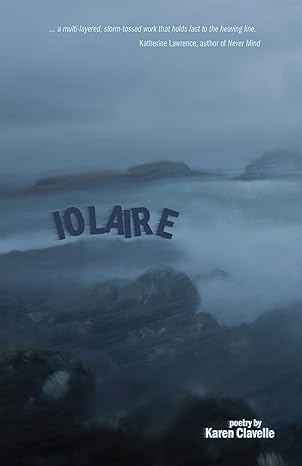
Iolaire by Karen Clavelle: Book Review

Something small and dark was rolling in the waves, in and out it went, what’s that, what’s that. And then stayed a sailor’s hat come right to my feet (18).

Iolaire is a hybrid telling of one of Scotland’s worse maritime disasters, a story of an island’s grief, a woman’s loss, and by the end, a new (though haunted) beginning.

***

The sailor’s hat (of the initial quote, above), echoes throughout Iolaire by Karen Clavelle. The hat, washed up on the shore, becomes a haunting reminder for Is (short for the Gaelic Iseabail) that her love has gone missing in the waters off the Beasts of Holm. He was lost in the early hours of 1919 when the HMS Iolaire broke apart on the Beasts, the rocks at the approach to Stornoway. New Year’s Day was to have been the joyful homecoming of sailors to the Long Island (Lewis and Harris) at the end of WWI; instead, it is the saddest day.

The bride, Is, becomes a widow, a woman who writes letters to her missing love, letters that she bundles and puts away in a drawer. But the book-long narrative is told not only in the epistolary form, which allows readers to access the thoughts and emotions of Is, but the lyric also includes actual excerpts from newspapers, and transcripts from the navy’s inquiry, folkloric prophecies, the poet’s interjections, and poetry.

The first time we’re given a look at the poignant folklore is shortly before the disaster:

Now, at that time of year it gets dusk in the afternoon, and if you’re going to be seeing anything, that’s when you’ll be seeing it — at dusk. And that’s when he did — he saw the stag, him and his sisters. Standing in the path in front of them, it was, and it turned its head and it looked right at them, and then it was gone.

… And sure enough, the boat wrecked that very night. The sister’s husband, he was lost…
(50).

Clavelle also uses her voice to interject observations and insights about the village where she lives during her research, and we readers time travel between then of the shipwreck and now. For example,

In the dream or out of it, I am absorbed in a village that boasts a school, a ceilidh house, a historical society, churches, a cemetery, and a tiny community shop, (the) Bùth, that besides offering groceries and hardware, houses the post office where Dorothy franks the mail with a date-stamp she changes daily by hand, and in the windows posts funeral announcements and community events (46).

Besides the village, Clavelle comments on the ship’s Gaelic name — iolaire sùil na grèine — sea eagle, a name in which irony brims: the boat named for the bird that foreshadowed war and disaster. Haliaeetus albicilla, its Gaelic name in the Seann-sgeulachdan (mythology): fior eun, the eagle, ‘the true bird’… (47).

Besides creative, lyrical, and factual prose, untitled poems also flow through Iolaire. One of my favourites is:

the tide bell rings

and I call for you in the heather and the thrift by An Cùl Beag
in the low tide from the caves from the
shadows of the stacks at Cala Ghearraidh

I call along the endless length of the Tràigh Mhòir.
beneath the slopes of the sand-cliffs, the scarred hills,
the tide pools; from the red seaweed I call
from black-sinewed strand where in grace in death gannets lie
feathers spread as though in flight, their eyes and bones picked clean
                                                  and burying beetles labour their days

I call from the blanket bogs, through the mists and the wind
from the shelter of the marram grass
where summer blues the forget-me-nots on the machair
     where the greylag geese and hoodie crows, and
          the ewes call in their own
         
  so strong the pain of separation (98)

Iolaire is a poetic narrative weaving fictional letters, nonfiction articles, as well as documentary notes into a lyrical tale of love, agony, and grief. Cavelle uses many strategies to unravel the heartbreaking tale of the ship’s break-up on the rocks, the desperate attempts the sailor’s made to reach shore, the lingering anguish of the people from over 60 villages mourning 205 deaths (only 82 sailors survived).

This New Year’s Day (2024) marks the 105th anniversary of the sinking of HMS Iolaire. It is a good time to read Iolaire by Karen Clavelle and to remember one of the saddest moments to ever mark a military homecoming.

Available through your local bookstore or online: Iolaire by Karen Clavelle (Turnstone Press, ISBN 978-0-88801-611-9)

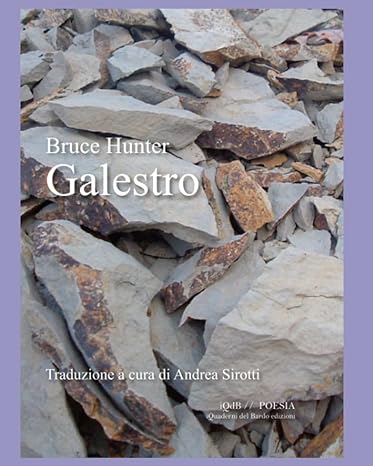
Galestro by Bruce Hunter: Book Review

In this life, we are visitors no matter where we go / on this earth, the headstones remind us.

— “The Rooks in the Sycamores at the Tomb at Dunn” (98-107)

Galestro, of the book’s title, is the name of the mineral-rich and stony soil of Tuscany. It’s the hard till that nurtures the Sangiovese vines and the Chianti that flows through poems like love. Smooth-flowing Chianti and stony hard till are wonderful metaphors that thread throughout the collection. Perhaps it is for this “flow” that Bruce Hunter has arranged the poems without distinct sections. However, the poems have been carefully organized. In the initial poems, Hunter reflects on his youth and working years; the middle section celebrates Tuscany and love; and the last poem circles back, exploring a theme introduced early on. Individual poems are constructed on a framework of details, which of course creates the pull of authenticity, but we also find allusion, together engaging both our love of facts and our love of fancy.

One poem that reflects on Hunter’s young years in and around Calgary surprised me with the flavour of a Patrick Lane poem. In no way does the poem mimic Lane, which makes it hard to put my finger on what exactly made me sit up in my chair when I read “Skyhooks” (30-33). In the poem, Hunter begins by describing kites:

Each of them angling for light, 
strung between existence and dream
trolling for skyfish or errant angels
lost in the lure of clouds.

But then he quickly moves to a tough work scene, the stuff of early Lane (and of Tom Wayman, too), before he brings humour into the poem. A complex juggle of tone, beauty, and grit.

The primary subject of the first sixty-five pages is the geography and people of Hunter’s childhood in Calgary and his adult life in Toronto, although there’s a wide range of themes and metaphors layering the poetry.  Then, to celebrate his actual retirement, Hunter travels with his wife to Italy. It is here we gain the benefit of Hunter’s apprenticeship as a gardener and arborist (as he tells us in “Lost and Found in Cortona,” p 90-93). This deep knowledge creates the details that make the Italian poems so fascinating. It is also here, in these Tuscany poems that we see Lisa as lover-muse. For example, in the title poem “Galestro” (p 76-83):

I learned to read soil in my apprenticeship,
and sky and wind, on the highest point of land,
where rain is made, and wine,
somewhere between alchemy and prayer,
reverence and ritual….

Hunter is sensitivo in his knowledge of gardening, but there’s been a subtle switch and suddenly Lisa, his wife, is sensitiva:

…the woman who teaches the heart,
who reads my eyes, who calms the animals, heals the beloved.

This is Bruce Hunter’s tenth book. His writing apprenticeship has led to multi-layered poems that offer at once a clear, straightforward read and, if you sit with them, a complex understanding of life, love, and endings. Much of my recent reading has included single-theme collections and book-length poems. Reading Galestro has forced a re-think. Hunter’s voice, as you can see, is wide-ranging. I’m breaking free of my mold.

For another example of Hunter’s versatility, “Ligurian Poppies” introduces the poet as witness:

Bomb cracks in the University of Bologna.
The missing towers of the Castello.
Neptune can hold back the sea
but not the vile will of hard men.

The collection is all metaphor.

In “The Rooks in the Sycamores at the Tomb at Dunn” (98-107), the final poem in the collection, Hunter reflects on a visit to the far northeastern edge of Scotland, Caithness, the Tomb of Dunn and of Hunter’s forebearers:

The tomb’s open now, pillaged.
The plank lid torn off and left where it landed.
Vines cover the chapel’s window-less walls.
The roof long ago gone….

//

And there’s an alder sapling between their graves.
Seeds from the ancient forest brought up by gravediggers.
One day the alder will crack the stone.
Trees stronger than stone in their kinetic lift.

When we search for the ancestors, for what are we searching? Hunter takes us on a journey through language and naming, through mythic and physical places, concluding the poem and collection with: and if I had one wish: / I be that tree, / stronger than stone in its lift. / And that my friends, is the gist.

What is there to say after that?

Galestro is a big book (8 x 10 inches, 122 pages) of poetry by Bruce Hunter, translated from English (on the left page) into Italian by Andrea Sirotti (on the right). It is a pleasure for word-lovers to see how the words fall and follow, a treat to compare and imagine how they sound and what they evoke in the second language.

Galestro, Quaderni del Bardo (2023) by Bruce Hunter

Available through your local bookstore or online: ISBN 9798376256602

Frost & Pollen by Helen Hajnoczky: Book Review

My bloom and martyr, your marrow, my morrow.

These “eclectic” book reviews of mine don’t follow the standard form: they include only books that I’ve liked, which means they have intrigued, inspired, and allowed me to enter the world they create. I appreciate craft — the basket of skills that poets employ to achieve their goals (see writing tips) — in both individual poems and in collections that hold together like smoky single malt Scotch. Frost & Pollen by Helen Hajnoczky does all of that.

Over the last six weeks, I’ve read and re-read Frost & Pollen, a most unusual poetry collection. The first long poem, “Bloom & Martyr,” leads me deep into a medieval garden, much as Alice leads me into Wonderland, plus there’s more than a suggestion of the bawdiness that flows through Canterbury Tales, subtle though it is (or perhaps subtle depends on the mood of the reader). In “Foliage,” the second and final long poem, readers enter a magical wood to become a bewildered Sir Gawain as we take on the persona of the Green Knight of Arthurian legend. Hajnoczky takes us on a wild romp, and we eagerly keep turning pages to match the flow of her tumbling words.

The prose poems of “Bloom & Martyr” almost demand to be read aloud. They blossom on the tongue. Their movement ever forward.

Your blush, my chrysanthemum. Your winter frost, dahlia and molten. My shoulder blades, raspberry and tarnish. Your breath, bloom and hemlock. Your frost, your flush, cold blossom, my mouth. (7)

Maybe you read this excerpt as being as nonsensical as Jabberwocky. It has that sense about it. But when I can let the words carry me as if floating down a stream, I slip into a dreamlike place. I do suggest you set time aside to read the entire poem in one sitting…then read it again.

“Foliage” is a hybrid poem (or perhaps a kind of tanka), since each prose poem is followed by a short lyric. “Foliage” begins in a more pristine world: “And so the boughs burgeoned and blossomed, flourished and failed, / And I dozed—drowsed by the harmonies of life’s rhythms.” With the “arrival of men” desecration begins and the tension is created as we side with the Green Man who wakes “to restore tranquility.” You can see how impossible it is to paraphrase Hajnoczky’s words, how tampering with them loses her headlong momentum. It’s better to read the book.

So, if you’d like to be enchanted by a very skillful poet who will guide you through a garden and then a wood, I suggest you find a copy of Frost & Pollen.

Helen Hajnoczky. Frost & Pollen, Invisible Publishing, 2021 (ISBN 978-1-988784-80-9)

The Sleep Orchard: A Response to Arshile Gorky by Amy Dennis – Book Review

I know // I know / nothing // of Armenia 1915 – “Admission”

In The Sleep Orchard, Amy Dennis reaches deep inside the life and myth of Arshile Gorky. She enters his paintings and photographs, reaches into the Armenian genocide’s impact on one man. She explores Gorky’s place in the history of art. And in attempting to understand Gorky, Dennis crosses borders of time and place.

In “On Waking,” the first poem in the collection, it is clear that Dennis has absorbed Gorky into her life. She writes: My lover says I have called out….

… I don’t remember.
But know after waking I’ve scavenged

old papers to find antique recipes for ink, hungry
for a hallowed liquid to write about Gorky. In dreams
he is tall and looks into me.

Every morning his paint rattles my thin grasp
on language.

In the second poem, “Greenware,” Dennis writes: …I’ve never before slit / my fingernails into this // wild apple and pistachio / where his mother wipes her hands. Gorky’s mother, who died in his arms when he was a boy of about fifteen years, becomes the monumental loss that haunts his paintings – and Dennis’s poems. In my reading of the collection, mother is at the root of the art connecting artist and author like the mycorrhizal network of tree roots. The theme begins with Gorky’s mother (Shushan der Marderosian), continues with his wife (Agnes Magruder, called Mougouch) who is mother of his children and, woven into the collection, is Dennis’s impending motherhood. Mother: a threaded root. Evocation: Mother. Armenia.

Arshile Gorky was a man who reinvented himself (his birthname was Vosdanik Adoian). In “Marny George at 36 Union Square,” Dennis writes: You were a Russian portraitist // Georgian prince, nephew to Maxim Gorky. Prodigy / who once studied in Paris. Gorky also reinvented art. Dennis traces his artistic lineage. For example, in “Shards,” she writes: he locates / shapes in these famous canyons:

Matisse’s Red
Studio, Miro’s Still Life
with Old Shoe, Picasso’s Plaster
Head, The City by Léger.

Gorky penetrates / where these artists end / and he began…. He became known as the father of abstract expressionism, paving the way for Pollock and Rothko and Gottlieb and de Kooning (“Ambiguous Spaces, Seemingly Random Angles”).

Although Dennis’s poems place Gorky in the spectrum of art history, it is context, neither art history nor art criticism. Although Dennis describes paintings and photographs, the ekphrastic nature of the poetry is not the only technique Dennis applies to reach the heart of her subject: “A Response to Arshile Gorky.” The Sleep Orchard contains poems in which Dennis writes of his mother, where she inhabits Mougouch, and where she writes to his daughters. But this collection is not a biography. Dennis writes of her own experiences during the writing of The Sleep Orchard, but it is not memoir. She claims to know nothing about Armenia – I know // I know / nothing // of Armenia 1915 (“Admission,” the third poem), but the collection bears witness to the impact of that genocide. The Sleep Orchard is all of this and more. The collection is tapestry, the colours of Armenia, a search for Arshile Gorky.

Dennis’s collection is sensuous, passionate, lyrical. Her skillful writing draws readers inside, always evocative. My favourite poem in the collection happens to have one of the longest titles: “Meditation on White (traced Backwards), Response, to Charred Beloved /, 1946.” You can see her skill, hear her poetic voice:

Named after lilies, his mother Shushan warmed
her infants in cradles lined with sand, grew daughters
to face east and hail Mary. Each November, string-tied
from ceilings, she dried pears, their skins distilled
with rippled sugar and the deathly

look of withdrawal, the fruits
parched as embalmed songbirds or small raptors
swathed in Egypt. Her once son, his voice-

box drowned with balsam, would not speak
until he was six, until six spoke only with birds. This,
a small sacrifice for the close studies of such wings, white
doves he let roost in his breaking.

You do not need to know a thing about Gorky’s art or ekphrastic poetry to be drawn inside the emotion of the poems. Dennis brings Gorky and his work to life, opening a door for readers to enter his world – and hers – whether or not you are an art afficionado. Art is the vehicle, but there is much more to The Sleep Orchard.

The Sleep Orchard (Mansfield Press, 2022) is available through your local bookstore, the publisher, or online (ISBN 978-1-77126-280-4).

You may also be interested in my review of Mechanics of a Gaze, Branka Petrovic’s poetry collection about Gustav Klimpt and Emile Flöge. (Mansfield Press, 2017). If this interests you, please also see The Painted Kiss (Washington Square Press, 2005) for my thoughts on Elizabeth Hickey’s fictionalized novel about Gustav Klimpt and Emile Flöge.

Everchild by Gwynn Scheltema: Book Review

This clementine skin is thin / clings fast, is old. — “Naartjies”

Everchild by Gwynn Scheltema. Aeolus House, 2023

Everchild by Gwynn Scheltema is a collection of poems by a practiced writer. It has earned the praise of Louise Bernice Halfe – Sky Dancer who writes, “Compelling and heartbreaking. The poems filled with longing, pain, a sensuous observation of a journey looking to repair itself.” Antony Di Nardo says, “[She takes] us into the heartland of Zimbabwe. There’s a lifetime in these poems, stories to be told about people and places and the state of the human heart, whether grieving or skipping to the beat of its own music.” E. Alex Pierce writes “Gwynn Scheltema writes from every aspect of her wide-lived life with every facet of her bold, courageous, female voice.”

Scheltema’s poems explore absence, loss without nostalgia, in their search for home and identity. They ring with authenticity, a truth richly lived. We find ourselves within the Zimbabwean child-heart that remains alive within the woman she has become. Flowing throughout the collection this thread is strong and constant.

The collection is laid out in four sections: Breathe, Ignite, Ebb, and Be. The prologue poem, “Moongate,” establishes what will follow:

            she breathes
            treads lightly

            on what was

            what will be—

From the first poem, called “The Old Swing,” the reader is placed in time looking back: “After layers of years / the tall metal swing frame stands /                  still.” And we understand that a kind of resolution if not acceptance will be found in the poems, despite the pain that inhabits them. The swing’s chains may be too rusty to achieve the sky of childhood, but it will rise in “song-birthed words.”

One of my favourite poems celebrates Nomvula, the woman of the cover art (a painting by the poet) in whose care the child lives:

Whimpers wend like wind spirals
from the child swaddled on her back who whispers
with spirits she does not want to know
a mother gone that no one speaks of
thula, thula, hush hush.

The song, almost anthem, stirs.

Nomvula…

removes the sandals with brass buckles
removes the dress with itchy white lace
gathers her to her breast
skin to skin
white to black
thula, thula, hush hush
ngilapha, I am here.

The mother is absent, an unspoken presence.

In the third section we meet the stepmother, and who wouldn’t think of fairy tales?     

the only hug
my mother ever gave me
I was six

I wonder
if I had hugged her back—

While I have omitted the crux of the poem, these words convey the sense of longing for what might have been, as well as a lingering self-doubt that haunts the collection. But do not misunderstand; there is no blame of self or other.

The final section, Be, brings poet and reader to what is, the place past memory, a place of now, a place secure. Scheltema writes, “What matters

            flies home right now from Saskatoon
            warm, wanting flesh inside cold steel
            ornery no doubt from his knees cramped to chin
            airless heat and stiff sandwiches
            but his heart still soft

            …

            our quiet walk in the blossoming.

While Everchild is a first full-length collection, Gwynn Scheltema’s fiction and poetry have been published in journals, magazines and anthologies. In 2021, Glentula Press released her chapbook, Ten of Diamonds, a “constraint” collection of ten poems. She has earned many accolades over the years, all culminating in this exquisite collection, a collection that at its heart is one poem.

***

For more about Everchild and its author, visit https://gwynnscheltema.com/.  A Kindle edition is available through Amazon.ca. For the print edition, order from your local independent bookstore, from the publisher  or get a signed copy by contacting the author.

Kevin Mulqueen: Le Mot juste

The High Window Review's avatarThe High Window

flaubert

*****

Kevin Mulqueen was born in Reading, UK, but his blood is pure Irish. He has been teaching English for 48 years – in England, Egypt, Tanzania, Argentina, Venezuela, Ghana and now Vietnam. At 70, He’s still going strong. He is married to a Vietnamese woman and lives in Ho Chi Minh City. He is a chess fanatic (Tanzanian National Champion in 1991), devotee of blues and jazz music, bibliophile (Shakespeare, Thomas Hardy, Brian Moore, Philip Larkin, Dick Francis, M.R. James and Jonathan Raban are among his favourites), vulcanophile (He’s climbed Tambora and Mt Mayon), traveller, writer (mainly of travel and nostalgia essays) and armchair sportsman (He loves football, cricket, tennis and boxing).

*****

LE MOT JUSTE

I first came across the phrase le mot juste at secondary school, when our French teacher, Mr Evans, used it in class. He said something along the lines of: ‘Il faut chercher le…

View original post 2,097 more words

Why Write a Chapbook? Plus Red Alders in an Island Dream by Christopher Howell

“What they say is / change / can bring you here.” (“Beyond the Dream Hatch”)

Fellow poet, friend, and blogger, Gwynn Scheltema, has recently written a piece about chapbooks — what they are and why we might consider publishing one. Here’s a short excerpt from Gwynn’s Writescape blog (with permission; thank you Gwynn):

Why publish a chapbook?

  • For the unpublished poet, it’s a chance to get publishing creds.
  • The process will prepare you for putting together a full collection.
  • A chapbook is a “safe” way to publish, because the work is not lost. You can publish it again in your collection.
  • You can take risks with a chapbook – give a chance to a new publisher, publish it yourself, create an artpiece.
  • A chapbook can keep you in the public eye in the time between publishing full poetry collections.
  • You need a home for perfectly good orphan poems that didn’t make it into a collection.

(To read Gwynn’s entire blog on Writescape, just click here: https://writescape.ca/site/2021/02/on-chapbooks/.)

***

This started me thinking about chapbooks slipped between full collections on my poetry shelves and to Red Alders in an Island Dream.

RED ALDERS IN AN ISLAND DREAM

… is an example of a 7-inch square, hand-stitched chapbook by Christopher Howell (Trask House Books, Portland, 1980). It was given to me recently by a friend who gifted it from his library. Howell has now published 11 books of poetry and won three Pushcart prizes among other awards.

This little treasure has been read many times. Just because it is small — home to only seven poems (one is in four parts, which sort of makes it eleven poems) — does not decrease its value. Actually, I like Red Alders in an Island Dream better than many full collections on my shelves. Don’t approach chapbooks in a condescending way. Sometimes the best things come in small packages.

The collection ends with the four-part poem “In Grey Water: The Day,” and these are the last four lines of “IV,” the final lines in Red Alders in an Island Dream:

Membranous and steady, like wind
moving in the darkening neighborhoods,
we seek the far shore. And window light
breaks from us
like the sound of oars.

***

For an interesting interview with Christopher Howell: http://true.proximitymagazine.org/2018/11/08/a-conversation-with-christopher-howell/, or just “Google” Christopher Howell poet.

Thanks for reading to the end. Please share your thoughts and this blog. Kate