Review (Poetry): Lines…and what’s between them (What the Soul Doesn’t Want by Lorna Crozier)

What the Soul Doesn’t Want is a new collection, the most recent of 17 books by Lorna Crozier. Five of her poetry collections live on my bookshelf and are frequently pulled off and carried to the oversize, plaid wingchair in my library/office to be read again. However, the poems in What the Soul Doesn’t Want are new to me; I haven’t had the time to ponder them, to return on a different day in a different mood to discover what they might offer. But it’s easy to see they are pure Lorna Crozier.

She writes with quirky wit and sensitive awareness. For readers, the poems provide pleasure and insight and the simple joy of the words she chooses. Her themes in What the Soul Doesn’t Want haven’t veered from past work, but the tautness and edginess are sharper here.

She draws from nature and not always what you might expect. In “Cockroach,” we get the sublime: “they creep from the baseboards, / climb the couch and burrow in her hair” which makes me involuntarily shudder. But I also learn that “In Japanese it’s gokiburi,” a word I expect my grandson teaching in Japan will be interested in adding to the personal dictionary he’s creating. Reading Crozier, one finds clear images and science next to odd bits of trivia and a telling that will cause you to smile and to think (even as you might shudder).

Aging and time are Crozier themes. My favourite poem in What the Soul Doesn’t Want is “When the Bones Get Cold.”

My husband sends me hummingbirds
from his eyes. Only he and I know
he’s going blind….
I am made beautiful by loss. The moon, too,

There’s a sweetness
that comes from accepting what I am,
not a mountain, not a river, not a tree.

Grief also ripples through her poems. In “Algorithm: The Way Out,” Crozier writes: “…Grief’s / a snowdrift that thickens / as you walk.” How simple. How brilliant. How true for all of us who have known sorrow and deep snow. It is this universality and, perhaps, the lightness (and the light) that gets the writer and the reader through the tough stuff she doesn’t shy from.

Crozier is an Officer of the Order of Canada, the Governor General’s Award for Poetry, and a three-time recipient of the Pat Lowther Award. After a long teaching career, she is now Professor Emerita at the University of Victoria (British Columbia). She must be the envy of poets everywhere.


07 Crozier covers LR-007

Lorna Crozier’s books are all available through your local bookstore or online: What the Soul Doesn’t Want

Review: Sine qua non cocktails (Evenings at Five by Gail Godwin, illustrations by Frances Halsband)

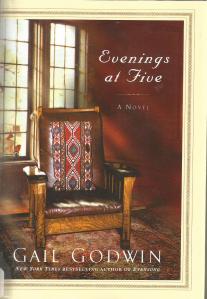
Evenings at Five is a tiny book, about the size of a diary, and scattered with sketches that lend a feeling of intimacy to a story that feels so real I wanted to classify it as autobiography and not fiction when I first read the book. I’ve read it many times since. It has not ceased feeling real and true; it’s the best kind of story – one that catches your breath and snags your heart. But don’t be mistaken, Evenings at Five is not even remotely sentimental. Gail Godwin is a master story-weaver.

Godwin begins, without preamble, with the five-o’clock cocktail ritual. Through actions like Rudy’s “cavalier slosh of the Bombay Sapphire” we meet the man and soon sense his wit and glimpse his moods and passions. We also meet Christina who “would cross her ankles on the Turkish cushions on top of the burled-wood coffee table and train her myopic gaze on Rudy’s long craggy face and familiar form reassuringly present in his Stickley armchair….” Here they connect, nip their tall gin and tonics (on a bad workday or a celebratory one Rudy might sip a scotch) and talk in the intimate way of intimate couples. This is the context in which most of the story unfolds.

The initial sketch shows Rudy’s empty Stickley chair. In fact, all of the sketches illustrate the home and personal things of Rudy and Christina, sans people. We see the “View of below from Christina’s study”; we see many bottles on Rudy’s medicine shelf; we see his downstairs study with the Yamaha grand. (“[H]e bought it the day after he watched Laurence Olivier’s deathbed scene in Brideshead Revisited: ‘What am I waiting for? If not now, when?’”) The home: a companionable room and two studies for a composer and a writer, everything pared down to essentials.

Evenings at Five is about a marriage between two artists (“’ah-tists,’ as the real estate lady who sold us our first house pronounced it”), about loss and grief, loneliness and reflection, and a story of longing for what was. But death is not the end of love; Christina continues the sine qua non cocktails, struggles to cope without Rudy, and reflects:

On some level of consciousness, Christina thought, I must have heard all those years of Rudy’s compositions forming themselves phrase by phrase, probably even note by note, but I told him the truth when I said I didn’t hear, that I was scrunched into some dark soundproof chamber behind my eyeballs, straining for flashes of images that then had to have words matched to them.

And, so, also regret for not being more present and guilt for leaving the hospital.

Perhaps, in the hands of a lesser-skilled writer, Evenings at Five would have become maudlin, given the themes and intense intimacy of the story. In Godwin’s hands, the story sings and evokes authenticity (sorry for this over-used word). As the cover copy states, the novel is “A fierce evocation of what – at some time or another – everyone is bound to endure…An amazing little volume that contains an explosive emotional wallop.”


03 Evenings at Five cover

Available through your local bookstore or online: Evenings at Five