Review of The Dialogues: The Song of Francis Pegahmagabow by Armand Garnet Ruffo

Here is a story that does not end, but continues today in those who believe in a country where justice will prevail, as new generations rise up to fill the footsteps of warriors who have fallen long ago, whose sacrifices and legacies we continue to remember and honour….
(133)

Armand Garnet Ruffo has published poetry and prose, made films, and created anthologies in addition to his academic credentials. The various skills required for these successes come together in The Dialogues: The Song of Francis Pegahmagabow, creating a literature that is extraordinary.

The Dialogues breaks the boundaries of what we think of as poetry. In poetry, we expect “density of meaning, felicity of language, authenticity of feeling.” It should also “deliver to us…the sense of urgency,” and Ruffo gives us all this and more. We don’t expect the weaving of documentation through the book-length poem, but here it is, smoothly echoing the poetic voice of Pegahmagabow and that of the poet-narrator who occasionally intervenes. And as suggested by the title, this overlays the idea of musical performance. The demands of staying true to an historical life, while working within the constraints of the musical, has resulted in the unique the structure of The Dialogues.

The poetry, as we’re accustomed to think of it, is on the lefthand page. On the facing page are facts substantiating the poetics: sometimes it is in the form of the poet’s memory; sometimes in the form of a government or military document; sometimes a background statement as is “An Interlude to Discuss Francis’s Encounter” (35). As well, this collection weaves an actual musical score from the production that inspired this book (21). 

The Dialogues is innovative in its narrative and story-telling, not only in its voice and in its structure but also in its immense impact. Reading it, I thought of Omeros by Derek Walcott. Ruffo’s scaffolding may not be created on a myth, but The Dialogues is mythic. Francis Pegahmagabow is a hero: in his soldiering; in his life after the Great War; and in his legacy. The Dialogues takes us on a time-journey, a culture-journey, a life-journey, from which I came away bruised but better understanding a life, a time, and a People in a “felt” way beyond intellectual knowledge alone. 

To read the entire review, click here.

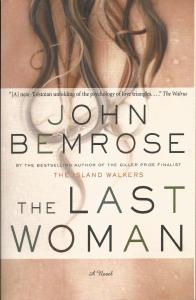
Review (& Controversy): Into Northern Lake Country (The Last Woman by John Bemrose)

“I’ve come to think of her as a sort of Mother Earth figure. You know, Lilith, Eve, the first woman –.”
“I don’t know,” Richard says….”Looks more to me like the last woman.”

The Last Woman by John Bemrose is an elegy for the ending of love; for a forest, clear-cut landscape; for simple equity for the lives of people – in this case Ojibway – who are caught in the ugly transition from “what was” to “what is.” On one level, The Last Woman is the story of a love triangle, simple and straightforward. On another, it is the story of a clash of cultures, each trying to do things for the right reasons and each totally misinterpreting motives. It is about politics where truth and justice don’t matter. It is about a land claim, secrets, ambitions and dreams, art and logic, and the totally different way that indigenous people think about and live on the land. In short, Bemrose has written a complex story, weaving the personal angst of his characters into a web that includes greed along with cultural and environmental destruction. Bemrose’s writing is measured; he doesn’t rant, although readers will see where his sympathies lie.

Over the years, I’ve bought books by the few Indians (First Nations in Canada) who managed to get published. I think that Halfbreed by Maria Campbell was among the first, along with books by N. Scott Momaday. Later, books by Louise Erdrich made their way to my shelf and some by Thomas King, plus harder to read books like for Joshua by Richard Wagamese, poets like Lee Maracle and gritty Métis poet Katherena Vermette. I own Anne Cameron’s Daughters of Copperfield, a book that generated controversy in the early 1980s (that continues to rage) about who has the right to the traditional stories, to their telling. Of course, I have the well-packaged and easy-to-embrace collections of quotes from the speeches of elders, such as Touch the Earth. And yes, academic and anthropological work sits there too.

More recently, publishing has opened to First Nations people in a way that seemed previously closed, and there’s new controversy on the topic of who speaks for whom. The editor of Write: The Magazine of the Writers’ Union of Canada resigned over his editorial in the Spring 2017 issue. He writes: “I don’t believe in cultural appropriation. In my opinion, anyone, anywhere, should be encouraged to imagine other peoples, other cultures, other identities.” I suspect that farther down in the editorial his admonition to “Set your sights on the big goal: Win the Appropriation Prize” is what skewered him. I read it as inappropriate, as did many others – not political correctness, but a “middle-finger salute.”  Indigenous people in Canada (likely everywhere) are capable of speaking for themselves. They don’t need interpreters. But there is a blurry line, although both history and today’s reality badly need the First Nations’ perspective. So, back to The First Woman….

Bemrose walks a fine and informed line as he writes about the land claim and as he develops the character of Billy, of Billy’s loss over his cultural heritage, his land, and the trees gone to clear-cutting. He writes with sensitivity about the childhood attraction and, later, physical love that Billy and Anne shared, as he does with the friendship that once existed between Billy and Anne’s husband Richard.

I wonder what critics today would think about Martin, my character in Calla & Édourd. Martin is a fiction, who grew out of my experience living in Winnipeg. My empathy grew out of my grandmother’s reluctance to talk and her mother’s stories. Yet, now I wonder if readers would feel a line has been crossed. But, once more, back to the novel….

The excerpt that leads into this review fixes our thoughts on a painting and on environmental destruction and provides the title for Bemrose’s novel. But the story is about more than that, it digs and niggles down into a core fault-line. I would love to learn what readers – who have read the novel (and maybe mine) – think.

09 The Last Woman

Available through your local bookstore or online: The Last Woman