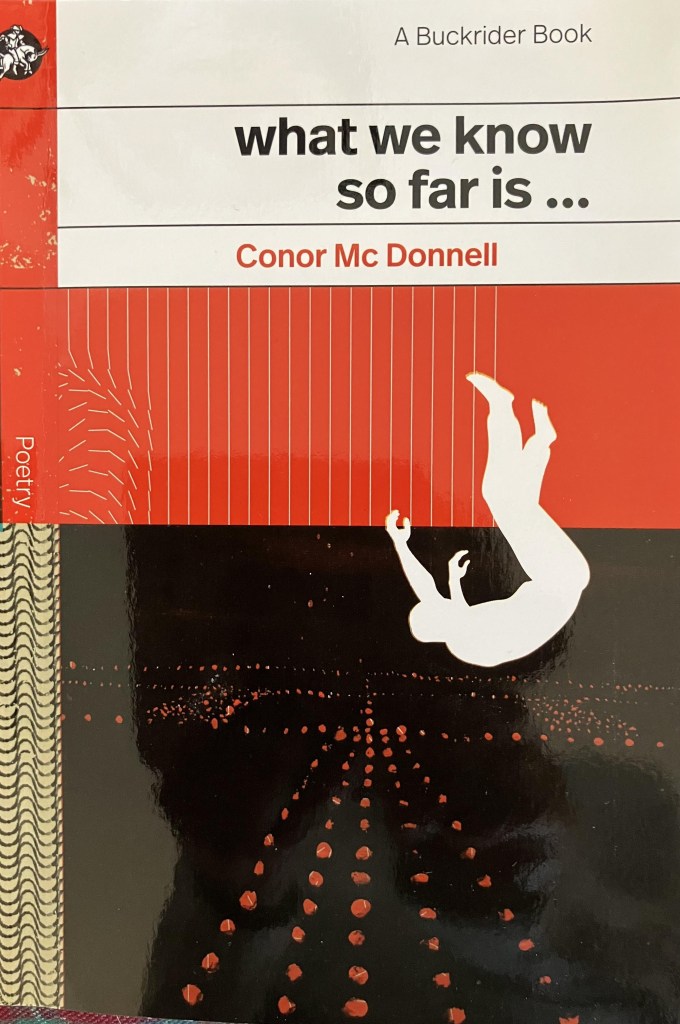
What We Know So Far Is…
by Conor Mc Donnell
Wolsak and Wynn (2025)
Conor Mc Donnell has published two poetry collections and three chapbooks and now this wild, exhilarating, and complex howl of a long poem: What We Know So Far Is….
Thirty numbered (in Roman numerals) fragments comprise the long poem. These are interspersed with 9 numbered short poems that, when read in sequence, form one long poem, which is in dialogue with the thirty longer pieces. Integral to the poetry are six pages of endnotes that provide insight into the many references and allusions Mc Donnell embeds in the poetry. This all sounds serious – and the poems are serious – but there is ample wordplay mixed with stream-of-consciousness thoughts on subjects from biology and medicine to vampire movies and musical groups that, like Mc Donnell’s writing, are experimental. Where to begin with a collection like What We Know So Far Is…?
Mc Donnell begins his endnotes with: “This book is influenced by anything and everything I have consciously/unconsciously soaked up through most if not all of my sentience to date” (87).
Following a poetic prologue in which Mc Donnell sets up the idea of dimensions, the first poem begins:
cars crash. Omagh. Wrists are slapped. Omaha.
Nothing happens not willed in a haptic universe (I, p 13).
Omagh, from Irish An Ómaigh, means the sacred, or virginal, plain, the site of the 1998 bombing in Northern Ireland during ‘The Troubles.’ Omaha is both an Indigenous People and the code name for a deadly D-Day landing during WWII. Haptic universe refers to digital sensations, simulations of touch. You can already hear the voice and see the philosophy that breathes throughout What We Know So Far Is… in the way events and ideas combine like a dream, not exactly surreal but the unconscious surfaces.
The speaker is on a quest, seeking, imagining, and reimagining. He is interested in so many things, a tumult of ideas cascading like time.
Mc Donnell describes “this flight of ideas” that run down the pages
like
throbbing skulls on stilts, like
turtles twisting over limerick’s worth of worms,
like snacking serpents shook loose and spread across fields;
the itches they scratch will weep and leak…
erupt if left undisturbed. (III, p 15)
The collection is a cornucopia of ideas and images tumbling down the pages, a torrent, but not random nor haphazard, as one might think on first reading. For example,
Since you’re in the post editor right now, the Tags section might just be hidden in the settings sidebar. Click the **Settings icon** (looks like a square with two uneven columns) in the top-right corner of the editor to open the sidebar, then scroll down to find the **Tags** section. Does that bring it back?
What We Know So Far Is
Interzone is safe haven within which to improvise:
This is why the first burial was the first act of love (XIIId, p 29)
The act of burial is symbolic, ritualistic, and it is evidence of love, an act bridging the liminal space between the living and the dead. …
To read the balance of the review, please click here.