
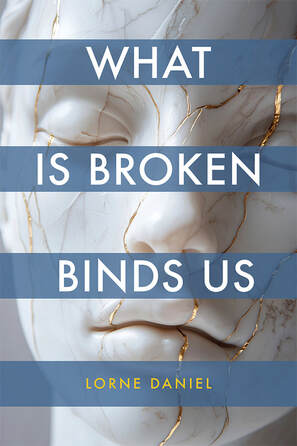
In What is Broken Binds Us, Lorne Daniel’s fifth poetry collection, he explores brokenness and the binding of lives within family and across generations and continents. The poems explore the shattering of bodies and minds, the brokenness of a society that condoned slavery and the racism that continues, and the diaspora that is reality for so many of us. Through a kind of kintsugi (the Japanese art of repairing pottery with gold, which emphasises the cracks rather than hiding them) Daniel names the shattering with poignancy, resilience, and beauty.
The collection is skillfully organized; the poems in each section closely relate in subject and theme. But there’s also a weaving that brings the overall threads together like a tapestry.
The first poem of the first of the seven sections in What is Broken Binds Us serves as a prologue poem, introducing many of the themes in the collection in Daniel’s clear, accessible, poetic voice. In “Lessons in Emergency Preparedness” (a three-part poem), we meet a younger poet/speaker Proudly / poor and adulting hard, a husband and new father, who would clamber onto my rusted one-speed / with its great sweeping handlebars / —wide as albatross wings— / and wheel urgently to the Office / of Emergency Preparedness. Daniel takes us into the workspace and introduces the team. There is an off-hours emergency, but the Emergency Preparedness friends have
…No plan. I checked my wrist
for some reason, then the wall
clock, the school gym. It was 12:25,
the second hand still, improbably,
moving.
Daniel captures an existential reality, our helplessness when the world we know turns upside down. And he does this with hints of humour, surprise, and irony.
“Crushed” is the transition between the first poem, in which death appears, and the following poems in the section that explores the broken body. It contains one of my favourite images: On the shoulder, waiting for a break, / me and this sleek crow, its cape / tucked and trim. The triad of danger, fear and survival, which theme the collection.
In the second section, Daniel broadens the scope: It is easy / to dip into purse and wallet, / give back the money. Cede the land. The bullets do not go easily / back into the barrel… (“Giving Back the Dream”).
There are echoes of Joni Mitchell in “What Has Taken Place”:
…No plan. I checked my wrist
for some reason, then the wall
clock, the school gym. It was 12:25,
the second hand still, improbably,
moving.
Daniel captures an existential reality, our helplessness when the world we know turns upside down. And he does this with hints of humour, surprise, and irony.
“Crushed” is the transition between the first poem, in which death appears, and the following poems in the section that explores the broken body. It contains one of my favourite images: On the shoulder, waiting for a break, / me and this sleek crow, its cape / tucked and trim. The triad of danger, fear and survival, which theme the collection.
In the second section, Daniel broadens the scope: It is easy / to dip into purse and wallet, / give back the money. Cede the land. The bullets do not go easily / back into the barrel… (“Giving Back the Dream”).
There are echoes of Joni Mitchell in “What Has Taken Place”:
what has taken place
here where roots of Garry oak
are paved over? what stories
have been told of this
place? what does placemaking mean
where place has been
taken? taken over meadow turned city
street bearing the name of a Spanish
naval officer
Daniel is a questioning poet; he urges us to think, to consider what we’re doing, what we’ve already done.
In “The Family Name,” the third section of What is Broken Binds Us, the poems dig into heritage and migration, the roots of who we’ve become and the lonely search of those in the diaspora. In Scottish English, to ken means to know, to see, to understand. The family immigrated to Canada from the U.S. and before that from Scotland. In “Kenning,” the family makes a pilgrimage to Charleston, the Magnolia Plantation, to confront slavery. “In the Family Name” is one of the most powerful poems in the book. Daniel writes,
Stories, grief, celebration. Distance, absence, loss. Where to start,
as a Daniel bearing the name of an English
enslaver…
[…]
…returning to the ties, to touch
what binds, to wonder what releases
the knotted, twisted, tangled.
In the fourth section, we return to the immediate family and the infant introduced in the first poem, now a sleepwalker, a three-year-old talker: Well into the night, he swings / from story to song. The halting rhythms / hypnotic as his voice rises and rises / until with one high note he slips away. In succeeding poems, he literarily slips away into chaos. Somehow Daniel writes these poignant poems without pathos, without sentimentality.
The theme of uncontrollable chaos lingers in the fifth section,
Please click The Temz Review to read the balance of the review. This is where the review is published.

 Kathryn MacDonald