Three poems: excerpts from A Breeze You Whisper

I read the whole thing all at once…each poem made me want to read the next one, and then, it was over, leaving me wanting more. [] I was totally entranced. MacDonald’s work is sensual, moving. She plays with words….The poet takes us off the page and into her mind and heart, into our own minds and hearts and beyond. (Amazon review)

ISBN 978-1-897475-66-9; Hidden Brook Press (HBP); 2011

The majority of the poems in the collection are in print for the first time, but some were previously published, including these three. The cover was created by the publisher from one of my photographs of a luna moth; the ink-brush drawings are also my creations. The book is divided into six sections: East; South; West; North; Above & Below.

“Earth,” was originally published in Ascent Aspirations Magazine (2007):

EARTH

Worms wiggle through soil
and at the end of the robin’s beak.

Ants build labyrinthine passageways
and a room fit for a queen’s eggs.

Below the raspberries
a brown field mouse curls in her nest.

Away from the garden path
under the evergreen rabbits burrow.

My fingers reach for weedy roots
find mysteries buried deep.

Gravity hold more than loam
to its stony heart.

East section pg 1

“City Hunter” was originally published in Descant (1981; a prestigious literary journal that published from 1970-2015):

CITY HUNTER

I watched the jazz man
reach through his horn
felt his mellow
breath caress my ears.
His dancing fingers
pushed the air
around the
room
rippling waves
of smoke
broke against
my flesh
the current
pulling toward his
plunging
centre.

He soared and
fell
catching his prey
in the quiet
echo
of his rhythm.

Above & Below section pg 107

The third poem that I’m sharing with you from the collection A Breeze You Whisper is titled “Migration.” It was first published in Northward Journal (under a pen name: Deneau; 1981; Penumbra Press).

MIGRATION

He watched fear
enter her eyes
as she bellied
through the prairie grasses.
He imagined
the pressure
against
her fleshy triangle as
the grasses pushed
between her legs.
Snaking forward, she,
initiation offering,
would clamp him
in her hairy, circular
trap
and devour
his hunger until the
fear leaped into
his eyes.
Slowly he watched the
seeds sown in her belly
swell.
His ear upon her naval
listening
to drums and gurgling
streams
to thundering hoof beats and
rustling grasses.
From the fissure sprung
the red waters
as the migrating herds
returned.

I thought perhaps after reading my reviews, you might be curious what kind of poetry I write. I would love to learn what you think of these poems, and if you’ve read the book, what you think of it.

Available online: A Breeze You Whisper.

(The caption is a quote from the book review on Amazon.)

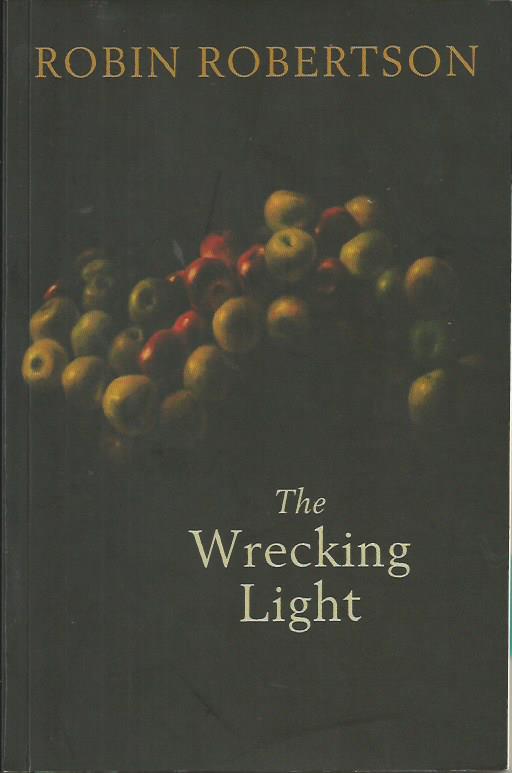
The Wrecking Light by Robin Robertson: Book Review

I find a kind of hope here, in this / homelessness, in this place / where no one knows me – / where I’ll be gone, like some / over-wintering bird, / before they even notice. (Beginning to Green)

The poet searches: for his shadow-self, for grief and guilt, and for life and meaning. In The Wrecking Light, Robin Robertson moves into the past, sheds light onto the present, and shape-shifts between reality and the surreal.

In the first section, Silvered Water, the first poem, “Album,” sets a tone that echoes throughout the collection. It begins:

I am almost never there, in these
old photographs: a hand
or shoulder, out of focus; a figure
in the background,
stepping from the frame.

(…)

A ghost is there; the ghost gets up to go.

The Wrecking Light is full of memories that include memories of others: the girl / with the hare lip / down by Clachan Bridge (“By Clachan Bridge”). And the collection ends with the personal memory of “Hammersmith Winter” when through the drawn curtain / shines the snowlight I remember as a boy, / sitting up at the window watching it fall. Mixed with memories is a sense of grieving, as in “Fall From Grace:”

My life a mix of dull disgraces
and watery acclaim, my daughters know
I cannot look into their clear faces;
what shines back at me is shame.

The theme continues. In “Tinsel,” in the woods: If you’re very quiet, you might pick up loss: or rather / the thin noise that losing makes – perdition. / If you’re absolutely silent. And with loss comes leaving. The very next poem, “Leaving St. Kilda,” takes us on a sea journey brimming with geographic details and clear images cut clean by departure. In this geographical catalogue: sea rhythm; progression.

But don’t get the wrong idea, these poems are neither nostalgic nor maudlin. In the skillful hands of this visionary, we are taken on a raucous ride with unexpected twists and turns.

In the second section called Broken Water, the first poem’s horror and the brutal honesty of rough island life and penance is laid bare. In “Law of the Island” Robertson paints a vivid description of island punishment and the casualness of its deployment. In this section, he gives us a back-and-forth of short poems with punch and longer, exploratory ones where he writes after Ovid, Neruda, Baudelaire, and myth to understand humanity’s weaknesses. Here, “Grave Goods,” is beyond surreal; it enters magic.

In the third section, Unspoken Water, the woods and forests of childhood again dominate. In “The Wood of Lost Things,” the vision is clearer and in its clarity, more haunting. Robertson writes: I have found the place I wasn’t meant to find (…)

Hung on a silver birch, my school cap
and satchel; next to them, the docken suit,
and next to that, pinned to a branch,
my lost comforter –
a piece of blanket worn to the size of my hand.

 You can see how he leads us. Like Narcissus he sees a face I seem to know. But unlike Narcissus, he isn’t struck by his beauty. Of course not. But he does give us a resolution (of sorts).

In The Wrecking Light, there is much of the sea, of woods, of love and loss, of searching. I return to the final poem, “Hammersmith Winter,” and the poet’s final plea: Look at the snow, / I said, to whoever might be near, I’m cold, / would you hold me. Hold me. Let me go.

Robin Robertson has written an intense, lyrical collection with movement as through dreams bordering on nightmare (I dare not use the word haunting again, although that is the effect his writing creates). This is Robertson’s forth book of poetry; I recommend you enter his world.

70 The Wrecking Light

Available through your local bookstore or online: The Wrecking Light

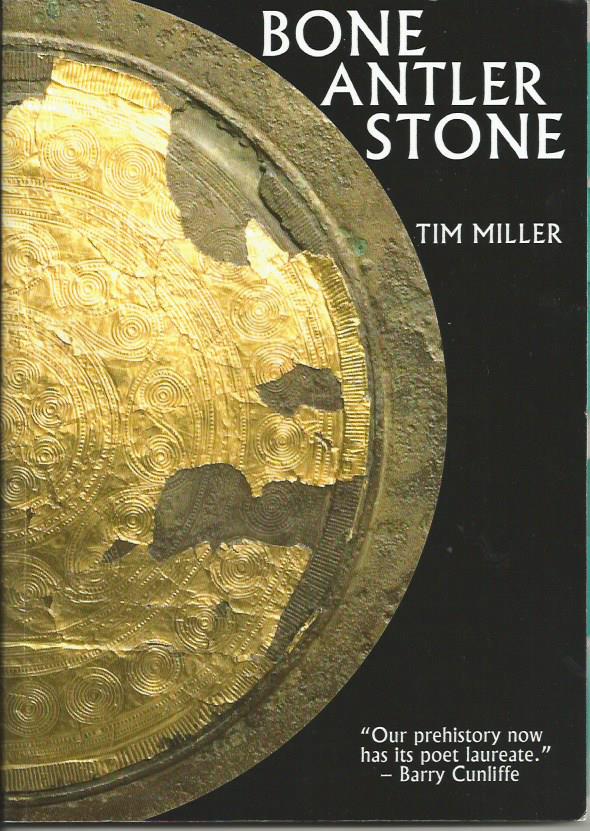
Bone Antler Stone by Tim Miller: Book Review

In every real way, the ring was placed here / the ring of now pock-marked, planetary stone (…) but the landscape was first, the stones only our / attempt at echo and veneration. (The Ring of Brodgar)

Tim Miller collapses 30,000 years of archaeology into a poetry collection that feels the thrill of immediate experience. He stirs a bit of magic, weaving it into the facts of what we know from long-past history.

In “Chauvet, Lascaux, Altamira” (France and Spain, 35,000 – 12,000 BC), Miller writes: Now we come to paint with light and fire. In this seven-part poem, we go beyond the images and enter the process of painting them:

A bison made with his hands, white hands dipped in red
And palms slapped on cold rock again and again,
Smacked hands turned or righted or angles
And his exhausted step back to see
The animal made only of red palms and rock,
Red like bison’s blood, stone vitality,
His awe at a heartbeat behind the wall,
And his hands red as a midwife’s.

The poet does not stand back, merely to look in wonder and awe, although the mystery inherent in that is present. He manages intimacy and time dissolves.

Lines jump off the page, lines like The sun sets into the sea and is doused / and rises with the sound of reborn flame / rolling into another red morning. The title, “The Sun Sets into the Sea” is incantatory, hypnotic. Doing the work of a chant, it carries us to the sea and the sun, which so many peoples worshipped.

The landscape, too, is revealed as it reveals burials of the long dead. In “Long Barrows,” graves become humps…in the landscape, / small rises like murmurs. The collapsing of then and now runs throughout the collection as it does in:

Horses and Cows on Orkney

Horses curled in the flaming spiral of sleep,
The huge immensity of their bodies
Belied by the blankets they wear, or the
Tight scroll they twist themselves into on the ground,
A
n enormity suddenly made small
Or at least passive, compact, the coiled braid
Of body closer to tree or landscape,
The tilted, chiseled head nearer to stone
Or to steel or something pulled from the fire,
Some monument to just how this place works,
That you do not escape the wind, but dream in it.

And this would not be a “prehistory” collection if the goddesses were not brought forth. “Female Figurines” begins with the urgency of poetic catalogue, an incantation:

Hum the words with me and you might understand:
Mammoth ivory, hematite, limestone,
Black jet, soapstone, antler and fired clay –
All of these become our bodies because
Our bodies are the place of becoming.

Tim Miller stirs the imagination. His narrative poems in Bone Antler Stone breathe life into the archeological past of Europe. Now my heart yearns for poetic translation of “New World” prehistory.

69 Bone Antler Stone

Available through your local bookstore or online: Bone Antler Stone

A personal note:
Reading “Female Figurines” (Bone Antler Stone), I walked over to a display table in my sitting area and picked up a cast replica of the Goddess of Willendorf, a gift of my professor of Art and Archeology. In that course, Professor Leonard Kroon insisted we experience art. I did two things: first, I visited the petroglyph site at Rice Lake, lay on the shamanic rock and listened to the earth gurgling through a slanted crack (out of that experience came a poem, “Migration,” which is included in A Breeze You Whisper) and I carved a hawk from a block of soapstone. Although I didn’t know it at the time, the red-tailed hawk would become a motif in later poems. That aside, I cradled the Willendorf figure – both tiny as my palm and monumental – and felt magic through the rotund Lilliputian goddess before returning to Miller’s poems.

For more about my writing, please see “About”

Ru by Kim Thúy (translated by Sheila Fischman): Book Review & Writing Tips

In French, ru means a small stream and, figuratively, a flow, a discharge — of tears, of blood, of money. In Vietnamese, ru means a lullaby, to lull.

In the previous blog, Away, I looked at the journeys of poet Andrea MacPherson who ferreted out people and places of ancestors who had emigrated from Ireland and Scotland a generation or two earlier. In this post — Ru, a poetic fictionalized memoir by Kim Thúy — we experience the harrowing journey of refugees fleeing Vietnam for Canada, escaping Saigon for Montreal. From war to an escape by boat, from a refugee camp in Malaysia to snowy Montreal, Thúy shares both the intimate and the universal realities of escape and renewal.

When NPR interviewed Thúy (“A Refugee’s Multilayered Experience in Ru”), they said that the “novel unfolds in the way a flower casts off its petals: one small scene after another.” On the page, the novel looks like a prose poem or perhaps the concise pages of a journal. Yet the narrative flows smoothly and coherently.

It begins with a ten-year-old girl, but like memory that doesn’t necessarily reveal itself chronologically, the story called Ru flows back and forth in time as one experience triggers another. It does so as the name suggests, as gently as a lullaby. This is extraordinary given the intense and often devastating experiences of the refugees. At the books core, Ru is a story of survival against all odds (Thúy has said the family expected to die) but it is also a beautiful story of a girl who becomes a woman almost in awe of the way lives unfold and people grow and blossom.

Near the middle of the book, Thúy introduces Monsieur Minh who gave me the urge to write. And we can see how writing flings windows wide open, creating space for seeing:

He was saved not by the sky but by writing. He had written a number of books during his time in the re-education camp—always on the one piece of paper he possessed, page by page, chapter by chapter, an unending story. Without writing, he wouldn’t have heard the snow melting or leaves growing or clouds sailing through the sky. Nor would he have seen the dead end of a thought, the remains of a star or the texture of a comma (88).

Later, we meet the grandmother who chose withdrawal into prayer as a way to cope:

Today, my grandmother is a very old woman, but still beautiful, lavishly so, like a queen. When she was in her forties, sitting in her parlour in Saigon, she epitomized a whole era of an extreme kind of beauty, of opulence.…

After the markets had been cleaned out of merchandise and merchants, after her Communist tenants had taken the contents of her safe and her lace scarves, she learned to dress in the long grey kimono worn by the faithful.…

She’d let her two youngest, a boy and a girl, leave with my mother despite the uncertainty. My mother asked my grandmother to choose between the risk of losing her son at sea and that of finding him torn to shreds in a minefield during his military service in Cambodia. She had to choose secretly, without hesitating, without trembling, without perspiring. Perhaps it was to control her fear that she started to pray. Perhaps it was to become intoxicated with the incense smoke that she no longer left the altar (116-117).

Imagine! Yet the story is so sensitively written that the horror fails to leap out and grab us with a scream. Instead, it silently builds and haunts long after we’ve read the last page.

Ru has won a string of prizes, including the Governor General’s Literary Award for Fiction, the Grand prix littéraire Archambault,  the Prix du Grand Public Salon du Livre/La Presse, the Grand prix littéraire RTL-Lire (France), and the Mondello Prize for Multiculturalism (Italy). In addition, it was the 2015 winner of “Canada Reads” (CBC Books/Canada Broadcasting Corporation).

Writing tips:

Structure: the lesson here is to not fear innovation. Choose the format that best suits the telling of your story. Think about how different the reading experience would be if the novel had been written in the usual chapter format, all those transitions and unnecessary details.

Consider the power being concise. In an interview or talk (I can’t be sure where), I heard Thúy say that whatever country that she has traveled people have related their unique journey through war and escape. I believe, in large part, that the brevity of her narration opened space wherein readers filled in their reality. You may want to take a longer piece you’ve written and streamline it down to essential; then consider the impact of each style.

68 Ru by Kim Thuy

Available through your local bookstore or online: Ru

Away by Andrea MacPherson: Book Review and Writing Tip

Before, there might have been children playing in the street, / the rumbling of cars and feet, / but now there is nothing. Taut, stretched stillness. Waiting.

“Walking Shankill Road” (29)

Andrea MacPherson travels in Away — and we travel with her through the magic of her poetry. The journey begins in Ireland, a personal quest where sites and family are sought.

This is the one place you insisted I come,
this place where limestone weeps
and children once played between execution sites
and burial grounds.

So begins “here’s to the wings of a bird” (12) and with it an elusive you, someone who has planted the seed of return, a return instead of, as if MacPherson is visiting the memories of another. Throughout, the time of the “Troubles” persists. In “boundaries” (16), she writes:

We anticipated a stop here,
men with guns and strict faces
(tightropes of unsmiling mouths,
eyes that have seen marchers falling)
a checkpoint at least, with flashlights
turning our faces to ghosts.

Instead there is nothing but seamless conversation;
rapeseed fields.
Trading prayer for something even quieter.

With the poet, we ride through countryside, lulled, until Belfast and RUC men… their guns and tanks.

Somehow we have forgotten about the strife
we had prepared to see, more content
with wavering fields a thousand shades of yellow
and ancient schoolhouses.

These places where people once sat.

The “Troubles” are old; the people we meet are old. It is as if all love and youth have left Ireland. MacPherson captures a poignancy that is haunting. In “the backyard faerie circle” (20), we visit an old man, alone:

A grey cardigan coming apart at the seams,
smelling of sheep and skin and age.
A threadbare chair,
imprinted with the memory of the body
thighs and shoulders and hip bones.
This is what his life has become:
wool and paisley just there.

We learn something of him, his youth and love, but now the small patch of wild roses / left untended, / forgotten in the shade.

The family journey of remembrance crosses the Irish Sea and continues in Scotland where we learn MacPherson’s mother’s mother left with only a rose-gold / wedding band, a few porcelain figurines (“blue salt,” 41). In “Caldrum Street,” MacPherson writes: I take photos to enter a past that is not mine (48); yet the poems lack nostalgia. They are immediate, felt, experienced. History – political and personal – continues to dig deep, becoming, as she says in one poem, fable.

MacPherson’s travels continue to France and Greece. In Paris: A streak of blue paint / thick / across a painter’s cheek (“sketches of Paris, 71). Allusions to artists and their art continue. In “La Goulue & Jane Avril” (77).

You write to me from Toulouse
and I think not of you and the red
city you describe, but of the small
deformed man with miniature legs
(childhood breaks that never quite healed)
who drew cabaret dancers
and whores and faceless men.
Smell the absinthe on his stale breath,
the unwashed quality of his hair.
Dark, dense in the spring sun.

Toulouse is nowhere in those photos,
only the possibility of his compressed figure in the corner,
black coat tails, shriveled leg
fleeting.

In “National Archaeological Museum” (85), Greece, archeology replaces the art trope of France:

[The statues] have all been saved from watery graves,
a shipwreck hundreds of years ago in the Aegean.
They might have been home for minnows,
crustaceous prawns, octopuses;
seaweed might have covered the boy’s eyes,
letting him forget he once had limbs.

As the trip comes to an end, she writes: I dream of the places I will go once home: / thick rainforests, yards of lilac and rose bushes…relearn the taste of green (“the geography of bougainvillea” 89).

Away describes a circle, a going out and a return – to place, to self – and it does so with keen observation and insight. This is Andrea MacPherson’s second book of poetry. It is now one of my favourites to be read and reread.

Hints for Writers 

  1. For writers on personal journeys to places of emigration, Away shows how the quest can embrace the stories of generations, the return (almost) on behalf of parents and grandparents but also open doors to others curious minds. MacPherson travels with purpose, but her list of places and people to see does not blind her. She finds ways to draw readers into her poems; she bridges the personal : universal divide. If this is your journey, read MacPherson with an eye and ear as to how she accomplishes the magic.
  2. The author’s voice is consistent throughout the collection, creating cohesion between poems and sections of the book. MacPherson’s voice is intimate/personal but also knowledgeable. We trust her. We also remain open to the surprises and insights that happen along the journey. Think about how she uses the first person to control what we see and feel and then how she inserts the twist that makes us pause and contemplate the awareness or insight or question revealed.

67 Away.jpg

Available through your local bookstore or online: Away

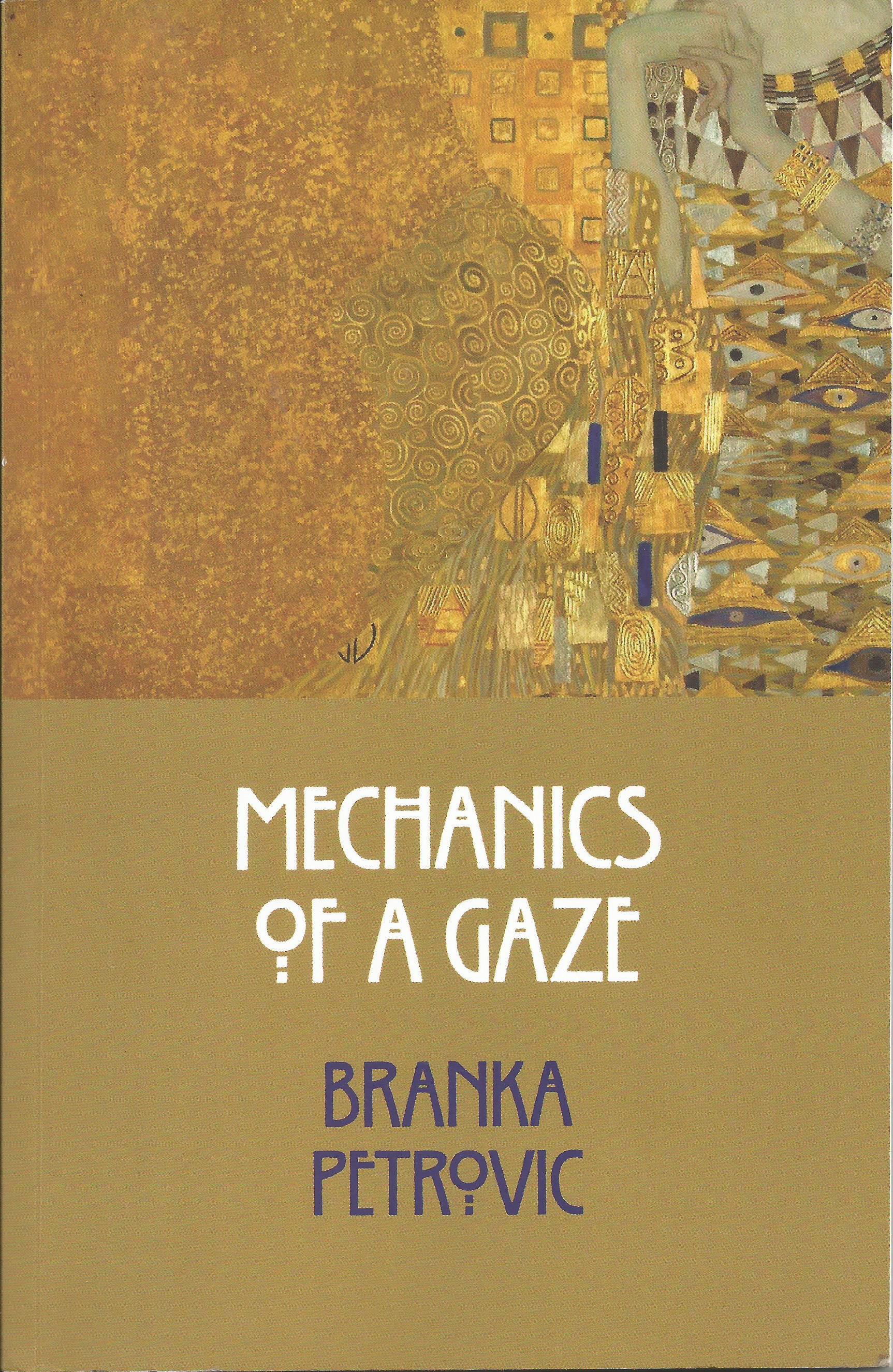
Mechanics of a Gaze by Branka Petrovic; poetry review and reading/writing tips

Inside his studio, a woman awaits // her turn to be myth

In Mechanics of a Gaze, Branka Petrovic strips the paintings of Gustav Klimt—layer by layer—until only the male gaze is left. Petrovic’s interpretation of the man and his work is not flattering. The poems are irreverent, provocative, skillful and mature.

The structure of the book leads us from insightful—although sometimes devastating profiles—and ekphrastic poems to historical notes and interpretations by others. In the first section (“His Women”), we meet a selection of the women who were model, muse and sexual object. The poems unmask the erotic within Klimt’s studio, sometimes blatantly and sometimes more suggestively.

Whatever’s semi about this nude, it’s not
the way we enter the sketch,
her swift dialogue of the illicit.

Slipped between the poems are excerpts from postcards sent by Klimt to Emilie Flӧge over their long relationship. They continue throughout, presaging the final section and providing an insight into the Klimt-Flӧge relationship and his character.

Next, the focus is on Emilie Flӧge, the woman who was Klimt’s friend, sometimes lover, and lifelong companion. In a poem called “Gustav & Emilie, Petrovic creates a scene (perhaps from a photo taken at her family cottage at Lake Attersee) but then imagines:

If he were to paint you right now,
the vertical lines of your dress
would leak jonquil, mutate

into a metallic-gold,

backdrop; osmanthus sprouting

from your hands….

…Your air,

a brooding saint.

Petrovic at once captures the essence of Klimt’s art and sexual fecundity as evidenced in “osmanthus.” In another poem, she does this with “Calder,” alluding to movement. Petrovic demonstrates a close reading of both the paintings/drawings and the characters that inhabit (and those who created) them. And in five words defines Flӧge and the relationship.

The third section places the gaze on Adele Bloch-Bauer. (You may recall the 2006 movie “The Woman in Gold,” starring Helen Mirren, which takes the point-of-view of Maria Altmann who reclaims the painting of her aunt from the Austrian establishment.)  In one poem, Petrovic expresses the essence of Adele and Klimt as “a Wittgenstein riddle.”

In the fourth section, “Mankind Drifting,” the perspective broadens to include Vienna and the Secessionists’ art (late 19th through early 20th centuries). The Secessionists led the way from traditional-to-modern art in Vienna. The movement turned conservative values on their head, and Gustav Klimt was in the vanguard.  In this section, Petrovic switches focus from Klimt’s portraits to his controversial work for the University of Vienna’s ceilings: Philosophy; Medicine; and Jurisprudence. It is also here that Petrovic returns to Egon Shiele, provocative protégé (“Disabled Sex” appears in the first section).

The final part, “Catalogue Raisonné,” is where we come to found poems and collages, information gleaned from sources such as Wikipedia and the Internet to reviews and the press from The New York Times to The Montreal Gazette. Petrovic’s innovative structuring of the collection leads readers from her subject—the sexualized gaze—of artist and model to the political subject of Nazi looting. With this innovation, Petrovic pushes the convention of most poetry collections.

Branka Petrovic’s debut collection reinvigorates Gustav Klimt and Secessionists’ art. You will never look at the stale gold and mosaic looking greeting cards of Klimt the same. I find Mechanics of a Gaze as invigorating as was the poetry of Sylvia Plath in the 1960s. My guess is that we’ll be hearing more from Branka Petrovic.


Tips for Writers

  1. Relevancy: read the poems as a whole, thinking about their subject and relevancy (see Good News for Poets and Readers). As a poet, what role does relevancy to your readers play in your writing? Is relevancy important?
  2. Read each poem for its ekphrastic insight, asking yourself if Petrovic captures the essence of the art. Does the poem work as a poem?
  3. In 2017, I reviewed The Painted Kiss by Elizabeth Hickey. Like “Peter Schjeldahl on Gustav Klimt Part 1” and “…Part II” in Mechanics of a Gaze, I have changed my mind somewhat. In that review, I ignored sexual politics and the inherent power of the “gaze.” But after reading The Mechanics of a Gaze, and having witnessed the revelations of the last couple of years, I’ve reread the more sympathetic Kiss. It is Hickey’s fictionalized story of Klimt, written entirely from the point-of-view of Emilie Flӧge. Hickey seeks to get under the skin and into the heart of a woman of the last century. Yet it is all there: the sexualized gaze and acts. Bring your consciousness to Petrovic’s collection. Is Mechanics of a Gaze a feminist collection? If so, does “the message” inform or detract from the work as art?
  4. The Secessionists rejected the orthodox conventions of late 19th-early 20th century Vienna. Their art was rejected by traditional art galleries, so they established their own, a movement toward modernity. Should it be judged/reinterpreted against today’s standards or accepted within its place in history?


Available through your local bookstore or online: Mechanics of a Gaze

Also, please see blog 14 The Painted Kiss (2005): The Painted Kiss

66 Mechanics of a Gaze

Panicle, poems by Gillian Sze, book review and writing tips

This is how the beginning sounds: an inkstick grinding against stone,
a dark circling like ancient gears. The water blackens from soot;
we paint with the burnt ashes of pine trees.

In “Calligraphy,” the first poem in Panicle by Gillian Sze, we are led into the art of writing which begins: “even before the brush touches the paper.” Sounds and the act of writing—of listening, witnessing, experiencing, reaching essence at the core—permeate Panicle. This is a collection about poetry itself.

In a prose poem, “Sound No2,” she writes:

There are things I want to show you, like the empty pause that encircles desire. Or how Klimt knew that a woman bends her neck that far for a kiss only if she really wants it. I want to show you how quiet it gets when you’re in the company of someone who no longer loves you.

Sze pushes beyond sound and sight, beyond even behavior, in order to explain poetry, as she does in “Bona Fide: or, Setting the Seine on Fire.” She begins by drawing us into “impressionist modes” (do you see the shimmering light?) and note how black differs in Paris where “even the chestnut trees never cast black shadows.” This thrusting of opposites applies to ideas about poetry as much as it does to the words within a poem. After creating the Parisian scene, she notes:

A modernist tells me
he’s searching for genuine tones
in poetry
something authentic, not fugitive…
Something, he repeats, in good faith.

And I tell him
I’m search for natural light.

She brings us back to experience and away from the theoretical voice of the critic.

In “Aubade,” Gillian Sze introduces a hospital room in which she sees “A raised cup / and behind my eyes / a rush of wings;” perhaps a reference to the Eucharist before she turns to nature as “each leaf lifts an eyebrow / and regards the day,” returning us to hope and light. (“Aubade translates from French roughly as auba=dawn + albus=light.) Her play on allusion and sound throughout the collection pares the subject down to its essence.

It seems to me that Sze breaks rules with “Staging Paris: Tableaux Vivants,” ten scenes that she outlines for us, each creating a situation, unresolved. She plays with light and sound. She leaves it to readers to resolve each situation.

My favourite section is the long poem that concludes the collection: “III Guillemets,” although she does not use the chevrons ‹ and › (single or double) in the poem. What is included are sketches by Jessica Hiemstra (please see the previous blog: Apologetic for Joy for Hiemstra-van der Horst’s poetry). The poem is a creative interpretation of Pouvoir du noir by Roland Giguère in which is contrasts black and white and much more in a clear, accessible way. I recommend Panicle for the clarity, contrasts, sound, and skill of Gillian Sze’s poems.

For the writers among us:

  1. Think about the place of sound in your poems;
  2. Think about creating tension through opposites;
  3. Think about leaving the door open for interpretation, allowing readers to draw their own conclusions, as Gillian Sze does in the “Tableaux.”

Available through your local bookstore or online: Panicle

65 Panicle

Apologetic for Joy by Jessica Hiemstra-van der Horst for poetry lovers

I ate quince with musicians and contemplated
transformation

In Apologetic for Joy, Jessica Hiemstra-van der Horst’s poems not only explore transformation but they also elicit the experience of transformation in her readers. In “Eating Quince with Musicians,” she creates images and takes us beyond the fruit and conversation.

It begins hard and yellow,” she said, needs peeling
and long heat.
Finally it is ambrosia, soft and red.

By the end of the fourth stanza, she weaves through the sensuality of experience, arriving at love and we do not question the transformation. This process unfolds throughout the collection, but sometimes there is a detour on the journey through the poem as there is in “Fingertips Are for Touching” when something discordant jars us into paying attention:

Do I leave a mark on you
when I graze by your chair?
Children understand loneliness
they sit in laps, cry
until they are empty.

Every mark I make
on you, on canvas,
is a brush with infinity, hoping
two of us under covers
see each other without light.

What do children have to do with the light mark she makes as she passes? Are the lonely children a way to tell us what the touch means to Hiemstra-van der Horst? Then we learn the marks she leaves “on you, on canvas…brush with infinity.” Infinity: an immensity, a vastness beyond quantity, beyond qualification. Notice how she leads us “under covers.” Notice how the poem takes us beyond sensuality into the deeper knowing of seeing beneath the surface, the deeper seeing even “without light.” Notice how simple the poem is on the surface of language and image and see how she transforms it into something difficult to quantify.

This is a woman like Daisy Johnson (please see Everything Under) who loves words and mines them for all they are worth. In the section Bad Things Erased by Oranges, Jessica Hiemstra-van der Horst travels to Southern Africa and into Setswana, a new language. The poems flow so smoothly the skill she employs could easily be overlooked. Then, with the abruptness of a phone call, she creates a shift and we see where she’s been taking us and the symbolic importance a simple thing like an orange can become.

Although seven sections make up Apologetic for Joy (most leading to sensual transformations), Notes for a Dying Amaryllis is different. It makes me smile despite its subject and situation. Here we meet George and God, two characters I have come to love. Once more, Hiemstra-van der Horst manages to reveal something easily overlooked. In “The Substance of Almost,” she once more sheds light on how she sees:

Gerald’s been complaining about a mouse in the wall.
For weeks I’ve assumed it’s in his head. Everything we see
is mixed with three colours and shades of darkness.

Nothing is quite as it seems. She uses words and painting, which she says in an interview are intertwined (please see “A Stabbing Out of Darkness”). With words, she strips the darkness away as if it was paint on her brush, making the image clear.

I have read Apologetic for Joy many, many times over the winter and into spring. Every reading has taken me deeper while also giving me more pleasure: pleasure in the insights Jessica Hiemstra-van der Horst shares about what she sees and where the experience of really seeing (and feeling) can take us. I’ve touched on only three of the seven sections of this collection. If you are a poetry lover—even if you are not—this is a rare book whose themes are pared down to their core. We are both fulfilled and left wanting more.

For the writers among us: Think about the excerpts and how every word is carefully chosen to provide sensual details that lead us to insight. Think about how she uses metaphor and symbol to make the abstract concrete and how she writes between the lines. Jessica Hiemstra-van der Horst is also a painter; think about how she integrates both art forms and what that adds to her writing.

Available through your local bookstore or online: Apologetic for Joy

64 Apologetic for Joy

Capturing a moment of time and light: the art of Daniel Fobert

Daniel Fobert’s art finds strength in the artist’s ability to tell a tale through his work.

By Kathryn MacDonald

Quinte Arts Council

On a cool afternoon last fall, I met Daniel Fobert at Gallery 121 on Bridge Street East in downtown Belleville, where he was exhibiting two oil paintings.

One of Fobert’s greatest strengths is the narrative in his paintings. In Kensington after the Rain, the foreground is taken up by a man gazing at a cell phone, while two friends look on. Behind them, people go about their daily business beneath colourful awnings. Imagine the story.

In the second painting exhibited at Gallery 121, a colourful nude fills the canvas. Here the oils dance in bright rainbow hues. In Untitled, a portrait of an unnamed woman, we have an example of Fobert’s balanced use of complementary colour.

He tells me that his greatest challenge “is to feel that what I do is relevant in the face of a world where everything is non-representational.”

Kensington after the Rain by Daniel Fobert


Abstract expressionism has been a dominant trend in Western art since the 1950s led by artists such as Jackson Pollock. Essentially, it defines non-representation work that strives to show the interior energy of experience rather than the outward image. Fobert adds even “[Jean-Paul] Riopelle returned to representational work after developing his renown in abstract expressionism.”

To compose the scene, Fobert uses photography as a guide to street paintings.

He doesn’t copy them; rather, he says, “I translate the photographed scenes into my composition.”

Daniel’s paintings demonstrate his drawing skill and his strength of composition. He also successfully achieves a sense of atmosphere or mood, a quality that is reminiscent of colourful expressionist artists such as LeRoy Nieman, whose name sports fans are especially likely to recognize for his paintings of athletes and sporting events.

Fobert began painting in high school, which is when he decided to “pursue an art career.” After studying graphic arts at Sheridan College—a wide-ranging program that included such courses as life drawing, print making, and colour theory—Fobert became involved with Toronto-based Screen Art Products.

There he was mentored by the owner, Ira Noble, who had studied with Arthur Lismer of Canada’s famous Group of Seven. Fobert eventually became co-owner of the company with his life-partner Mervin Patey. Among their clients were the Art Gallery of Ontario, the Royal Ontario Museum, and the Aga Khan Museum. During this period, Fobert “kept his creative spirit alive” by participating in Artists 25, a non-profit artists’ cooperative in Toronto.

A few years ago, Fobert “came home” to the Quinte region. “Part of my retirement goal is giving back,” he says. He is an active member of Gallery 121, the Baxter Art Centre, and the Quinte Arts Council.

To see more of Daniel Fobert’s work or to be in touch, please visit his website: danielfobert.com. You can find him on Facebook and Twitter as well.

Everything Under by Daisy Johnson Book Review and Writing Tips

The places we are born come back. They disguise themselves as migraines, stomach aches, insomnia. They are the way we sometimes wake falling….

Everything Under by Daisy Johnson is the story of a daughter, mother, and digging into memory:

If I really cared about you I would put you in a home for your own good. Floral curtains, meals at the same time every day, others of your kind. Old people are a species all of their own. If I really still loved you I would have left you where you were, not carted you here, where the days are so short they are barely worth talking about and where we endlessly, excavate, exhume what should remain buried.

It is the story of words: their creation, meaning, and power:

Occasionally we find those old words sneaking back in and we are undone by them. It’s as if nothing has ever changed, as if time doesn’t mean a jot. We have gone back and I am thirteen years old and you are my awful, wonderful, terrifying mother. We live on a boat on the river and we have words that no one else does. We have a whole language of our own.

And it is a story about fear: naming it, running from it:

One night I wake and you are screaming and screaming. I skid along the corridor, knock you door open, put on the light.

The Bonak is here, you say, and for a moment—because it is night and I am only just awake—I feel a rise of sickening panic.

Johnson’s story reverberates from the present to the past and it balloons into more than a mother’s dementia and a daughter’s search to find meaning behind the words, truth.

Some mornings I am cold with certainty that only some ancient punishment will do, a stoning or a blinding, leaving you out for the wolves. You tell me that you didn’t know and we grow silent and wonder if either of us really believes that. Again and again I go back to the idea that our thoughts and actions are determined by the language that lives in our minds.

Truth is elusive, stretching to include a run-away youth: Margo/Marcus. And it becomes tangled like the weeds beneath the boat, knotted into words woven into the Oedipus myth.

Daisy Johnson has created an original page-turning story that was shortlisted for The Man Booker Prize 2018. Fall into Everything Under and let her laden words carry you like the river’s current.

Reading as a writer:

  1. Gretel, the daughter-narrator, is a lexicographer. Pay attention to the role words play in the story and why Johnson made her a word person. As you read, also consider the naming of people and objects in Johnson’s story. What is the importance of Gretel’s career choice and how does it impact or layer the story? In your writing, what do character’s names bring to your stories? What do their roles contribute?
  2. Can you read “Gretel” without thinking of the fairy tale Hansel and Gretel? What does this allusion bring to Everything Under? Gretel is as lost in her own way as her mother is lost in dementia. Another literary reference is made to the Oedipus myth. Think about your own literary references and ask yourself if they are integral to your story, layering it and deepening the meaning, or if they are superficial and ostentatious.

63 Everything Under

Available through your local bookstore or online: Everything Under