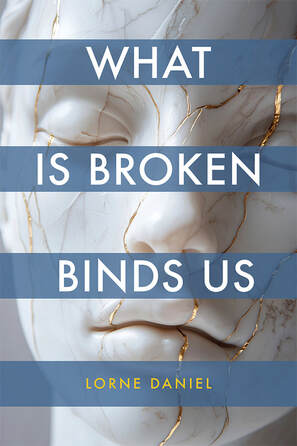
BOOK REVIEW: What is Broken Binds Us by Lorne Daniel

On the shoulder, waiting for a break, / me and this sleek crow, its cape / tucked and trim. (“Crushed”)

In What is Broken Binds Us, Lorne Daniel’s fifth poetry collection, he explores brokenness and the binding of lives within family and across generations and continents. The poems explore the shattering of bodies and minds, the brokenness of a society that condoned slavery and the racism that continues, and the diaspora that is reality for so many of us. Through a kind of kintsugi (the Japanese art of repairing pottery with gold, which emphasises the cracks rather than hiding them) Daniel names the shattering with poignancy, resilience, and beauty.

The collection is skillfully organized; the poems in each section closely relate in subject and theme. But there’s also a weaving that brings the overall threads together like a tapestry.

The first poem of the first of the seven sections in What is Broken Binds Us serves as a prologue poem, introducing many of the themes in the collection in Daniel’s clear, accessible, poetic voice. In “Lessons in Emergency Preparedness” (a three-part poem), we meet a younger poet/speaker Proudly / poor and adulting hard, a husband and new father, who would clamber onto my rusted one-speed / with its great sweeping handlebars / —wide as albatross wings— / and wheel urgently to the Office / of Emergency Preparedness. Daniel takes us into the workspace and introduces the team. There is an off-hours emergency, but the Emergency Preparedness friends have 

…No plan. I checked my wrist
for some reason, then the wall
clock, the school gym. It was 12:25,
the second hand still, improbably,
moving.

​Daniel captures an existential reality, our helplessness when the world we know turns upside down. And he does this with hints of humour, surprise, and irony.

“Crushed” is the transition between the first poem, in which death appears, and the following poems in the section that explores the broken body. It contains one of my favourite images: On the shoulder, waiting for a break, / me and this sleek crow, its cape / tucked and trim. The triad of danger, fear and survival, which theme the collection.

In the second section, Daniel broadens the scope: It is easy / to dip into purse and wallet, / give back the money. Cede the land. The bullets do not go easily / back into the barrel… (“Giving Back the Dream”).

There are echoes of Joni Mitchell in “What Has Taken Place”: 

…No plan. I checked my wrist
for some reason, then the wall
clock, the school gym. It was 12:25,
the second hand still, improbably,
moving.

Daniel captures an existential reality, our helplessness when the world we know turns upside down. And he does this with hints of humour, surprise, and irony.
 
“Crushed” is the transition between the first poem, in which death appears, and the following poems in the section that explores the broken body. It contains one of my favourite images: On the shoulder, waiting for a break, / me and this sleek crow, its cape / tucked and trim. The triad of danger, fear and survival, which theme the collection.
 
In the second section, Daniel broadens the scope: It is easy / to dip into purse and wallet, / give back the money. Cede the land. The bullets do not go easily / back into the barrel… (“Giving Back the Dream”).
 
There are echoes of Joni Mitchell in “What Has Taken Place”: 

what has taken place
here where roots of Garry oak
are paved over?     what stories
have been told of this 
place?     what does placemaking mean
where place has been
taken?      taken over     meadow turned city
street     bearing the name of a Spanish
naval officer

​Daniel is a questioning poet; he urges us to think, to consider what we’re doing, what we’ve already done.

In “The Family Name,” the third section of What is Broken Binds Us, the poems dig into heritage and migration, the roots of who we’ve become and the lonely search of those in the diaspora. In Scottish English, to ken means to know, to see, to understand. The family immigrated to Canada from the U.S. and before that from Scotland. In “Kenning,” the family makes a pilgrimage to Charleston, the Magnolia Plantation, to confront slavery. “In the Family Name” is one of the most powerful poems in the book. Daniel writes, 

Stories, grief, celebration. Distance, absence, loss. Where to start, 
as a Daniel bearing the name of an English 
enslaver…
[…]
…returning to the ties, to touch
what binds, to wonder what releases
the knotted, twisted, tangled.

​In the fourth section, we return to the immediate family and the infant introduced in the first poem, now a sleepwalker, a three-year-old talker: Well into the night, he swings / from story to song. The halting rhythms / hypnotic as his voice rises and rises / until with one high note he slips away. In succeeding poems, he literarily slips away into chaos. Somehow Daniel writes these poignant poems without pathos, without sentimentality.

The theme of uncontrollable chaos lingers in the fifth section, 

Please click The Temz Review to read the balance of the review. This is where the review is published.
BOOK REVIEW: The Character Actor Convention by Guy Elston

I’d sit with Napoleon in exile
and chat casually. (St. Helena)


The Character Actor Convention by Guy Elston brings together sharp, edgy, quirky voices in which the actor/poet speaks for the historic and the legendary, for a songbird, oxygen, and a board of directors. On first reading of Elston’s collection, thoughts of lad lit, then theatre of the absurd surface (Six Actors in Search of an Author?), but these poems are neither superficial or existential. A second reading challenges the first impression of witty lightness. The poems imagine; they reimagine, and they question. Elston’s “voice” is clear, clever, and has something to say.

The collection’s initial poem, “The Stake,” begins: “The night before, / and Joan is certain. As ever.” Like the absurdist existential authors of the 1950s, the ending mirrors the beginning: “Oh, I’ll burn, Joan laughs. / I do every time. Your move.” The magic lies in the couplets between. The chess-playing voice asks: “Do I want to make her wonder?” In the fifth couplet Joan asks: “How can these cassocked frauds judge me, / Joan sighs. Are you like them?” The voice watches a spider. Chess, a suggestion that life and death are a game? The spider, an allusion to spider-wisdom à la Charlotte’s Web? There’s also a “fallen bishop” and much to ponder.

This prologue poem introduces key themes that thread through The Character Actor Convention. Thoughts of dying and death subtly weave through the poems, as do games. The bishop (religion) and judging also thread through the collection, as they do in “St. Helena” (21) where the voice plays cards with Napoleon:

St. Helena

I’d sit with Napoleon in exile

and chat casually.

There are more variants of Patience

named after me than any other man,

he’d mention, casually. He had a habit

of counting waves and cheating

every time we played cards.

The money meant nothing to him,

less than nothing to me.

You do know that nobody

who joins me here may leave?

he sometimes asked, while watching

the distance for sails. I dug a little hole

in the sand with my left foot.

All summer, I never told him

we don’t even have God in the future.

Joan and Napoleon aren’t the only characters that confront death. In “For a Good Time” (57), fish fly larvae “die within days.” Elston refers to other historical personalities who meet death – “eight / dead Philippes. Eleanor of Castile, / of Provence, of Aquitaine…Joan of Arc…the dead Louis’s.” But I’m struck by the fish flies – hundreds gathered on outside furniture this spring and every light-coloured surface in my river town, crunching underfoot as I walked on downtown stinking. What inspires Elston to combine fish fly larvae with these historical figures? His vision is playful, unique, and surprisingly perfect. He draws us in with the whimsy and stops us with insight and the juxtapositions of his subjects. Life is brief for both the larvae and us. Life is so brief, the voice “stop[s] gunrunning, / start[s] writing poems.”

The title poem falls mid-collection (33).

To read the full review, please click here for the link to The tEmz Review.

Review of The Dialogues: The Song of Francis Pegahmagabow by Armand Garnet Ruffo

Here is a story that does not end, but continues today in those who believe in a country where justice will prevail, as new generations rise up to fill the footsteps of warriors who have fallen long ago, whose sacrifices and legacies we continue to remember and honour….
(133)

Armand Garnet Ruffo has published poetry and prose, made films, and created anthologies in addition to his academic credentials. The various skills required for these successes come together in The Dialogues: The Song of Francis Pegahmagabow, creating a literature that is extraordinary.

The Dialogues breaks the boundaries of what we think of as poetry. In poetry, we expect “density of meaning, felicity of language, authenticity of feeling.” It should also “deliver to us…the sense of urgency,” and Ruffo gives us all this and more. We don’t expect the weaving of documentation through the book-length poem, but here it is, smoothly echoing the poetic voice of Pegahmagabow and that of the poet-narrator who occasionally intervenes. And as suggested by the title, this overlays the idea of musical performance. The demands of staying true to an historical life, while working within the constraints of the musical, has resulted in the unique the structure of The Dialogues.

The poetry, as we’re accustomed to think of it, is on the lefthand page. On the facing page are facts substantiating the poetics: sometimes it is in the form of the poet’s memory; sometimes in the form of a government or military document; sometimes a background statement as is “An Interlude to Discuss Francis’s Encounter” (35). As well, this collection weaves an actual musical score from the production that inspired this book (21). 

The Dialogues is innovative in its narrative and story-telling, not only in its voice and in its structure but also in its immense impact. Reading it, I thought of Omeros by Derek Walcott. Ruffo’s scaffolding may not be created on a myth, but The Dialogues is mythic. Francis Pegahmagabow is a hero: in his soldiering; in his life after the Great War; and in his legacy. The Dialogues takes us on a time-journey, a culture-journey, a life-journey, from which I came away bruised but better understanding a life, a time, and a People in a “felt” way beyond intellectual knowledge alone. 

To read the entire review, click here.

What I’m reading: Legwork by Michael Vince

In July, I read a review of Legwork by Michael Vince, his tenth collection, in The High Window Reviews. I travel and often write about my experiences and was curious; I ordered the book.

The reviewer, Edmund Prestwich, notes how the poet “interweaves gravity with quirky humour,” how the poems often include a “shimmer of implicit reflections,” and sometimes the poems take on a “more cerebral, conceptual form.”

Although the poems are set in specific places with specific details, the actual location is not named, and the poet manages, with apparent ease, to jump the gap from personal to universal. I often find the poems take me on a surprising journey, as my favourite poem does:

Spa Town

We walk to the spa town, just a small village,
hard going in the heat, though nobody seeking
for its healing waters goes there on foot,
uphill and down, it’s just too much for them,
like the sudden appearance of a tethered bull
or a flurry of chickens, where rocks and pines
hide the sea view. On the spa town streets
elderly folk no longer linger over lunch,
or smoke and sip at coffee, but well wrapped
in layers of showy abstinence and in cosy
dressing-gowns seek health-restoring waters.
Here we watch one, an old man in pyjamas,
stroll out unsteadily down a concrete pier
towards the ocean, followed by a ginger cat,
tail up, pacing to keep company. The man
turns back several times and mutters,
exchanging nods with this attentive creature
who hasn’t come here for its health. They look
like a couple out for a walk, taking the air
on holiday. When they reach the end of the pier
perched above the waves, the cat sits
and grooms. The old man lights a cigarette,
and convinces himself that nobody can see,
while the ginger cat waits, much like a nurse,
or a child out with grandpa, who comes each year
for coffee-less, wine-less days. The old man
gazes out, where the healing waters mingle
with the bitter salt. He takes laboured breaths,
then turns. He says the word, the cat agrees,
and they both begin their slow return to the shore.

A poem with a very different feel from “Spa Town” is “Borderland,” which begins: “She told me the day they crossed over, / almost as if it was a holiday….” It’s a homecoming poem in which memory, dissociation, and the absurd collide. In part 2, Vince writes: “People from across the border / come here to walk around the suburb, / the designs are quite famous, / people whose grandparents lived here / when it was another country. …Home, that’s a flexible idea, isn’t it? / Have some more wine.”

Vince writes on his website: “I’ve always been interested in the historical and psychological pressure points of living in a particular place…. As I have lived and worked for much of my life in other countries, and being part of a bi-cultural family, my writing explores places and people, feelings and experiences, with that perspective. I believe that we constantly explore and recreate such identities, which shift through time and place and language….”

If you follow my reviews, you know that I read many Canadian writers. Yet, I think it’s important to read widely and internationally. There are different tones, different ways to find the core of a subject, shifts of perspective. What are you reading?

Mica Press, 2024

What I’m reading – Hunger: The Poetry of Susan Musgrave selected by Micheline Maylor

Her dress is the colour of soft butter. / Her hunger tastes of whiskey and rain. (“Hunger”)

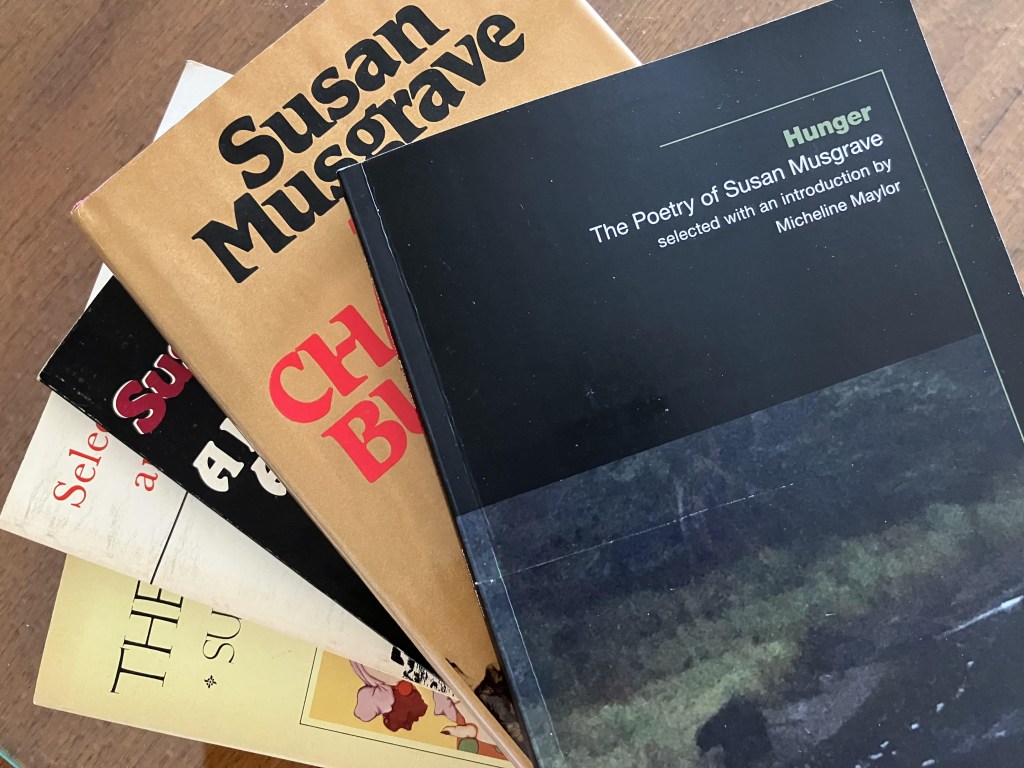
Back in the 1970s when I was at university, few female poets were invited for readings – poetry was a man’s game – and Susan Musgrave is the only woman that I recall reading at the university during that decade. I was hooked. During that time, I collected three poetry books and one novel, each autographed by Susan, along with a postcard note. (In another book, I found a slender feather used as a page marker.) To this small group of her early work, I’ve now added, Hunger: The Poetry of Susan Musgrave selected with an introduction by Micheline Maylor.

In the introduction, Micheline Maylor writes that Susan Musgrave’s “poetry is personal, intimate, confessional, esoteric, and infused with sadness…(xiii). Further along, Maylor writes: “Her impeccable use of grammar is that kind that causes poets a sort of aesthetic arrest. I could write an essay on the grammar in her poem ‘Tenderness’ from Exculpatory Lilies. The use of colons and question marks as midline-forced full stops gave me a new standard for structural parallelism and a kind of a craft that is a master class of internal enjambment and pacing at line level” (xx). ‘Tenderness’ is included in the collection as is an afterward by Susan Musgrave.

Each poem takes my breath away and I’m finding new favourite passages – “Lately I have come to believe / all that is of value is the currency / of the heart…” (“Origami Dove,” 27); “wild and alone is the way to live” (“Wild and Alone,” 47) in which she learns a life lesson from a mouse – besides the sadness, you will also find a little subtle humour (or so I’m reading it that way today). Like Musgrave’s Granny, brew a pot of strong tea and enjoy.

The Impstone by Susan Musgrave (McClelland and Stewart Limited, 1976)

Selected Strawberries and Other Poems by Susan Musgrave (Sono Nis Press, 1977)

A Man to Marry, A Man to Bury (McClelland and Stewart Limited, 1979)

The Charcoal Burners: a novel (McClelland and Stewart Limited, 1980)

Hunger: The Poetry of Susan Musgrave selected by Micheline Maylor (Wilfrid Laurier University Press, 2025)

Only five of the 35 books by Susan Musgrave. Wow!

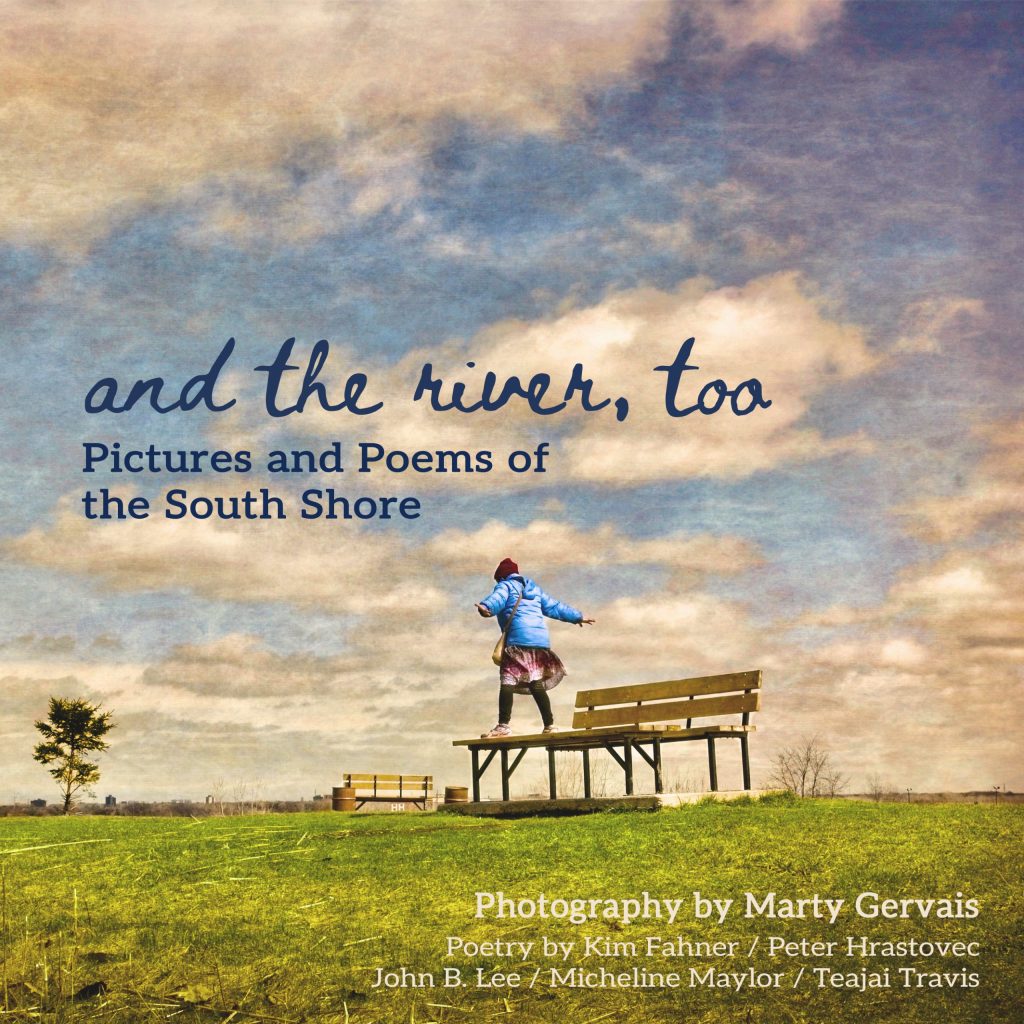
What I’m Reading: and the river, too: Pictures and Poems of the South Shore

Photography by Marty Gervais, Poetry by Kim Fahner, Peter Hrastovec, John B. Lee, Micheline Maylor, Teajai Travis (Black Moss Press, 2025)

Like Windsor, the photographs in and the river, too are gritty, bold, beautiful; each is a story; each is a poem. Music overflows the poetry – perfect since we grew up on Motown, on the jazz that crossed the river, on our own homegrown – and each poem also suggests the grit and sensuous experiences that connect the poets to the place.

Some of my favourite lines include:

“I am a crow, caught on lift of current, restless and open.” (“Migration Patterns,” Kim Fahner)

“…but the guy-wires of the bridge 
appear strung in pairs 
like piano wires / carrying the music of the wind”
(“The Gordie Howe International Bridge,” John B. Lee)

“A smooth descent down a fretless spin.” (“Honey Suckle Steel Beneath a Blue Sun (Jazz)” Teajai Travis)

“Here in the alley,” a phrase repeated, beginning four of the seven stanzas, creating music and echoes (“Here in the Alley, Peter Hrastovec)

“I’m made from rivermud, muck-sludge with scrap metal,
truck traffic, human traffic, tunnel traffic, bridge traffic
Georgian buildings turned to falafel shops. A wreckage
[…]
(“Ground Zero: Ouellette and Riverside,” Micheline Maylor — I love the rush of it, the music of it, the truth of it)

Black Moss Press, 2025

What I’m reading: The Moon that Turns You Back by Hala Alyan

The Moon that Turns You Back by Hala Alyan “blurs boundaries and borders between place, time, and poetic form” (cover copy). The poems are beautifully rendered and pulse with emotion; they look inside and out into the world. This poem, “Half-Life in Exile” is representative of a major theme in the collection, but the form and structure of the poems varies from rather traditional to experimental. I’m loving the read.

The Moon that Turns You Back by Hala Alyan (Ecco, 2024)

Other reviews under the “witness” umbrella that may interest you include:

Almond Blossoms & Beyond by Mahmoud Darwish, trans. by Mohammad Shaheen (here)

Songs of Exile by Bänoo Zan (here)

Alien Correspondents by Antony Di Nardo (here)

[…] by Fady Joudah (here)

A Crash Course in Molotov Cocktails by Halyna Kruk (here)

from Sarajevo with Sorrow by Goran Simić, translated by Amela Simić (here)

Poetry is Blood by Keith Garebian (here)

The Sleep Orchard: A Response to Arshile Gorky by Amy Dennis (here)

Review of Hollay Ghadery’s Rebellion Box

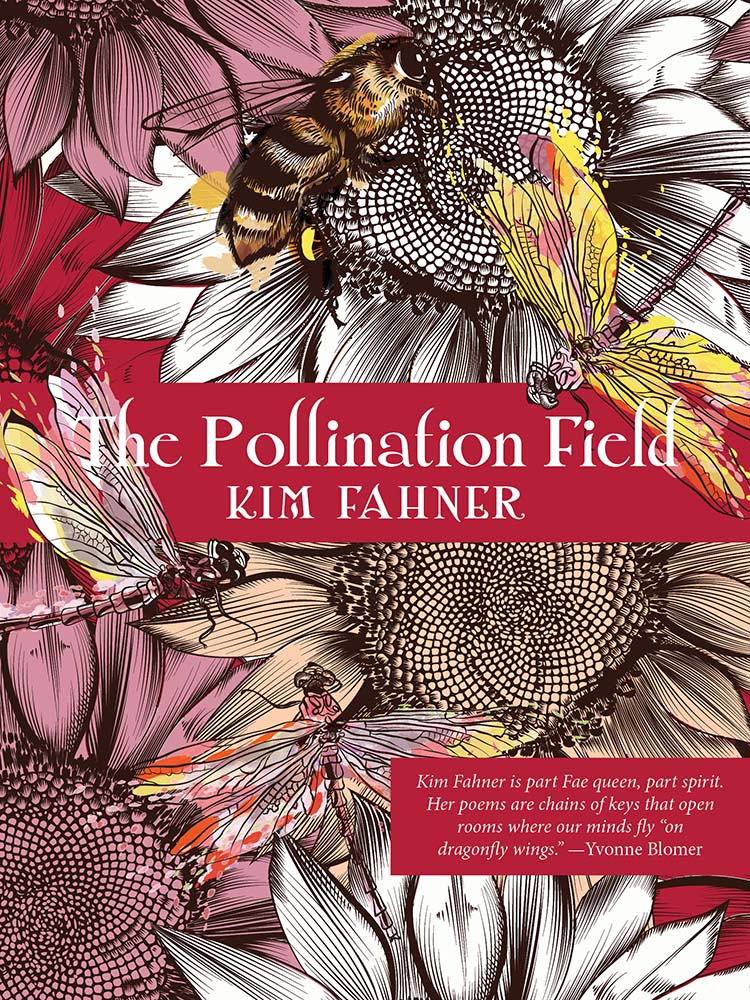
Perhaps one shouldn’t judge a book by its cover, but the cover of Rebellion Box is revealing. The illustration is dominated by a housedress trimmed in pink upon a paint-peeling background exposing an opaque scene that leads the eye to another and another. This, in a way, is what the poems do in Ghadery’s debut collection.

Opening to the first poem, “Postcard, Santa Maria,” we meet a girl, sensuous beside a pool, but then, a disclaimer: “I’m not that girl / anymore.” This, followed by the surprise “the cervix / of a fifteen-year-old, / my doctor says. / Not bad / for four kids” (1-2). And so, we are introduced to the speaker of many of the poems that follow, and a dominant theme of the collection is identified. Who is this woman who once lay by a pool in sunshine, who is a mother, who we will learn is biracial and bicultural, who attends historical talks, who writes poetry “to get [her] thoughts straight,” as suggested in an article Ghadery published in The New Quarterly.

In that article, Ghadery refers specifically to the title poem (45-46), a sestina, in which form controls and shapes the poem – a box as it were, for sharing the 1837 love story of Joseph, prisoner of the rebellion, and his love, Mary. The form disciplines Ghadery, allowing her to reveal the “mores and values” of the time in a tight, coherent way. Those mores and values are a constraint for the protagonist who cannot approach Mary directly, and I wonder, as I read through the collection time and again, if the Rebellion Box hasn’t become a metaphor for the constraints experienced by the poet herself. 

To read the entire review that is published by FreeFall Magazine, please click here.

What I’m reading: Almond Blossoms & Beyond by Mahmoud Darwish, trans. by Mohammad Shaheen

Early in his long poetic career, Mahmoud Darwish became known as “the poet” of Palestine. Each time I read through Almond Blossoms and Beyond, I become more aware of how deeply tied the words he chooses are to the metaphors and symbolism of Palestine and Palestinians.

One of my favourite poems in the collection is “To Describe an Almond Blossom.” It begins: “To describe an almond blossom no encyclopedia of flowers / is any help to me, no dictionary. / Words carry me off to snares of rhetoric / that wound the sense, and praise the wound they’ve made.” He searches. He questions. He writes: “Neither homeland nor exile are words, / but passions of whiteness in a / description of the almond blossom.” He concludes the poem without having written the national anthem that he set out to write in the 1960s. Palestine is not yet free.

The almond blossom – metaphor of resilience and hope – is a presence in the collection, along with many other symbols: horseman and gazelle, pomegranate blossoms, the olive, bridge, moth, and that is the beginning. These metaphors and symbols are easy to research and doing so will deepen your understanding of place (Palestine) and the loss of place, the anguish of exile.

In reading and rereading the collection, I experience the poems as witness to the diaspora that began in 1948, and of the agony of exile. “Exile” is the title of half the eight sections that structure the book (Exile V to Exile VIII). Each is a long poem occupying pages 49-95. (In a review I wrote on my blog on February 10, 2020, I quoted Carolyn Forché’s definition of witness poetry. You can find it here.)

The poems in Almond Blossoms & Beyond are among the last poems Darwish wrote, and they overflow with the fullness of his passion and the skill of his years.

Almond Blossoms & Beyond by Mahmoud Darwish (1941-2008), translated by Mohammad Shaheen (Interlink Books 2024; first published in Arabic in 2009)

What I’m Reading:

No wonder the land is so rich / Blood is the best water
(“Battle of Books”).

Songs of Exile by Bänoo Zan (Guernica Editions, 2016)

Last fall, I met Bänoo Zan at the Northumberland Festival of the Arts literary event where she read. What a pleasure! I purchased a copy of Songs of Exile and have enjoyed (maybe not the best word for a book that unsettles) many read-throughs. Since then, Bänoo has received The Writers’ Union of Canada’s 2025 Freedom to Read Award. If you haven’t read Songs of Exile, My Father, or any of her other published work, I suggest you visit your library or bookstore. Bänoo Zan writes with passion, insight, and skill.