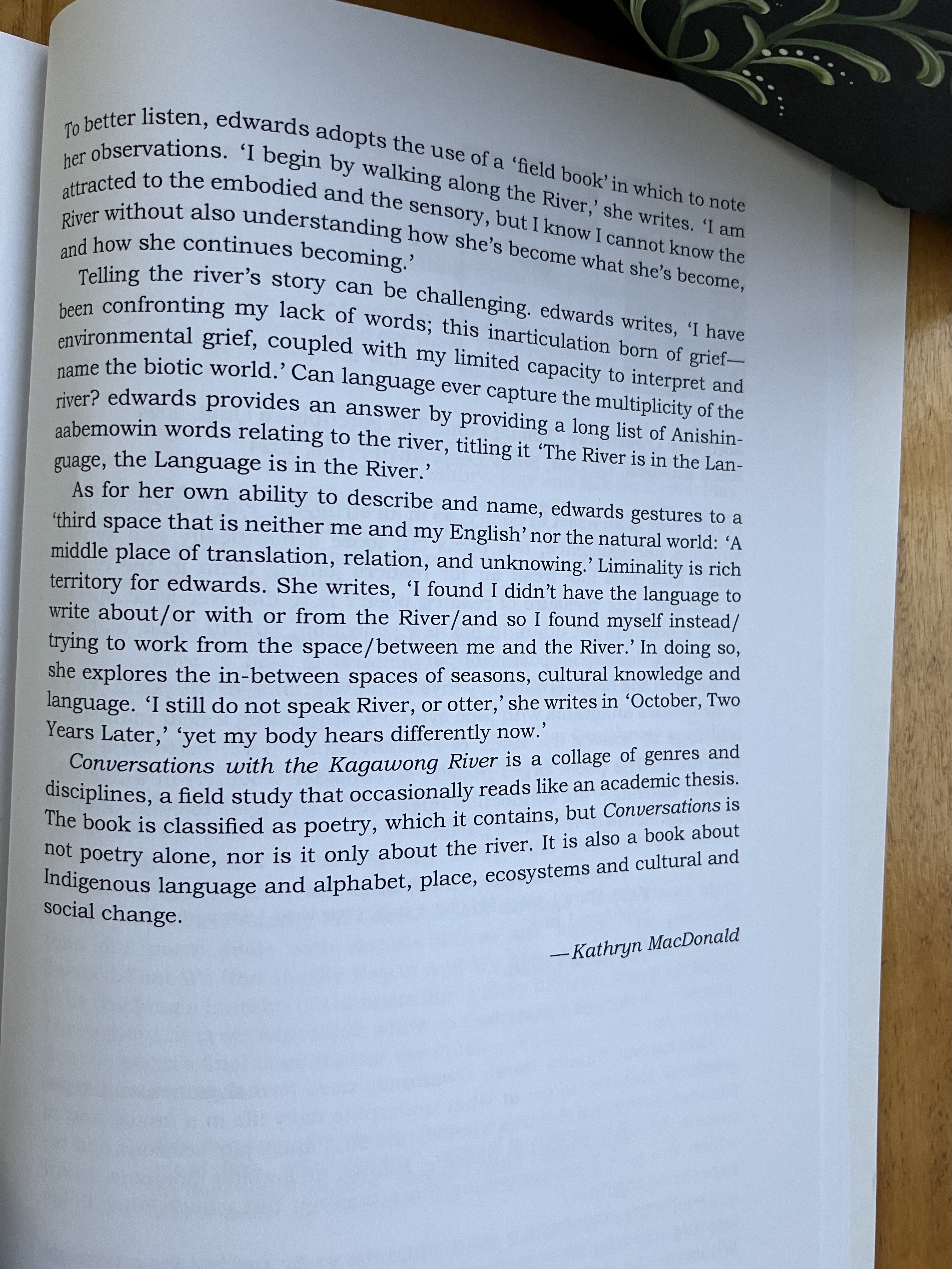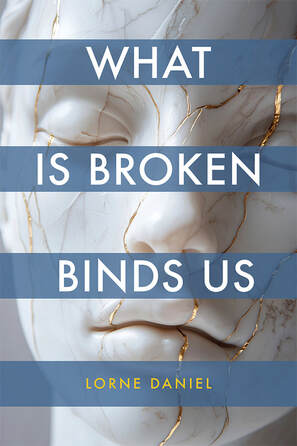
BOOK REVIEW: What is Broken Binds Us by Lorne Daniel

On the shoulder, waiting for a break, / me and this sleek crow, its cape / tucked and trim. (“Crushed”)

In What is Broken Binds Us, Lorne Daniel’s fifth poetry collection, he explores brokenness and the binding of lives within family and across generations and continents. The poems explore the shattering of bodies and minds, the brokenness of a society that condoned slavery and the racism that continues, and the diaspora that is reality for so many of us. Through a kind of kintsugi (the Japanese art of repairing pottery with gold, which emphasises the cracks rather than hiding them) Daniel names the shattering with poignancy, resilience, and beauty.

The collection is skillfully organized; the poems in each section closely relate in subject and theme. But there’s also a weaving that brings the overall threads together like a tapestry.

The first poem of the first of the seven sections in What is Broken Binds Us serves as a prologue poem, introducing many of the themes in the collection in Daniel’s clear, accessible, poetic voice. In “Lessons in Emergency Preparedness” (a three-part poem), we meet a younger poet/speaker Proudly / poor and adulting hard, a husband and new father, who would clamber onto my rusted one-speed / with its great sweeping handlebars / —wide as albatross wings— / and wheel urgently to the Office / of Emergency Preparedness. Daniel takes us into the workspace and introduces the team. There is an off-hours emergency, but the Emergency Preparedness friends have 

…No plan. I checked my wrist
for some reason, then the wall
clock, the school gym. It was 12:25,
the second hand still, improbably,
moving.

​Daniel captures an existential reality, our helplessness when the world we know turns upside down. And he does this with hints of humour, surprise, and irony.

“Crushed” is the transition between the first poem, in which death appears, and the following poems in the section that explores the broken body. It contains one of my favourite images: On the shoulder, waiting for a break, / me and this sleek crow, its cape / tucked and trim. The triad of danger, fear and survival, which theme the collection.

In the second section, Daniel broadens the scope: It is easy / to dip into purse and wallet, / give back the money. Cede the land. The bullets do not go easily / back into the barrel… (“Giving Back the Dream”).

There are echoes of Joni Mitchell in “What Has Taken Place”: 

…No plan. I checked my wrist
for some reason, then the wall
clock, the school gym. It was 12:25,
the second hand still, improbably,
moving.

Daniel captures an existential reality, our helplessness when the world we know turns upside down. And he does this with hints of humour, surprise, and irony.
 
“Crushed” is the transition between the first poem, in which death appears, and the following poems in the section that explores the broken body. It contains one of my favourite images: On the shoulder, waiting for a break, / me and this sleek crow, its cape / tucked and trim. The triad of danger, fear and survival, which theme the collection.
 
In the second section, Daniel broadens the scope: It is easy / to dip into purse and wallet, / give back the money. Cede the land. The bullets do not go easily / back into the barrel… (“Giving Back the Dream”).
 
There are echoes of Joni Mitchell in “What Has Taken Place”: 

what has taken place
here where roots of Garry oak
are paved over?     what stories
have been told of this 
place?     what does placemaking mean
where place has been
taken?      taken over     meadow turned city
street     bearing the name of a Spanish
naval officer

​Daniel is a questioning poet; he urges us to think, to consider what we’re doing, what we’ve already done.

In “The Family Name,” the third section of What is Broken Binds Us, the poems dig into heritage and migration, the roots of who we’ve become and the lonely search of those in the diaspora. In Scottish English, to ken means to know, to see, to understand. The family immigrated to Canada from the U.S. and before that from Scotland. In “Kenning,” the family makes a pilgrimage to Charleston, the Magnolia Plantation, to confront slavery. “In the Family Name” is one of the most powerful poems in the book. Daniel writes, 

Stories, grief, celebration. Distance, absence, loss. Where to start, 
as a Daniel bearing the name of an English 
enslaver…
[…]
…returning to the ties, to touch
what binds, to wonder what releases
the knotted, twisted, tangled.

​In the fourth section, we return to the immediate family and the infant introduced in the first poem, now a sleepwalker, a three-year-old talker: Well into the night, he swings / from story to song. The halting rhythms / hypnotic as his voice rises and rises / until with one high note he slips away. In succeeding poems, he literarily slips away into chaos. Somehow Daniel writes these poignant poems without pathos, without sentimentality.

The theme of uncontrollable chaos lingers in the fifth section, 

Please click The Temz Review to read the balance of the review. This is where the review is published.

BOOK REVIEW: The Character Actor Convention by Guy Elston

I’d sit with Napoleon in exile
and chat casually. (St. Helena)


The Character Actor Convention by Guy Elston brings together sharp, edgy, quirky voices in which the actor/poet speaks for the historic and the legendary, for a songbird, oxygen, and a board of directors. On first reading of Elston’s collection, thoughts of lad lit, then theatre of the absurd surface (Six Actors in Search of an Author?), but these poems are neither superficial or existential. A second reading challenges the first impression of witty lightness. The poems imagine; they reimagine, and they question. Elston’s “voice” is clear, clever, and has something to say.

The collection’s initial poem, “The Stake,” begins: “The night before, / and Joan is certain. As ever.” Like the absurdist existential authors of the 1950s, the ending mirrors the beginning: “Oh, I’ll burn, Joan laughs. / I do every time. Your move.” The magic lies in the couplets between. The chess-playing voice asks: “Do I want to make her wonder?” In the fifth couplet Joan asks: “How can these cassocked frauds judge me, / Joan sighs. Are you like them?” The voice watches a spider. Chess, a suggestion that life and death are a game? The spider, an allusion to spider-wisdom à la Charlotte’s Web? There’s also a “fallen bishop” and much to ponder.

This prologue poem introduces key themes that thread through The Character Actor Convention. Thoughts of dying and death subtly weave through the poems, as do games. The bishop (religion) and judging also thread through the collection, as they do in “St. Helena” (21) where the voice plays cards with Napoleon:

St. Helena

I’d sit with Napoleon in exile

and chat casually.

There are more variants of Patience

named after me than any other man,

he’d mention, casually. He had a habit

of counting waves and cheating

every time we played cards.

The money meant nothing to him,

less than nothing to me.

You do know that nobody

who joins me here may leave?

he sometimes asked, while watching

the distance for sails. I dug a little hole

in the sand with my left foot.

All summer, I never told him

we don’t even have God in the future.

Joan and Napoleon aren’t the only characters that confront death. In “For a Good Time” (57), fish fly larvae “die within days.” Elston refers to other historical personalities who meet death – “eight / dead Philippes. Eleanor of Castile, / of Provence, of Aquitaine…Joan of Arc…the dead Louis’s.” But I’m struck by the fish flies – hundreds gathered on outside furniture this spring and every light-coloured surface in my river town, crunching underfoot as I walked on downtown stinking. What inspires Elston to combine fish fly larvae with these historical figures? His vision is playful, unique, and surprisingly perfect. He draws us in with the whimsy and stops us with insight and the juxtapositions of his subjects. Life is brief for both the larvae and us. Life is so brief, the voice “stop[s] gunrunning, / start[s] writing poems.”

The title poem falls mid-collection (33).

To read the full review, please click here for the link to The tEmz Review.

What I’m reading: Legwork by Michael Vince

In July, I read a review of Legwork by Michael Vince, his tenth collection, in The High Window Reviews. I travel and often write about my experiences and was curious; I ordered the book.

The reviewer, Edmund Prestwich, notes how the poet “interweaves gravity with quirky humour,” how the poems often include a “shimmer of implicit reflections,” and sometimes the poems take on a “more cerebral, conceptual form.”

Although the poems are set in specific places with specific details, the actual location is not named, and the poet manages, with apparent ease, to jump the gap from personal to universal. I often find the poems take me on a surprising journey, as my favourite poem does:

Spa Town

We walk to the spa town, just a small village,
hard going in the heat, though nobody seeking
for its healing waters goes there on foot,
uphill and down, it’s just too much for them,
like the sudden appearance of a tethered bull
or a flurry of chickens, where rocks and pines
hide the sea view. On the spa town streets
elderly folk no longer linger over lunch,
or smoke and sip at coffee, but well wrapped
in layers of showy abstinence and in cosy
dressing-gowns seek health-restoring waters.
Here we watch one, an old man in pyjamas,
stroll out unsteadily down a concrete pier
towards the ocean, followed by a ginger cat,
tail up, pacing to keep company. The man
turns back several times and mutters,
exchanging nods with this attentive creature
who hasn’t come here for its health. They look
like a couple out for a walk, taking the air
on holiday. When they reach the end of the pier
perched above the waves, the cat sits
and grooms. The old man lights a cigarette,
and convinces himself that nobody can see,
while the ginger cat waits, much like a nurse,
or a child out with grandpa, who comes each year
for coffee-less, wine-less days. The old man
gazes out, where the healing waters mingle
with the bitter salt. He takes laboured breaths,
then turns. He says the word, the cat agrees,
and they both begin their slow return to the shore.

A poem with a very different feel from “Spa Town” is “Borderland,” which begins: “She told me the day they crossed over, / almost as if it was a holiday….” It’s a homecoming poem in which memory, dissociation, and the absurd collide. In part 2, Vince writes: “People from across the border / come here to walk around the suburb, / the designs are quite famous, / people whose grandparents lived here / when it was another country. …Home, that’s a flexible idea, isn’t it? / Have some more wine.”

Vince writes on his website: “I’ve always been interested in the historical and psychological pressure points of living in a particular place…. As I have lived and worked for much of my life in other countries, and being part of a bi-cultural family, my writing explores places and people, feelings and experiences, with that perspective. I believe that we constantly explore and recreate such identities, which shift through time and place and language….”

If you follow my reviews, you know that I read many Canadian writers. Yet, I think it’s important to read widely and internationally. There are different tones, different ways to find the core of a subject, shifts of perspective. What are you reading?

Mica Press, 2024

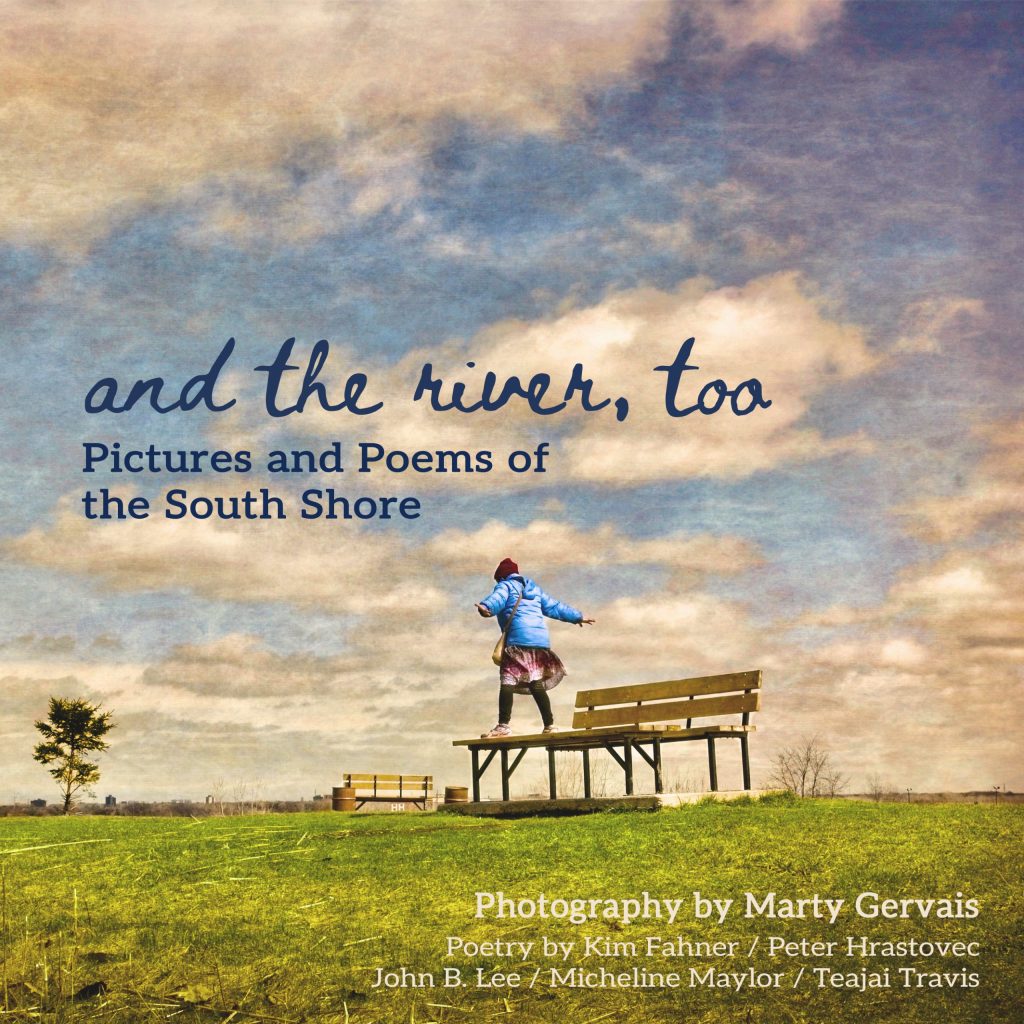
What I’m Reading: and the river, too: Pictures and Poems of the South Shore

Photography by Marty Gervais, Poetry by Kim Fahner, Peter Hrastovec, John B. Lee, Micheline Maylor, Teajai Travis (Black Moss Press, 2025)

Like Windsor, the photographs in and the river, too are gritty, bold, beautiful; each is a story; each is a poem. Music overflows the poetry – perfect since we grew up on Motown, on the jazz that crossed the river, on our own homegrown – and each poem also suggests the grit and sensuous experiences that connect the poets to the place.

Some of my favourite lines include:

“I am a crow, caught on lift of current, restless and open.” (“Migration Patterns,” Kim Fahner)

“…but the guy-wires of the bridge 
appear strung in pairs 
like piano wires / carrying the music of the wind”
(“The Gordie Howe International Bridge,” John B. Lee)

“A smooth descent down a fretless spin.” (“Honey Suckle Steel Beneath a Blue Sun (Jazz)” Teajai Travis)

“Here in the alley,” a phrase repeated, beginning four of the seven stanzas, creating music and echoes (“Here in the Alley, Peter Hrastovec)

“I’m made from rivermud, muck-sludge with scrap metal,
truck traffic, human traffic, tunnel traffic, bridge traffic
Georgian buildings turned to falafel shops. A wreckage
[…]
(“Ground Zero: Ouellette and Riverside,” Micheline Maylor — I love the rush of it, the music of it, the truth of it)

Black Moss Press, 2025

What I’m Reading:

No wonder the land is so rich / Blood is the best water
(“Battle of Books”).

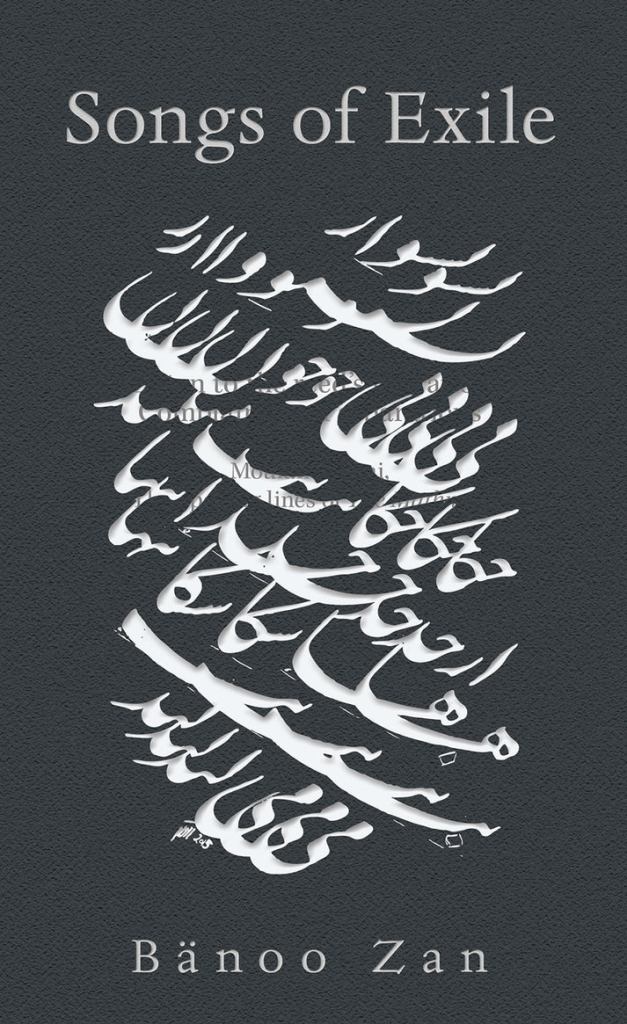
Songs of Exile by Bänoo Zan (Guernica Editions, 2016)

Last fall, I met Bänoo Zan at the Northumberland Festival of the Arts literary event where she read. What a pleasure! I purchased a copy of Songs of Exile and have enjoyed (maybe not the best word for a book that unsettles) many read-throughs. Since then, Bänoo has received The Writers’ Union of Canada’s 2025 Freedom to Read Award. If you haven’t read Songs of Exile, My Father, or any of her other published work, I suggest you visit your library or bookstore. Bänoo Zan writes with passion, insight, and skill.

BOOK REVIEW: In a Tension of Leaves and Binding by Renée M. Sgroi

(Guernica Editions, 2024, 121 pages)

                            observe the body

as it worms between leaves, squeezes into folio, witness to textured
weave, to signatures bound in faux leather, in paperback, translations
between rows of beans, pods of verbal clauses dangling from stems
while fields lie fallow, forests burn perforated pages where words,
who paragraphs steak justified in columns, sliced cubes of letters
under crumble of Pink Pearl erasers as the system of nature,
like absented rivers, flows unmarked in the margins
(“systema,” 11)

In a Tension of Leaves and Binding is Renée M. Sgroi’s second poetry collection. With its varied forms (traditional and experimental) and play of voices (the poet’s and those of plants and animals) we enter a world both multilayered and accessible. Beautifully conceived and delivered, In a Tension of Leaves and Binding delights and intrigues.

Grounded in the garden, the poems are dirt under the fingernails, both real and metaphor.  Reading In a Tension… we learn about the inhabitants of, and visitors to, the garden. We sense grief. And we learn about the gardener – her intense stare, touch, involvement – her leap into “other.”

To distinguish the voices of poet from “other,” Sgroi shifts margins. The poems on the left margin are in the poet’s voice. Others, she tells us are “centred in the middle of the page, a sign that the imagined voice of the onion, the carrot, the grasshopper is bounded by the margins of what is knowable and what is not” (“In other words, two,” 113).

She also plays with form in other ways. For example, the words in “Morphology” box a rectangle, a garden. Words in the seven “visitations” poems are scattered across the pages like birds visiting a feeder. Sgroi experiments with form in still other ways. In “MIXED METHODS EXPERIMENTAL STUDY OF ACER SACCHARUM IN SITU, WITH PROGNOSIS BY ARBORISTS AND LINGUISTS ON THE FUTURE OF INTERSPECIES COMMUNICATION: AN INVESTIGATION” (45-49) Sgroi’s form mimics a research paper under the headings of abstract through conclusions.

Some poems reveal, some stir questions like riddles in a caldron. Some poems, like the titular poem connect us – mothers and daughters – to trees and leaves:

sweetness is the sound a pen makes
or a spine’s crack when first opened

as a birth canal binds daughter, mother
into a book of doubled pages

and into the sweep a willow branch extends
low beside the river,

and snaps

in a tension of leaves and binding,”
… (50).

Please read the remainder of the review in The Temz Review.

Review of Erina Harris’ “Trading Beauty Secrets with the Dead”

This review has been published by FreeFall Magazine (December 2024)

Trading Beauty Secrets with the Dead
by Erina Harris
Wolsak & Wynn (2024)

Academic and poet, Erina Harris, has several interests and concerns, many find their way into the subjects and themes of her second poetry collection, Trading Beauty Secrets with the Dead.

According to Harris’ profile on the University of Alberta website, where she teaches, her research interests include fairy tales, rhyme and nonsense verse, gender and women’s writing, subjectivity and relationality, experimentalism and more. Given this array, Harris meets the organizational challenge of creating a cohesive collection by structuring the poems into an abecedarium. But the complex weaving of varied subjects and themes into a whole is not the only thing that readers will notice. As in her first book, The Stag Head Spoke, the poetry here is highly original and experimental.

Readers are treated to rhyme and nonsense verse, word-play and music, a taste of Dadaism and Surrealism among other isms. The poems are subversive. They inform, create context for her research interests, while shifting perspective in unusual ways. They play with form, structure, ideas – and in the case of “Letter B: Bestiary Rondo” with sound.

… in the breath, in the breeze, that the breathing beasts
breathe in, the breaths of the bees breathing trees’ breaths, the
breeze breathes the bee-breaths with trees breathing beast-
breaths, breath breezes in beast-breathing bees breathe the
bee-breath-ing trees in the breath-tree will be in the breeze of
the bee in the tree-bees will breathe with breeze-breaths will
beasts bleed …

[Da Capo] (3)

Harris is a skillful weaver of words.

Please go to FreeFall‘s website by clicking on this link to read the rest of the review.

WHAT I’M READING: The King of Terrors by Jim Johnstone

Last night the lake rose to meet me as I crossed. “Future Ghost” (13)

Writing “in time” with a brain tumour diagnosis is an amazing feat that Jim Johnstone does with honesty and grace. I offer a small look at the beauty and tone he achieves while writing through uncertainty.

Who can say why specific poems speak louder, but five seem to always surface with each reading, always curled up in a big old armchair – somehow comforting. Of the five, “Kracken” (43) rises to the top:

KRAKEN

Slip of the tongue, slip of the sea’s
eight arms, and the whirlpool begins
to compress its armour;
failed spears, failed reel, a lens
to enlarge the pericardial inferno
threshing like an ocean

the wine-dark whine of the unseen.

The others among my favourites to reread over and over again include: “Invitation (Set to Summer Radio)” (53), “Three Sons” (56-57), and “Slice-Selective Excitation (Brain Scans 1-5)” (63).

The final poem “This is the End” (89-95) haunts with insight and intensity. These lines from the middle speak to the fear: “The future is as uncertain // as the body // it inhabits / and multiplies rapidly” (93).

Near the poem’s end: “The future // (heart) // heath // hearth // is coming // When it climbs through / an open window // we’ll know // it’s the end. / Ghost orchid, clover, crab- // grass grown to replace / evidence // … (94-95). The words are space openly on the pages, the future open-ended.

The King of Terror is a poetry collection to read slowly and to reread.

Available through your local bookstore or online: The King of Terrors. Jim Johnstone, Coach House Books, 2023, ISBN 978 1 55245 470 1

What I am reading: Great Silent Ballad by A. F. Moritz

Only the squelch of her footfalls, / slap of small waves, wind ruffling. Still / Corot was with her and took her up…. [“A Woman in a Painting but Not So,” 17]

Earlier this fall, I reread The Sparrow: Selected Poems by A. F. Moritz (Anansi, 2018) in preparation for an opportunity to join the poet and a small number of others to discuss our poetry, a wonderful privilege provided by Third Thursday Reading Series (Cobourg, Ontario). That evening Al Moritz read from his newest collection, Great Silent Ballad.

I had read a review by Colin Carberry that was posted on The High Window blog (August 1, 2024). I have now read Moritz’s newest collection more than once. However, I’ve decided to share The High Window’s review because I can’t do better than Colin Carberry. Even the poems that he discusses as favourites are also favourites of mine. Nevertheless, I would like to mention two additional poems.

Great Silent Ballad contains a section that reflects on social issues (Carberry discusses “The Tawer” and the idea of exploitation and restitution.) Another poem from the section of that name is “The Tradition” (115). I like the poem for different reasons on different readings, always with an undercurrent of sadness that haunts. It suggests to me the impossibility of rising above subjugation and of Isobel Wilkerson’s book Caste: the Origins of our Discontents.

The Tradition

He descended to the dead,
wrapped an old towel around his waist,
cooked the soup,
manhandled the huge tin vat to the trestle table,
ladled into bowls,
handed to hands,
listened to lappings and suckings,
watched sad eager lips.
So my grandmother did the same.

I’ll mention one more favourite that Carberry doesn’t, “Would have Taken Up” (107-108). Like other poems at the end of the collection, the poet reflects, writes a lament. It begins: “I rise, the sun too. / It passes over and I work. / I work and it passes farther.” Time goes on. The poet asks, “What have I done”? And at the end:

…O if I’d written her
what I wanted, everything
that composed itself
in my heart, a sung world
as glorious as this one
in a moment of thought,
it would have taken up
my whole day. Sweetly,
And then: sleep. It would have
taken up
all my life.

It’s a pensive and thoughtful poem on many levels, while suggesting that while one focuses on work other things are missed. As in my previous review of still arriving by Bruce Kauffman, Moritz is a poet of a certain age, and perhaps this reflection (even if imagination and not a personal experience) does come through in the collection. What I haven’t mentioned is the boyhood section of Great Silent Ballad: buy or borrow the book and give yourself a treat.

Great Silent Ballad is a pleasure to read. The collection is Moritz’s twenty-second. These poems demonstrate craft, passion, thought, and so much more. Enjoy.

Great Silent Ballad by A. F. Moritz (Anansi, 2024) is available through your local bookstore or online (ISBN 978-1-4870-1296-0).

Book Review: still arriving by Bruce Kauffman

i’d like to believe / that when we leave / this world / we do it without / breaking stride
[“the final exit,” 68]

Still arriving is Bruce Kauffman’s fourth full-length collection of poetry, which earned an honourable mention in the Don Gutteridge Poetry Award (2022) competition. In addition to his full-length work, Kauffman has published four chapbooks. But writing is not the sole reason for the widespread recognition of his name. For those living in the Kingston area, Bruce Kauffman needs no introduction. In 2020, he was presented with the Mayor’s Arts Champion Award; his work in the community as a poetry booster was featured in The Queen’s Journal (April 2, 2021).

I met Bruce in 2011 during the launch of my first poetry collection and more recently know him as a poetry editor for Devour: Art and Lit Canada, an online journal. Our paths crossed again at the Northumberland Festival of the Arts (NFOTA, September 2024) where he read during the WOW! Words on a Wire event. That is where I found a copy of still arriving, drawn to it by Bruce’s reading and by the quiet pensiveness of the cover image.

The poems have a haunting quality to them, yet feel immediate. In the Queen’s Journal article, Kauffman is quoted as saying, “A lot of my work seems to be sort of nature-drive, sort of Zen-like. Where I get inspiration is in a process called intuitive writing […] I find it important to not think. That’s the first step.” In this sense, the poems are experimental, if not in form. It is easy to accept that some of the poems, such as “unfinished notes from a journal #15” (43) were written using this method. They are reflective, a bit like notes-to-self.

Besides a peek into his journals, Kauffman alludes to Greek mythology, reminding readers of Virgil’s Charon who ferried the dead across the River Styx. Kauffman’s “ferryman” (14) waits. There’s a sense of mourning the impending loss of the self:

quiet comes
the ferryman

the water
before behind
shows no trace of
ripple wave

From whatever references or allusions Kauffman draws, they are well known, needing no explanation. His poems are direct, intimate – as if he’s talking to you over a glass of wine in a quiet spot – accessible, written by a man of certain years and life experience.

Early in the collection, the poet establishes the season of his life and the overriding tone of the poems, as in “autumn” (11):

we all
in an autumn
of our days

not simply any autumn
instead perhaps
that final one

His meditative mood becomes an undercurrent running throughout the collection.

In “epiphany” (20) he seems surprised that his present view of life differs greatly from that of youth:

epiphany

for this poet
this late in life

a reminder that
lesser writ
those mourning and vibrant poems
              of youth
instead now
these evening and mourning poems
of and to
      the dead
      the dying

In “gone,” the mourning is for another. The poem begins: “this morning i packed up / the few things left of you / in a box,” and ends with “in the drought /       of a lifetime //       a last morning dew.” Although the book’s title looks forward, this elegiac feeling drifts across the pages.

Perhaps my favourite poem in still arriving falls midway between the book’s covers:

Zhivago, again

After Boris Pasternak’s novel, “Doctor Zhivago”,
with reference to a scene in David Lean’s 1965 film
based on the book

oh, Pasternak
                Zhivago
how you arrive again
in these days
and my dreams
to comfort     to haunt

we both     all
torn inside     outside
by family     place

yours and my
               fiction or not
different era-ed
distant but somehow
                parallel lives
either of us married to ink
as much as flesh

and this morning
dear Larissa
after I now too
have become
              the deserter
having crossed through blizzards
over frozen tundra
left my steed dead
              along the way

Despite Kauffman’s attempts to put a positive light on aging, “Zhivago, again” captures disquiet, loss, regret, the toll of being “married to ink.” This despite the theme suggested by the title and his neighbourhood walks, coffee in a corner café – the things that occupy the “intuitive” poems. This tension in the collection makes it interesting, but it also feels at odds, portraying a conflicted poet who wants a Zen-like life and death, but one who is living and facing it with some trepidation. Still arriving is a thoughtful collection written by a skilled and sensitive writer.

Still arriving by Bruce Kaufman (Wet Ink Books, 2023) is available through your local bookstore or online (ISBN 9781989786819).