as it worms between leaves, squeezes into folio, witness to textured weave, to signatures bound in faux leather, in paperback, translations between rows of beans, pods of verbal clauses dangling from stems while fields lie fallow, forests burn perforated pages where words, who paragraphs steak justified in columns, sliced cubes of letters under crumble of Pink Pearl erasers as the system of nature, like absented rivers, flows unmarked in the margins (“systema,” 11)
In a Tension of Leaves and Binding is Renée M. Sgroi’s second poetry collection. With its varied forms (traditional and experimental) and play of voices (the poet’s and those of plants and animals) we enter a world both multilayered and accessible. Beautifully conceived and delivered, In a Tension of Leaves and Binding delights and intrigues.
Grounded in the garden, the poems are dirt under the fingernails, both real and metaphor. Reading In a Tension… we learn about the inhabitants of, and visitors to, the garden. We sense grief. And we learn about the gardener – her intense stare, touch, involvement – her leap into “other.”
To distinguish the voices of poet from “other,” Sgroi shifts margins. The poems on the left margin are in the poet’s voice. Others, she tells us are “centred in the middle of the page, a sign that the imagined voice of the onion, the carrot, the grasshopper is bounded by the margins of what is knowable and what is not” (“In other words, two,” 113).
She also plays with form in other ways. For example, the words in “Morphology” box a rectangle, a garden. Words in the seven “visitations” poems are scattered across the pages like birds visiting a feeder. Sgroi experiments with form in still other ways. In “MIXED METHODS EXPERIMENTAL STUDY OF ACER SACCHARUM IN SITU, WITH PROGNOSIS BY ARBORISTS AND LINGUISTS ON THE FUTURE OF INTERSPECIES COMMUNICATION: AN INVESTIGATION” (45-49) Sgroi’s form mimics a research paper under the headings of abstract through conclusions.
Some poems reveal, some stir questions like riddles in a caldron. Some poems, like the titular poem connect us – mothers and daughters – to trees and leaves:
…
sweetness is the sound a pen makes or a spine’s crack when first opened
as a birth canal binds daughter, mother into a book of doubled pages
and into the sweep a willow branch extends low beside the river,
This review has been published by FreeFall Magazine (December 2024)
Trading Beauty Secrets with the Dead by Erina Harris Wolsak & Wynn (2024)
Academic and poet, Erina Harris, has several interests and concerns, many find their way into the subjects and themes of her second poetry collection, Trading Beauty Secrets with the Dead.
According to Harris’ profile on the University of Alberta website, where she teaches, her research interests include fairy tales, rhyme and nonsense verse, gender and women’s writing, subjectivity and relationality, experimentalism and more. Given this array, Harris meets the organizational challenge of creating a cohesive collection by structuring the poems into an abecedarium. But the complex weaving of varied subjects and themes into a whole is not the only thing that readers will notice. As in her first book, The Stag Head Spoke, the poetry here is highly original and experimental.
Readers are treated to rhyme and nonsense verse, word-play and music, a taste of Dadaism and Surrealism among other isms. The poems are subversive. They inform, create context for her research interests, while shifting perspective in unusual ways. They play with form, structure, ideas – and in the case of “Letter B: Bestiary Rondo” with sound.
… in the breath, in the breeze, that the breathing beasts breathe in, the breaths of the bees breathing trees’ breaths, the breeze breathes the bee-breaths with trees breathing beast- breaths, breath breezes in beast-breathing bees breathe the bee-breath-ing trees in the breath-tree will be in the breeze of the bee in the tree-bees will breathe with breeze-breaths will beasts bleed …
[Da Capo] (3)
Harris is a skillful weaver of words.
…
Please go to FreeFall‘s website by clicking on this link to read the rest of the review.
Last night the lake rose to meet me as I crossed. “Future Ghost” (13)
Writing “in time” with a brain tumour diagnosis is an amazing feat that Jim Johnstone does with honesty and grace. I offer a small look at the beauty and tone he achieves while writing through uncertainty.
Who can say why specific poems speak louder, but five seem to always surface with each reading, always curled up in a big old armchair – somehow comforting. Of the five, “Kracken” (43) rises to the top:
KRAKEN
Slip of the tongue, slip of the sea’s eight arms, and the whirlpool begins to compress its armour; failed spears, failed reel, a lens to enlarge the pericardial inferno threshing like an ocean
…
the wine-dark whine of the unseen.
The others among my favourites to reread over and over again include: “Invitation (Set to Summer Radio)” (53), “Three Sons” (56-57), and “Slice-Selective Excitation (Brain Scans 1-5)” (63).
The final poem “This is the End” (89-95) haunts with insight and intensity. These lines from the middle speak to the fear: “The future is as uncertain // as the body // it inhabits / and multiplies rapidly” (93).
Near the poem’s end: “The future // (heart) // heath // hearth // is coming // When it climbs through / an open window // we’ll know // it’s the end. / Ghost orchid, clover, crab- // grass grown to replace / evidence // … (94-95). The words are space openly on the pages, the future open-ended.
The King of Terror is a poetry collection to read slowly and to reread.
Available through your local bookstore or online: The King of Terrors. Jim Johnstone, Coach House Books, 2023, ISBN 978 1 55245 470 1
Only the squelch of her footfalls, / slap of small waves, wind ruffling. Still / Corot was with her and took her up…. [“A Woman in a Painting but Not So,” 17]
Earlier this fall, I reread The Sparrow: Selected Poems by A. F. Moritz (Anansi, 2018) in preparation for an opportunity to join the poet and a small number of others to discuss our poetry, a wonderful privilege provided by Third Thursday Reading Series (Cobourg, Ontario). That evening Al Moritz read from his newest collection, Great Silent Ballad.
I had read a review by Colin Carberry that was posted on The High Window blog (August 1, 2024). I have now read Moritz’s newest collection more than once. However, I’ve decided to share The High Window’s review because I can’t do better than Colin Carberry. Even the poems that he discusses as favourites are also favourites of mine. Nevertheless, I would like to mention two additional poems.
Great Silent Ballad contains a section that reflects on social issues (Carberry discusses “The Tawer” and the idea of exploitation and restitution.) Another poem from the section of that name is “The Tradition” (115). I like the poem for different reasons on different readings, always with an undercurrent of sadness that haunts. It suggests to me the impossibility of rising above subjugation and of Isobel Wilkerson’s book Caste: the Origins of our Discontents.
The Tradition
He descended to the dead, wrapped an old towel around his waist, cooked the soup, manhandled the huge tin vat to the trestle table, ladled into bowls, handed to hands, listened to lappings and suckings, watched sad eager lips. So my grandmother did the same.
I’ll mention one more favourite that Carberry doesn’t, “Would have Taken Up” (107-108). Like other poems at the end of the collection, the poet reflects, writes a lament. It begins: “I rise, the sun too. / It passes over and I work. / I work and it passes farther.” Time goes on. The poet asks, “What have I done”? And at the end:
…O if I’d written her what I wanted, everything that composed itself in my heart, a sung world as glorious as this one in a moment of thought, it would have taken up my whole day. Sweetly, And then: sleep. It would have taken up all my life.
It’s a pensive and thoughtful poem on many levels, while suggesting that while one focuses on work other things are missed. As in my previous review of still arriving by Bruce Kauffman, Moritz is a poet of a certain age, and perhaps this reflection (even if imagination and not a personal experience) does come through in the collection. What I haven’t mentioned is the boyhood section of Great Silent Ballad: buy or borrow the book and give yourself a treat.
Great Silent Ballad is a pleasure to read. The collection is Moritz’s twenty-second. These poems demonstrate craft, passion, thought, and so much more. Enjoy.
Great Silent Ballad by A. F. Moritz (Anansi, 2024) is available through your local bookstore or online (ISBN 978-1-4870-1296-0).
i’d like to believe / that when we leave / this world / we do it without / breaking stride
[“the final exit,” 68]
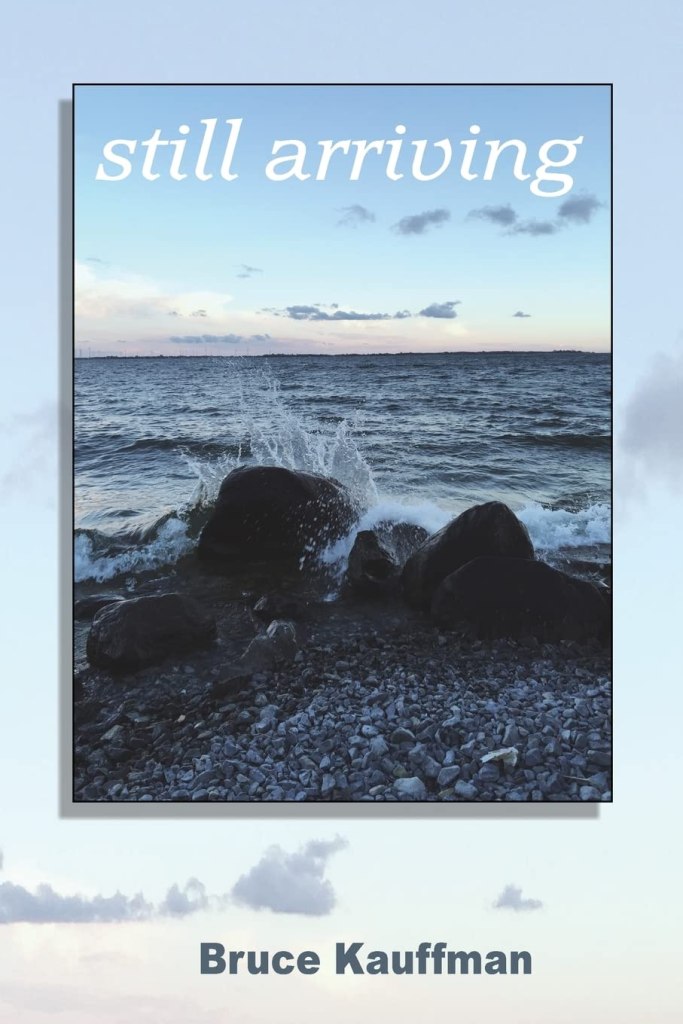
Still arriving is Bruce Kauffman’s fourth full-length collection of poetry, which earned an honourable mention in the Don Gutteridge Poetry Award (2022) competition. In addition to his full-length work, Kauffman has published four chapbooks. But writing is not the sole reason for the widespread recognition of his name. For those living in the Kingston area, Bruce Kauffman needs no introduction. In 2020, he was presented with the Mayor’s Arts Champion Award; his work in the community as a poetry booster was featured in The Queen’s Journal (April 2, 2021).
I met Bruce in 2011 during the launch of my first poetry collection and more recently know him as a poetry editor for Devour: Art and Lit Canada, an online journal. Our paths crossed again at the Northumberland Festival of the Arts (NFOTA, September 2024) where he read during the WOW! Words on a Wire event. That is where I found a copy of still arriving, drawn to it by Bruce’s reading and by the quiet pensiveness of the cover image.
The poems have a haunting quality to them, yet feel immediate. In the Queen’s Journal article, Kauffman is quoted as saying, “A lot of my work seems to be sort of nature-drive, sort of Zen-like. Where I get inspiration is in a process called intuitive writing […] I find it important to not think. That’s the first step.” In this sense, the poems are experimental, if not in form. It is easy to accept that some of the poems, such as “unfinished notes from a journal #15” (43) were written using this method. They are reflective, a bit like notes-to-self.
Besides a peek into his journals, Kauffman alludes to Greek mythology, reminding readers of Virgil’s Charon who ferried the dead across the River Styx. Kauffman’s “ferryman” (14) waits. There’s a sense of mourning the impending loss of the self:
quiet comes the ferryman
the water before behind shows no trace of ripple wave
From whatever references or allusions Kauffman draws, they are well known, needing no explanation. His poems are direct, intimate – as if he’s talking to you over a glass of wine in a quiet spot – accessible, written by a man of certain years and life experience.
Early in the collection, the poet establishes the season of his life and the overriding tone of the poems, as in “autumn” (11):
we all in an autumn of our days
not simply any autumn instead perhaps that final one …
His meditative mood becomes an undercurrent running throughout the collection.
In “epiphany” (20) he seems surprised that his present view of life differs greatly from that of youth:
epiphany
for this poet this late in life
a reminder that lesser writ those mourning and vibrant poems of youth instead now these evening and mourning poems of and to the dead the dying
In “gone,” the mourning is for another. The poem begins: “this morning i packed up / the few things left of you / in a box,” and ends with “in the drought / of a lifetime // a last morning dew.” Although the book’s title looks forward, this elegiac feeling drifts across the pages.
Perhaps my favourite poem in still arriving falls midway between the book’s covers:
Zhivago, again
After Boris Pasternak’s novel, “Doctor Zhivago”, with reference to a scene in David Lean’s 1965 film based on the book
oh, Pasternak Zhivago how you arrive again in these days and my dreams to comfort to haunt
we both all torn inside outside by family place
yours and my fiction or not different era-ed distant but somehow parallel lives either of us married to ink as much as flesh
and this morning dear Larissa after I now too have become the deserter having crossed through blizzards over frozen tundra left my steed dead along the way
Despite Kauffman’s attempts to put a positive light on aging, “Zhivago, again” captures disquiet, loss, regret, the toll of being “married to ink.” This despite the theme suggested by the title and his neighbourhood walks, coffee in a corner café – the things that occupy the “intuitive” poems. This tension in the collection makes it interesting, but it also feels at odds, portraying a conflicted poet who wants a Zen-like life and death, but one who is living and facing it with some trepidation. Still arriving is a thoughtful collection written by a skilled and sensitive writer.
Still arriving by Bruce Kaufman (Wet Ink Books, 2023) is available through your local bookstore or online (ISBN 9781989786819).
I was out sinking in the sea, thinking of Carthage, / the night making sense of someone’s feast / of blasted blocks, rebar spiking signals where missiles / fell, so much glass under arches / smashed. [“South Beirut”]
ALIEN CORRESPONDENT by Antony Di Nardo (Brick Books, 2010)
Earlier this summer, Antony said, “I am a poet of place.” He is also a poet of witness. Antony was living and teaching in Beirut, Lebanon, during the summer war of 2006 and he was still there in May 2008 during the three-day barrage of “shells and grenades.” The collection is insightful, balanced, and heartfelt and gives us an inside view of the city’s beauty, its people, and also the brutality of war without romanticizing or moralizing. Alien Correspondent is as relevant now in 2024 as it was in 2010. I heartily recommend the poetry collection to you.
Available through your local bookstore or the publisher.
If you like this review, you may like others of the same ilk:
Poetry is wrestling with what lies behind the curtain – Simon Constam
I’ve been rereading Brought Down by Simon Constam since last fall, trying to understand what is layered beneath the obvious beauty of the poems. One middle-of-the night I scribbled on a piece of paper: These poems feel like Buddhist koans – a search for insight – tests. Or maybe, not to provoke “great doubt,” but to express both doubt and faith. It is with this idea that I’ve approached the review. The first poem is a good place to enter the collection, since prologue/first poems generally set the tone and subject for a book.
The first two lines of “Every Glory is Diminished by the Truth” establishes one of the issues nagging away at Constam: And do I flinch at the mention of Deir Yassin? / And do you flinch at the mention of Ma’alot? (The Glossary tells us that Deir Yassin is the site of a massacre of Arabs by Jews in 1948 and it tells us that Ma’alot is the site of a 1984 Palestinian terrorist attack that resulted in the deaths of 25 hostages.) Brought Down was published in 2022 before the current war in Gaza; war is not what this collection is about. (Although it might be the backstory.) This collection is one man “wrestling with what lies behind the curtain.”
Writing in a “blurb” for the book, George Elliott Clarke says: “Constam appears as … a Seinfeld-mode Job, questioning God about his ‘masquerading as the dark.’ God is ‘arbitrary’ and we are fickle … .” A disquiet comes through Constam’s struggle, as in:
Simon Agonistes
I am hiding from Him, like Adam. Way down in the labyrinth of Tokyo’s malls, Eve knows nothing about it, she thinks it is just a trip, into the city.
Not to belabour the struggle aspect of the poems, I also want to quote from “HaMakom” (a name for God, also meaning place), and the struggle for place resonates across the decades. “[T]he mind wanders,” the people wander, the book is a jail daring the heart to accept. Finally, I am left with the suggestion of the diaspora.
HaMakom
We meet in a small place, a shel shul, beneath a tallis’ embrace. There is a book in my hands, but I do not need it. The text is a jail. Behind its black bars the mind wanders. Behind the music of the words, the meaning is obscure. Some say the words themselves are Prayer. Some say the emptiness behind them is the God who deigns to meet you there, dares you, some say, dares your heart, to be without meaning, to come unrooted as a tree would give in to the wind and a leaf would float to the sea.
Before turning to Domestic Recusals, let’s look at the title poem, “Brought Down,” the final poem in the collection. It begins: Blood is a river that will not stop and toward the end Constam writes … Everywhere we look, / there is an explanation of who we are and / who they are and what we might become. / In every room we gather, we see certain things / about ourselves but never speak them. We see how they [the ancestors] have suffered // and humanity suffers, every beautiful child / who came from long, long ago … .
There is beauty in the writing; there is pain in the struggle. Brought Down is poetry with subject, tension, music, and craft.
The poet’s conflict, found in Brought Down, continues in Domestic Recusals, but it is different. Simon Constam writes that the poems “come from experiences in and out of marriage, in and out of depression, into and out of different ideas of how men and women operate in relationships.” In these poems readers will find the seriousness cut with something close to humour:
Billet-Doux
Walking out this evening, wrapped against the snow, when I see the idea of home in the eyes of passersby.
I miss you deeply.
And when I am warm again in my rooms, my footsteps are alone. But I lie down with you. Listen, the future comes calling ceaselessly. I cannot keep even your absence Here for long.
The poems in Domestic Recusals are love poems with a twist of angst and self deprecation, although that might be too strong a word. But argument and God are still present although limited, as in the short poem “Certainty.”
Certainty
With certainty, we subdue the inexactitudes of God. With certainty, praise of Him comes easily. With certainty, no one, not even God disturbs us. With certainty, we’ve won the argument with ourselves.
In Constam’s writing, he argues with his loves, within himself, with his God, and with the forebearers who carry the weight of religion. His self-questioning even flows through the more earthy, lush, sensuous poems that run throughout Domestic Recusals. Consider the titles: “Come to Bed with Me Tonight, Solo Traveler,” “Little Black Book of Scars,” and “Seduced.” Constam’s undercurrent of arguing with himself is his voice, the voice that remains constant regardless of his subject. I am captivated by the way it holds me.
I admit that my first reading of these collections left me uncertain (not unusual for me) and so I returned again and again. The more I read the poems, the more certain I’ve become that Simon Constam is a poet to follow.
Available through your local bookstore or online:
Brought Down by Simon Constam (Resource Publications, Eugene, Oregon, 2022). ISBN 978-1-6667-3435-5.
Domestic Recusals by Simon Constam (AOS Publishing, Montreal, Quebec, 2024). ISBN 978-1-990496-47-9.
You who remove me from my house / are blind to your past / which never leaves you, / blind to what’s being done / to me now by you “[…]” (69-70).
In literature, an ellipsis is a narrative device indicating that something has intentionally been left out of the narrative, or it might suggest the passage of time. An ellipsis might also be a symbolic doorway, a gap, a silence. There is no statement in the collection as to exactly what Fady Joudah intends us to read into the space. […] is not only the book’s title, but also the powerful title of a series of poems, suggesting a number of things including the passage of time during the on-again, off-again conflict in Palestine, the generational trauma of the diaspora, the war, colonialism and so on.
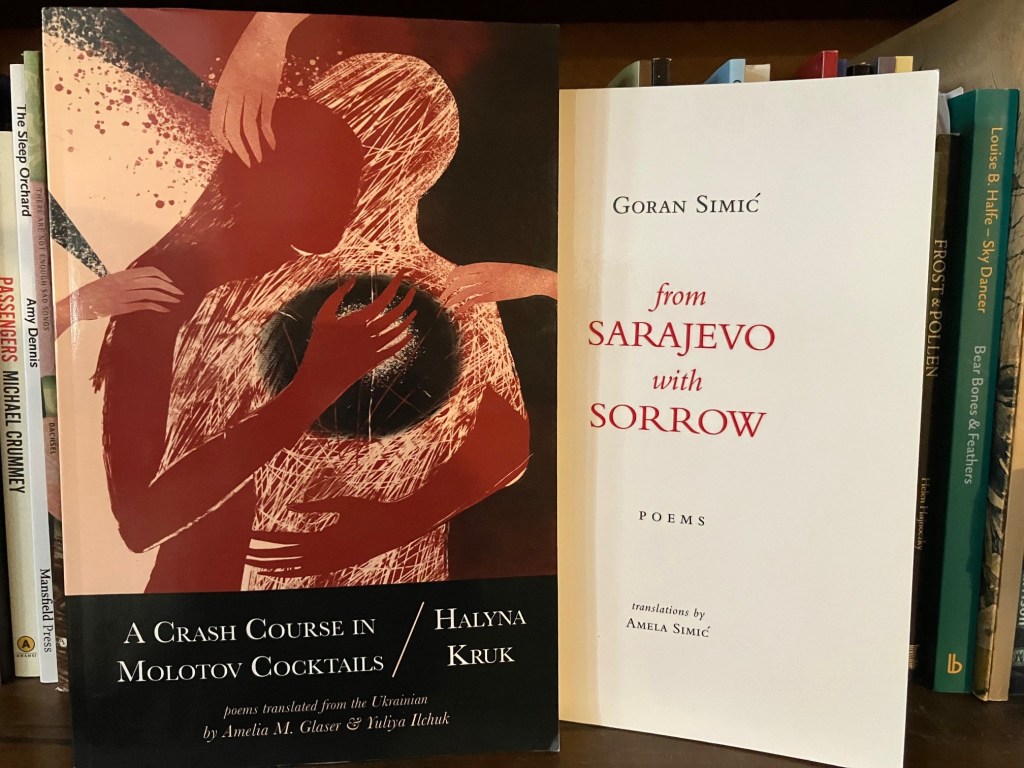
Joudah is a Palestinian-American, physician, and prize-winning translator and poet. He writes “witness” poetry, although his poetry is not from the “battlefield,” as was my “teaser” review of A Crash Course in Molotov Cocktails by Halyna Kruk and the reminder of Goran Simić’s from Sarajevo with Sorrow that I published a few days ago. (You can read that review here.)
Joudah lives in the United States, a first-generation American of Palestinian-born parents. His experience of war is more like Keith Garebian’s whose subject is the Armenian genocide of 1915-1920. Garebian bears witness to the continuing trauma left in war’s wake. (In my review of Garebian’s Poetry is Blood, you will find notes on generational trauma, click here.) Joudah experiences the losses through his parents: “… What childhood does / a destroyed childhood beget? / My parents showed me the way” (12).
As with Garebian, Joudah lives with “home” missing. His past a mirage, a source of loss, a source of anger. The poem quoted at the top of this review, concludes:
You who remove me from my house have also evicted my parents and their parents from theirs: How is the view from my window? How does my salt taste?
Shall I condemn myself a little for you to forgive yourself in my body? Oh how you love my body, my house.
Joudah’s poems are also poignant with the loss of mother tongue, a people’s language, as in “[…]” (6):
From time to time, language dies. It is dying now. Who is alive to speak it?
Another narrative technique that Joudah uses is dialogue as in “[…]” (24):
“Your oppressor,” they said, “has suffered more than you have.”
“As have others,” you said, … .
Finally, there is one more poem I’d like to quote from: “I Seem As If I Am: Ten Maqams,” #5:
… At a traffic light an old man hands me a rose and says, It’s for nothing. He meant, I don’t have to pay nothing
or sign a petition. How our faces appear to him. Quickly he walks away to let the weight
of the rose grow sovereign in my heart
to the extent it can on the eve of a new war.
(Note: maqam is Arabic for place.)
Fady Joudah won the Giller International Prize (2013) for his translation of Like a Straw Bird it Follows Me and Other Poems. In the preface, he writes, “Ghassan Zaqtan’s poems, in their constant unfolding invite us to enter them, exit them, map and unmap them, code and decode them, fill them up and empty them, with the living and nonliving, the animate and inanimate, toward a true freedom.” This could be said of Joudah’s own writing in […].
Available through your local bookstore or online: […] by Fady Joudah. Minneapolis (Minnesota, USA): Milkweed Editions (2024). ISBN 978-1-63955-128-6.
Poetry is Blood by Keith Garebian. Toronto (ON, Canada): Guernica Editions, 2018. ISBN 978-1-77183-279-3.
Books have collected in piles and so I’m going to post a few “not quite” book reviews, call them teasers. They are about books that I want to share and that I hope will pique your interest so that you check them out at the library or nearest bookstore.
A Crash Course in Molotov Cocktails by Halyna Kruk (trans. by Amelia M. Glaser & Yuliya Ilchuck) – shortlisted for the Griffin Poetry Prize
From Sarajevo with Sorrow by Goran Simić (trans. by Amela Simić)
Halyna Kruk’s book is new and currently shortlisted for the Griffin Poetry Prize, it reminded me of Goram Simić’s collection that I have read and reread many times. They each offer accessibility and insight on the horror of war, Kruk’s Ukraine and Simić’s Bosnia.
In a poem titled “war,” Kruk writes: “… a human walks in the woods like an echo, / lost in thought, distracted // some bullet moves with its own trajectory, let loose / in a right or left hemisphere. somebody’s. the earth’s.” In another poem titled “we act like children with our dead,” Kruk writes, “… as if none of us knew until now / how easy it is to die / everyone still hopes they’ll lie there for a while and rise again ….”
In the introduction, Kruk is quoted as saying that her“poems have changed since the outbreak of war.” She says they no long pay attention to “form and style, now my poems are almost entirely focused on content — they document the reality of war, literally, emotionally, and sensually….” They are intense. I can read only three or four at a time. They are beautiful. They are horrific. And something about them made me go to my bookshelves and take Goram Simić’s Sarajevo collection down to read alongside Kruk’s poems.
Simić says of his poems: “In Sarajevo hell I wrote these poems as epitaph and testimony.” One poem I always search for among the many “flags” stuck to the pages of his book is “Love Story.” It describes a scene on a bridge that seems to me more chilling than the rest. I quote from that poem in a book review that I previously posted. You can read it here.
Available through your local bookstore or online:
A Crash Course in Molotov Cocktails by Halyna Kruk, trans. by Amerlia M. Glaser & Yuliya Ilchuk (Arrowsmith Press, 2023), ISBN: 9798986340197.
From Sarajevo with Sorrow by Goran Simić, trans. by Amela Simić (Biblioasis, 2005), ISBN: 978-0-9735971-5-8.
UPDATE: I’ve just come across this Youtube post: Amelia M. Glaser, Yuliya Ilchuk, and Halyna Kruk interviewed by Griffin Trustee Aleš Šteger. You can view it here.
“Weathering Water-Wave Theory,” Consilience Journal, Columbia University, forthcoming Fall, 2025 — The editors wrote: “Our reviewers enjoyed reading your poem, which highlights moments when opposing forces come together—whether in nature or within ourselves. We also admired the choice of words, the use of enjambment and punctuation, and the masterful use of meter.”
“Unmarked: A Lament for the Children Buried in the Unmarked Graves of Residential Schools,” Strong Hands Stop Violence poetry anthology, ONWA, Vol. 9 (December 2025)
“On that Forbidden Evening,” “Willow Dream,” and “Albinoni’s Adagio,” Live Encounters, Volume Four, 16th Anniversary, November-December 2025
“Weathering Water-Wave Theory,” Consilience Journal, Columbia University, (2025-09-22)
“She Sings Only at Twilight,” “Company of Wayfarers,” “A Blizzard Blows,” “Phantasm,” and “Beloved,” Lothlorien Poetry Journal Volume 28 (print and online) Sept. 30, 2023).
“Musical Invocation” poem profiled and read/recorded, Jerry Jazz Musician (September 2023).
“Journey,” “Ashes,” This Wine into Water, a chapbook anthology (Forward by Lorna Crozier, Wintergreen Studios Press, December 2018.)
Earlier writing was published in literary journals including the Fiddlehead (#130 Summer 1981) Descant (#32-33 1981) and Northward Journal (#20 June 1981) as well as anthologies such as The Wisdom of Old Souls (2008), Grandmothers Necklace (2010), Close to Quitting Time (2011). (Some early poems published as Kathryn Deneau.)
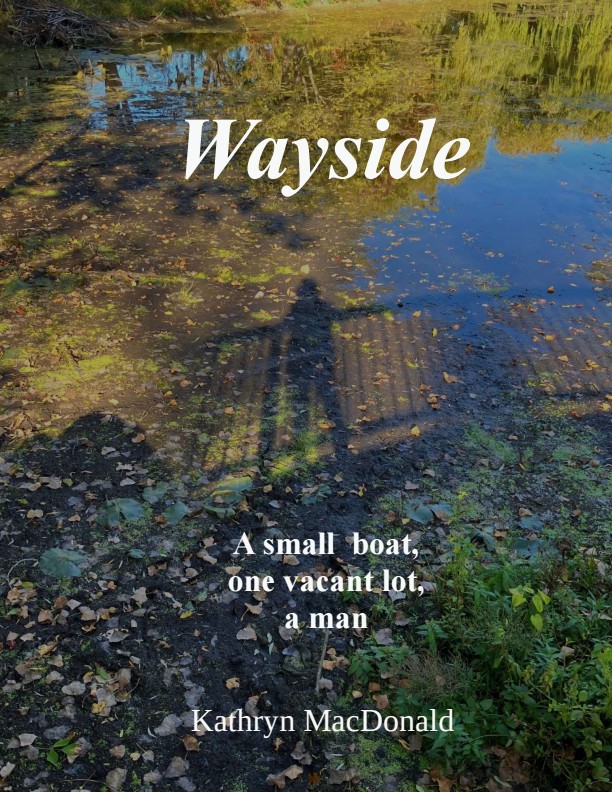
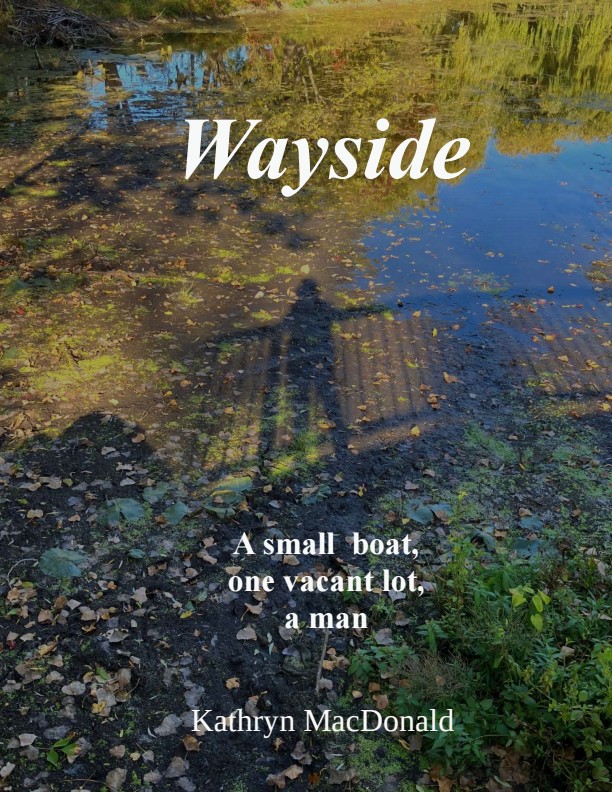
Review of Wayside: a small boat, one vacant lot, a man by Antony Di Nardo (The Miramichi Reader)
Some words, when you string them together, defy their simplicity and create a world of their own. They take on the voice of their writer and that writer’s moment in time. And where mind and matter intersect, a singular world of genuine emotions, the poet’s “objective correlative,” comes to life on the page. Such is the art of Kathryn MacDonald. Hers is a vivid, intimate world, where Nature flourishes and serves as the source of her language, giving us Wayside: A small boat, one vacant lot, a man. Twenty-one poems. Twenty-one facets of a poet’s lyrical “I.”
These poems, both by design and content, are watercolours. Oils, pastels, hard acrylics, are made of edges, rely on borders, illusions based on blocks of space. I generalize, of course, but for me, watercolours blur the lines between what’s real and what is felt. They soften those distinctions between our inner and outer worlds and, in so doing, suggest sensations that intensify the human experience. Each poem in this collection has been rendered that way, with brushstrokes dipped in water, light and words. They evoke a faithfulness to life steeped in love and friendship despite the grief and sorrow of loss. And all of this MacDonald achieves without the gush of sentimentality.
These are wonderful poems. Literally, full of wonder and acceptance of a poet’s right to rearrange feelings into words. Her images, as one would expect, are exquisite. She paints tableaux that manifest the presence of another in their absence. She writes: “his lips brush mine when we part / leaving my blue bicycle wobbling.” So much is said in those few words: minimum of brushstrokes not only illustrate a fleeting moment but paint a powerful human emotion. Her use of “wobbling” – after a succession of alliterative b’s – is a master stroke of lyricism, its sound and sense depicting a feeling I associate with the thrill of uncertainty and stirrings of physical attraction. A heron “stands on willow-whip legs,” appears as a Modigliani figure that “strolled / along the dock” and becomes “a small grey man – / before taking flight.” I am awe-struck by that compression of a human figure and a giant bird in flight, the two synchronized to evoke the beautiful contradictions of Nature’s work. And MacDonald’s craft.
The skies are sometimes grey in Wayside. There is illness and tragic ultimatums. That “small grey man” who sails the Bliss, a small boat, must also face its loss. As does the painter of these poems who “listens as his cane shatters silence” and is resigned to acknowledge that “[c]ells in his body blossom multiply.” Loss is tragic and death inevitable, but life goes on and the poet puts that feeling into words:
Air sits heavy, burdened with coming rain. A tear breaks in the flock of cumulous clouds and light slips obliquely into the river’s mouth, slips onto moon-round lily leaves where flowers will one day bloom.
I so admire the cadence and sway of such fluid lines – I can’t say enough about their music, their subtle, almost imperceptible, alliterated syncopations! These lines are a testament to Kathryn MacDonald’s vivid way with words, both pictorially and sonically.
In this chapbook, kayaks resemble “elongated sunrises.” Reflections float “downriver / downriver / to the sea.” Dragonflies are dragons and “soar / in six directions, / hover / like hummingbirds.” A kiss is “as subdued as the gauzy sky, still as the mouth of the river.” Birds and flora, waterfront creatures populate these poems. And turtles. Turtles “especially.” MacDonald writes “I wonder if we were to decipher / the map carried on their backs / what journey might be revealed.” Her metaphors come naturally. They are both the light and brushstrokes of these poems. Here’s a scene she frames to portray dusk at the end of a summer’s day:
Day slips toward July’s long dusk the quiet hour when mallards and geese return to their nests, the great blue spreads his wings and flies to the willow’s shadows, an osprey circles toward its platform of sticks, the moon-pale swans glide across the bay.
This scene sets the mood for what transpires between two people when one must leave for good. I’ve never liked the term “pathetic fallacy” to describe the way poets personify their natural environment, it seems demeaning to me. Regardless, MacDonald’s use of this device gives us lines like these: “My sorrow wreaks havoc / with fast-falling snow / as I kick through drifts / that bury the river trail / to him.” She compresses both a narrative (her friend is dying) and an intense feeling (her sorrow) in a tightly woven yarn of diction, voice and theme. As for the dynamics of form and text that structure these poems, they are, in the words of Emily Dickinson, like Oars divide the Ocean, / Too silver for a seam.
MacDonald’s art comes with a clear sense and understanding of what makes poetry, and how to translate emotion into words. Wayside is evidence of that. Pick up the book, open it to any page, there you’ll find a watercolour of metaphors, imagery and soundscapes that tell a story of a small boat, one vacant lot, a man … and, not to forget how books like these really come to be, of a poet’s working mind.
Details
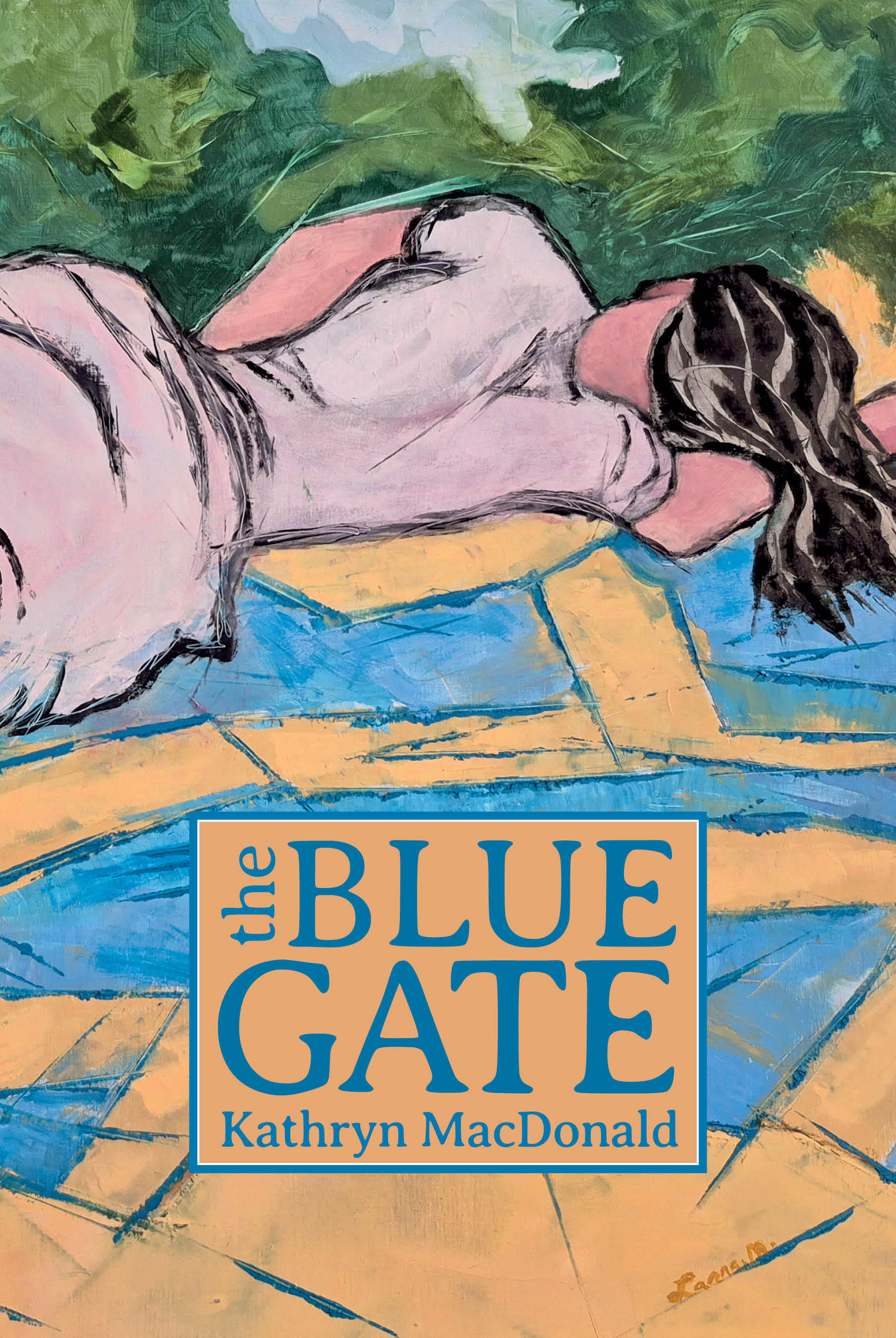
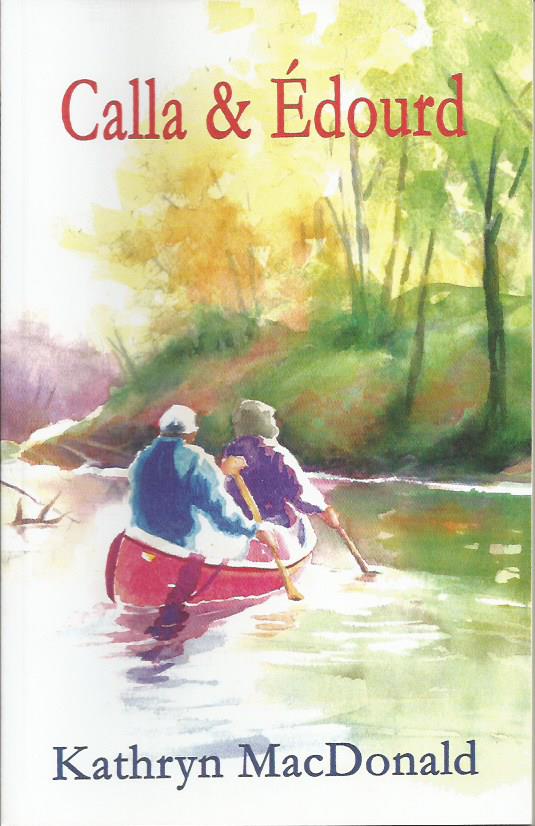
Kathryn MacDonald’s poetry has been published in Room, FreeFall and other Canadian literary journals and anthologies, as well as internationally in the U.K., U.S., and other countries. Her new poetry collection, The Blue Gate is available this Spring 2026 (Frontenac House). Kathryn has three chapbooks: Wayside: a small boat, a vacant lot, a man (Big Pond Rumours Press, 2026), Liminal Spaces , a chapbook anthology of ekphrastic poetry by Kathryn and three fellow-poets (Glentula Press, 2025), and Far Side of the Shadow Moon: Enchantments (Glentula Press, 2024). Her first full poetry collection, A Breeze You Whisper: Poems, and a novel, Calla & Édourd were published by Hidden Brook Press (2011, 2009).
Antony Di Nardo lives in Cobourg, Ontario and is the author of seven books of poetry. His most recent, Forget-Sadness-Grass (Ronsdale Press 2022), was a CBC Books poetry pick. His suite, “May June July,” won Exile’s Gwendolyn MacEwen Poetry Prize and was nominated for a National Magazine Award. “Among the Boughs,” first published in The Fiddlehead, will appear in this year’s Best Canadian Poetry anthology.