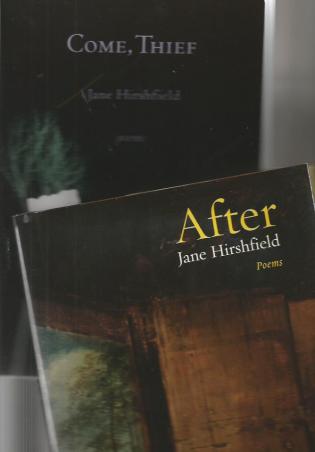
Book review: Ten Windows: How Great Poems Transform the World (by Jane Hirshfield)

Jane Hirshfield’s words perceptively reveal the seduction of poetry, of art. They open windows of clarity while simultaneously celebrating ambivalence and paradox. Ten Windows provides both a brilliant journey and practical guidance through the world of poetry for both readers and writers.

Poetry’s addition to our lives takes place in the border realm where inner and outer actual and possible, experienced and imaginable, heard and silent, meet…In a poem, everything travels inward and outward.

The essays in Ten Windows: How Great Poems Transform the World lead us from what is inherent in poetry (and the other arts) through metaphorical windows of language, image, sound/music, hidden/unsaid, ambiguity, surprise, transformation, and more. Throughout, Jane Hirshfield reminds us of the importance of poetry in our lives, how it reflects culture, and how it can even change cultural borders.

In “Seeing Through Words: An Introduction to Bashō, Haiku, and the Suppleness of Image” (Chapter Three), Hirshfield writes, “…if you see for yourself, hear for yourself, and enter deeply enough this seeing and hearing, all things will speak with and through you.” Haiku was not new when Bashō came around in the 17th century, but he changed it and influenced writing since. Bashō sought more from the form than did his predecessors. He sought

…to make of this brief, buoyant verse form a tool for emotional, psychological and spiritual discovery, for crafting new experience as moving, expansive, and complex ground as he felt existed in the work of earlier poets. He wanted to renovate human vision by putting what he saw into a bare handful of mostly ordinary words, and he wanted to renovate language by what he asked it to see.

Even for poets who veer from the Haiku form, this goal is an ambitious one. In this small poem of image and sound, Bashō excels in meeting the challenge:

seas darkening

the wild duck’s calls

grow faintly white

In Ten Windows, Hirshfield reminds writers and readers to see what isn’t said, to read between the lines. To me, this poem speaks volumes beyond what Bashō saw; it stirs emotions of darkness, of the fleetingness of experience, and of things disappearing/lost. Hirshfield notes:

“The reader who enters Bashō’s perceptions fully can’t help but find in them a kind of liberation. They unfasten the mind from any single or absolute story, unshackle us from the clumsy dividing of world into subjective and objective, self and other…. 

In a chapter about uncertainty, Hirshfield reminds us:

Poetry often enacts the recovering of emotional and metaphysical balance, whether in an individual (primarily the lyric poem’s task) or in a culture (the task of the epic). Yet to do that work, a poem needs to retain within its words some of the disequilibrium that called it forth, and to include when it is finished some sense also of uncomfortable remainder, the undissolvable residue carried over—disorder and brokenness are necessarily part of human wholeness.

A couple of paragraphs on, she continues developing her idea: “The most serene works on the bookshelf are…in the lineage of Scheherazade’s stories—art holding incoherence and death at bay by invention of beauty, detour, and suspense.” In the colloquial, we say show, don’t tell; leave something to the reader’s imagination; tie up loose ends, but leave the door open.

A work of art is not color knifed or brushed onto a canvas, not shaped rock or fired clay, a vibrating cello string, black ink on a page—it is our participatory, agile, and responsive collaboration with those forms, colors, symbols, and sounds.

Later, in the transformation chapter, Hirshfield writes:

The experience of art takes place within and under the skin. When we read the word “orange,” neuroscientists have found, our taste buds grow larger, more so if we are hungry. A mountain in a poem is known by what has been motionless and stony in us, and by what we have internalized of rock and steepness through legs and eyes. The characters of a story or play are lent our lives’ accumulated comprehensions and history, in order to make theirs our own.

Writing and reading is collaborative. “Poems are made of words that act beyond words’ own perimeter because what is infinite in them is not in the poem, but in what it unlocks in us.” This can be said of all art forms. Jane Hirshfield’s words perceptively reveal the seduction of poetry, of art. They open windows of clarity while simultaneously celebrating ambivalence and paradox. Ten Windows provides both a brilliant journey and practical guidance through the world of poetry for both readers and writers.

46 Ten Windows

Available through your local bookstore or online: Ten Windows

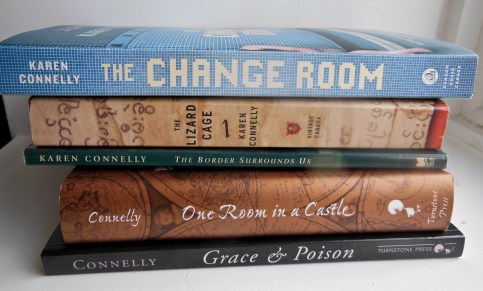
Journeys: a Writer’s (incomplete) Oeuvre (Prose: One Room in a Castle 1995; The Lizard Cage 2005; Burmese Lessons 2009; The Change Room 2017. Poetry: The Border Surrounds Us 2000; and Grace & Poison 1990 by Karen Connelly)

I know this. Our lives begin and end with journeys made alone.
“The Lid Over Europe” (100-101), One Room in a Castle

Karen Connelly makes many journeys. Travel introduces us to strangers and both her poems and prose reveal ways of understanding the other and experiencing ourselves.

In her 2017 novel, The Change Room, she notes two paths toward knowing: listening and storytelling. “Listening,” she writes, “was a way of pulling a stranger toward you without touching.” And so is storytelling: Shar or Shaharzad or Sheherazade – the great storyteller of One Thousand and One Nights – is the siren of enticement in The Change Room and the sensual “amazon” of the story. Listening and storytelling, strangers and borders, are common themes in Connelly’s oeuvre.

Writers’ recurrent themes interest me. I like their unfolding like fans, and their closing tight. I like the way they spread across continents and genres – always surprising, maturing, shifting but remaining, in important ways, the same. In Karen Connelly’s writing, the travellers and lovers among us glimpse ways of knowing ourselves and the other. This holds true from her earliest stories to the most recent novel.

In Connelly’s stories, strangers often become intimate in a variety of ways, sensuality being one. In “Esmeralda, a story” (One Room in a Castle 36-67), readers glimpse insights into what has matured into the novel The Change Room.

From Castle: “Our greatest similarity was our love of water, the freedom of motion it creates. ‘It’s flying,’ Esmé said. ‘It’s the closest we’ll come to being free of our bodies.’ We began to meet in the change-room before swimming….” Esmé swims; she is also a musician. Music, like water, is freeing and sensuous: “She closed her eyes, bent herself over the piano, and laid her hands on its black surface…. Then I leaned forward and kissed her eyelids.” These themes sown in Castle dominate in Room.

In The Change Room, the writing is more complex, layered and mature, but in the early work, we glimpsed seeds that later became mature fruit. (For more on recurring themes of individual writers, please also see my review of Bicycle Thieves by Mary di Michele.)

Connelly writes across genres, which leads me to think about truth in nonfiction and fiction. One Room in a Castle, for example, was published as nonfiction – purportedly as correspondence and travel. The Change Room – 22 years later — as fiction. It begins with an Emily Dickinson quote:

“Ourself, behind ourself, concealed,
should startle most.”

And we are left wondering about the difference between reality and imagination – a conundrum for writers and readers. Connelly does provide hints. For example, in “Extrah-dinary” (Castle 33-35) she writes “It is difficult to get to the truth of one’s self; how much more difficult to create an imaginary world and reveal its truth.” Still…. (For more on this topic of fact and truth, please see my review of Beatrice and Virgil by Yann Martel.)

I was introduced to Connelly’s writing through a book club reading of her mid-1990s memoir, Burmese Lessons, which still pops into consciousness despite the time lapse. But it’s the poetry collection, The Border Surrounds Us, which remains my favourite – especially section II – which I’ve read over-and-over again.  It is only recently that I discovered Grace & Poison, a compilation of Connelly’s first two poetry books. Even in 1990 her themes were clear and her voice strong. From that collection, a prose poem – “A Story for Suradev, In Bangkok” – stands out. In it we find her mature themes of intimacy/compassion, strangers/self. The closeness of her observations stand stark.

Her passion for travel and imagining the experiences of those she meets into story is continuous. Perhaps Connelly’s most intense book is The Lizard Cage, published in 2005, which drew me back to Burmese Lessons. Burmese Lessons is essentially a love story/a political story. The Lizard Cage is darker, taking readers inside a Burmese prison and into the isolation of an ancient man and a small boy, cruelty beyond comprehension, love, and survival. Somehow Connelly manages to maintain dignity, love, compassion, and beauty.

Karen Connelly began her writing career with the idea of borders, journeys from the known into the unknown: “Our lives begin and end with journeys made alone,” she wrote in her early twenties. In between life’s bookends, many other journeys are made and borders crossed: some geographic and cultural; some social and political; most intimate and sensual. They are all crossed personally, alone, and usually with risk of one sort or another. The intimacy with which she crosses borders can challenge us; she touches the heart, the soul, and the body.

22 Connelly Bks LR (1 of 1)

Various publishers have put Karen Connelly’s writing into print. Search her name or the name of one of her books and that will take you to a source. Most are available through your local bookstore or online.

Review (Poetry): Lines…and what’s between them (What the Soul Doesn’t Want by Lorna Crozier)

What the Soul Doesn’t Want is a new collection, the most recent of 17 books by Lorna Crozier. Five of her poetry collections live on my bookshelf and are frequently pulled off and carried to the oversize, plaid wingchair in my library/office to be read again. However, the poems in What the Soul Doesn’t Want are new to me; I haven’t had the time to ponder them, to return on a different day in a different mood to discover what they might offer. But it’s easy to see they are pure Lorna Crozier.

She writes with quirky wit and sensitive awareness. For readers, the poems provide pleasure and insight and the simple joy of the words she chooses. Her themes in What the Soul Doesn’t Want haven’t veered from past work, but the tautness and edginess are sharper here.

She draws from nature and not always what you might expect. In “Cockroach,” we get the sublime: “they creep from the baseboards, / climb the couch and burrow in her hair” which makes me involuntarily shudder. But I also learn that “In Japanese it’s gokiburi,” a word I expect my grandson teaching in Japan will be interested in adding to the personal dictionary he’s creating. Reading Crozier, one finds clear images and science next to odd bits of trivia and a telling that will cause you to smile and to think (even as you might shudder).

Aging and time are Crozier themes. My favourite poem in What the Soul Doesn’t Want is “When the Bones Get Cold.”

My husband sends me hummingbirds
from his eyes. Only he and I know
he’s going blind….
I am made beautiful by loss. The moon, too,

There’s a sweetness
that comes from accepting what I am,
not a mountain, not a river, not a tree.

Grief also ripples through her poems. In “Algorithm: The Way Out,” Crozier writes: “…Grief’s / a snowdrift that thickens / as you walk.” How simple. How brilliant. How true for all of us who have known sorrow and deep snow. It is this universality and, perhaps, the lightness (and the light) that gets the writer and the reader through the tough stuff she doesn’t shy from.

Crozier is an Officer of the Order of Canada, the Governor General’s Award for Poetry, and a three-time recipient of the Pat Lowther Award. After a long teaching career, she is now Professor Emerita at the University of Victoria (British Columbia). She must be the envy of poets everywhere.


07 Crozier covers LR-007

Lorna Crozier’s books are all available through your local bookstore or online: What the Soul Doesn’t Want