Away by Andrea MacPherson: Book Review and Writing Tip

Before, there might have been children playing in the street, / the rumbling of cars and feet, / but now there is nothing. Taut, stretched stillness. Waiting.

“Walking Shankill Road” (29)

Andrea MacPherson travels in Away — and we travel with her through the magic of her poetry. The journey begins in Ireland, a personal quest where sites and family are sought.

This is the one place you insisted I come,
this place where limestone weeps
and children once played between execution sites
and burial grounds.

So begins “here’s to the wings of a bird” (12) and with it an elusive you, someone who has planted the seed of return, a return instead of, as if MacPherson is visiting the memories of another. Throughout, the time of the “Troubles” persists. In “boundaries” (16), she writes:

We anticipated a stop here,
men with guns and strict faces
(tightropes of unsmiling mouths,
eyes that have seen marchers falling)
a checkpoint at least, with flashlights
turning our faces to ghosts.

Instead there is nothing but seamless conversation;
rapeseed fields.
Trading prayer for something even quieter.

With the poet, we ride through countryside, lulled, until Belfast and RUC men… their guns and tanks.

Somehow we have forgotten about the strife
we had prepared to see, more content
with wavering fields a thousand shades of yellow
and ancient schoolhouses.

These places where people once sat.

The “Troubles” are old; the people we meet are old. It is as if all love and youth have left Ireland. MacPherson captures a poignancy that is haunting. In “the backyard faerie circle” (20), we visit an old man, alone:

A grey cardigan coming apart at the seams,
smelling of sheep and skin and age.
A threadbare chair,
imprinted with the memory of the body
thighs and shoulders and hip bones.
This is what his life has become:
wool and paisley just there.

We learn something of him, his youth and love, but now the small patch of wild roses / left untended, / forgotten in the shade.

The family journey of remembrance crosses the Irish Sea and continues in Scotland where we learn MacPherson’s mother’s mother left with only a rose-gold / wedding band, a few porcelain figurines (“blue salt,” 41). In “Caldrum Street,” MacPherson writes: I take photos to enter a past that is not mine (48); yet the poems lack nostalgia. They are immediate, felt, experienced. History – political and personal – continues to dig deep, becoming, as she says in one poem, fable.

MacPherson’s travels continue to France and Greece. In Paris: A streak of blue paint / thick / across a painter’s cheek (“sketches of Paris, 71). Allusions to artists and their art continue. In “La Goulue & Jane Avril” (77).

You write to me from Toulouse
and I think not of you and the red
city you describe, but of the small
deformed man with miniature legs
(childhood breaks that never quite healed)
who drew cabaret dancers
and whores and faceless men.
Smell the absinthe on his stale breath,
the unwashed quality of his hair.
Dark, dense in the spring sun.

Toulouse is nowhere in those photos,
only the possibility of his compressed figure in the corner,
black coat tails, shriveled leg
fleeting.

In “National Archaeological Museum” (85), Greece, archeology replaces the art trope of France:

[The statues] have all been saved from watery graves,
a shipwreck hundreds of years ago in the Aegean.
They might have been home for minnows,
crustaceous prawns, octopuses;
seaweed might have covered the boy’s eyes,
letting him forget he once had limbs.

As the trip comes to an end, she writes: I dream of the places I will go once home: / thick rainforests, yards of lilac and rose bushes…relearn the taste of green (“the geography of bougainvillea” 89).

Away describes a circle, a going out and a return – to place, to self – and it does so with keen observation and insight. This is Andrea MacPherson’s second book of poetry. It is now one of my favourites to be read and reread.

Hints for Writers 

  1. For writers on personal journeys to places of emigration, Away shows how the quest can embrace the stories of generations, the return (almost) on behalf of parents and grandparents but also open doors to others curious minds. MacPherson travels with purpose, but her list of places and people to see does not blind her. She finds ways to draw readers into her poems; she bridges the personal : universal divide. If this is your journey, read MacPherson with an eye and ear as to how she accomplishes the magic.
  2. The author’s voice is consistent throughout the collection, creating cohesion between poems and sections of the book. MacPherson’s voice is intimate/personal but also knowledgeable. We trust her. We also remain open to the surprises and insights that happen along the journey. Think about how she uses the first person to control what we see and feel and then how she inserts the twist that makes us pause and contemplate the awareness or insight or question revealed.

67 Away.jpg

Available through your local bookstore or online: Away

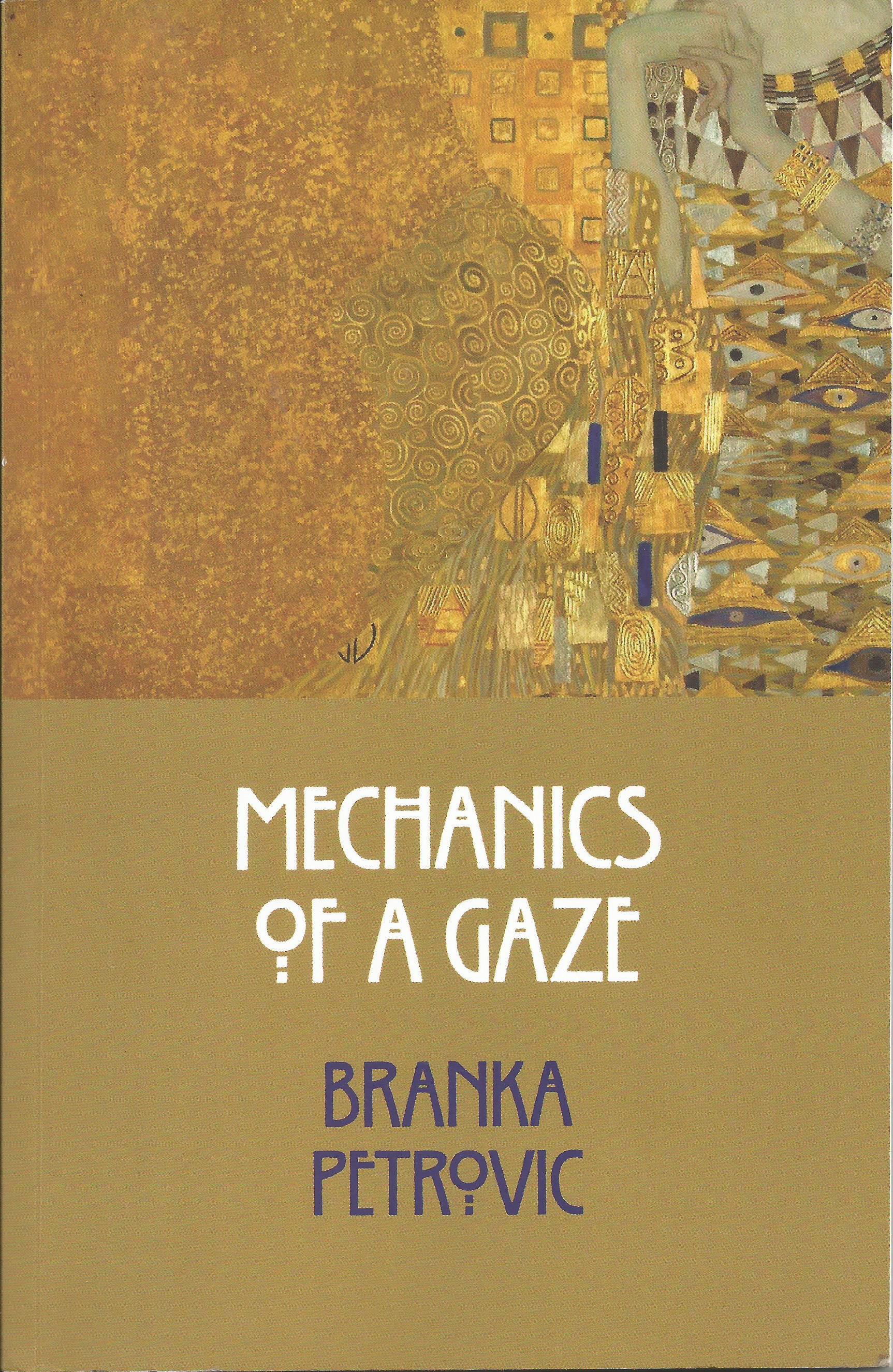
Mechanics of a Gaze by Branka Petrovic; poetry review and reading/writing tips

Inside his studio, a woman awaits // her turn to be myth

In Mechanics of a Gaze, Branka Petrovic strips the paintings of Gustav Klimt—layer by layer—until only the male gaze is left. Petrovic’s interpretation of the man and his work is not flattering. The poems are irreverent, provocative, skillful and mature.

The structure of the book leads us from insightful—although sometimes devastating profiles—and ekphrastic poems to historical notes and interpretations by others. In the first section (“His Women”), we meet a selection of the women who were model, muse and sexual object. The poems unmask the erotic within Klimt’s studio, sometimes blatantly and sometimes more suggestively.

Whatever’s semi about this nude, it’s not
the way we enter the sketch,
her swift dialogue of the illicit.

Slipped between the poems are excerpts from postcards sent by Klimt to Emilie Flӧge over their long relationship. They continue throughout, presaging the final section and providing an insight into the Klimt-Flӧge relationship and his character.

Next, the focus is on Emilie Flӧge, the woman who was Klimt’s friend, sometimes lover, and lifelong companion. In a poem called “Gustav & Emilie, Petrovic creates a scene (perhaps from a photo taken at her family cottage at Lake Attersee) but then imagines:

If he were to paint you right now,
the vertical lines of your dress
would leak jonquil, mutate

into a metallic-gold,

backdrop; osmanthus sprouting

from your hands….

…Your air,

a brooding saint.

Petrovic at once captures the essence of Klimt’s art and sexual fecundity as evidenced in “osmanthus.” In another poem, she does this with “Calder,” alluding to movement. Petrovic demonstrates a close reading of both the paintings/drawings and the characters that inhabit (and those who created) them. And in five words defines Flӧge and the relationship.

The third section places the gaze on Adele Bloch-Bauer. (You may recall the 2006 movie “The Woman in Gold,” starring Helen Mirren, which takes the point-of-view of Maria Altmann who reclaims the painting of her aunt from the Austrian establishment.)  In one poem, Petrovic expresses the essence of Adele and Klimt as “a Wittgenstein riddle.”

In the fourth section, “Mankind Drifting,” the perspective broadens to include Vienna and the Secessionists’ art (late 19th through early 20th centuries). The Secessionists led the way from traditional-to-modern art in Vienna. The movement turned conservative values on their head, and Gustav Klimt was in the vanguard.  In this section, Petrovic switches focus from Klimt’s portraits to his controversial work for the University of Vienna’s ceilings: Philosophy; Medicine; and Jurisprudence. It is also here that Petrovic returns to Egon Shiele, provocative protégé (“Disabled Sex” appears in the first section).

The final part, “Catalogue Raisonné,” is where we come to found poems and collages, information gleaned from sources such as Wikipedia and the Internet to reviews and the press from The New York Times to The Montreal Gazette. Petrovic’s innovative structuring of the collection leads readers from her subject—the sexualized gaze—of artist and model to the political subject of Nazi looting. With this innovation, Petrovic pushes the convention of most poetry collections.

Branka Petrovic’s debut collection reinvigorates Gustav Klimt and Secessionists’ art. You will never look at the stale gold and mosaic looking greeting cards of Klimt the same. I find Mechanics of a Gaze as invigorating as was the poetry of Sylvia Plath in the 1960s. My guess is that we’ll be hearing more from Branka Petrovic.


Tips for Writers

  1. Relevancy: read the poems as a whole, thinking about their subject and relevancy (see Good News for Poets and Readers). As a poet, what role does relevancy to your readers play in your writing? Is relevancy important?
  2. Read each poem for its ekphrastic insight, asking yourself if Petrovic captures the essence of the art. Does the poem work as a poem?
  3. In 2017, I reviewed The Painted Kiss by Elizabeth Hickey. Like “Peter Schjeldahl on Gustav Klimt Part 1” and “…Part II” in Mechanics of a Gaze, I have changed my mind somewhat. In that review, I ignored sexual politics and the inherent power of the “gaze.” But after reading The Mechanics of a Gaze, and having witnessed the revelations of the last couple of years, I’ve reread the more sympathetic Kiss. It is Hickey’s fictionalized story of Klimt, written entirely from the point-of-view of Emilie Flӧge. Hickey seeks to get under the skin and into the heart of a woman of the last century. Yet it is all there: the sexualized gaze and acts. Bring your consciousness to Petrovic’s collection. Is Mechanics of a Gaze a feminist collection? If so, does “the message” inform or detract from the work as art?
  4. The Secessionists rejected the orthodox conventions of late 19th-early 20th century Vienna. Their art was rejected by traditional art galleries, so they established their own, a movement toward modernity. Should it be judged/reinterpreted against today’s standards or accepted within its place in history?


Available through your local bookstore or online: Mechanics of a Gaze

Also, please see blog 14 The Painted Kiss (2005): The Painted Kiss

66 Mechanics of a Gaze

Panicle, poems by Gillian Sze, book review and writing tips

This is how the beginning sounds: an inkstick grinding against stone,
a dark circling like ancient gears. The water blackens from soot;
we paint with the burnt ashes of pine trees.

In “Calligraphy,” the first poem in Panicle by Gillian Sze, we are led into the art of writing which begins: “even before the brush touches the paper.” Sounds and the act of writing—of listening, witnessing, experiencing, reaching essence at the core—permeate Panicle. This is a collection about poetry itself.

In a prose poem, “Sound No2,” she writes:

There are things I want to show you, like the empty pause that encircles desire. Or how Klimt knew that a woman bends her neck that far for a kiss only if she really wants it. I want to show you how quiet it gets when you’re in the company of someone who no longer loves you.

Sze pushes beyond sound and sight, beyond even behavior, in order to explain poetry, as she does in “Bona Fide: or, Setting the Seine on Fire.” She begins by drawing us into “impressionist modes” (do you see the shimmering light?) and note how black differs in Paris where “even the chestnut trees never cast black shadows.” This thrusting of opposites applies to ideas about poetry as much as it does to the words within a poem. After creating the Parisian scene, she notes:

A modernist tells me
he’s searching for genuine tones
in poetry
something authentic, not fugitive…
Something, he repeats, in good faith.

And I tell him
I’m search for natural light.

She brings us back to experience and away from the theoretical voice of the critic.

In “Aubade,” Gillian Sze introduces a hospital room in which she sees “A raised cup / and behind my eyes / a rush of wings;” perhaps a reference to the Eucharist before she turns to nature as “each leaf lifts an eyebrow / and regards the day,” returning us to hope and light. (“Aubade translates from French roughly as auba=dawn + albus=light.) Her play on allusion and sound throughout the collection pares the subject down to its essence.

It seems to me that Sze breaks rules with “Staging Paris: Tableaux Vivants,” ten scenes that she outlines for us, each creating a situation, unresolved. She plays with light and sound. She leaves it to readers to resolve each situation.

My favourite section is the long poem that concludes the collection: “III Guillemets,” although she does not use the chevrons ‹ and › (single or double) in the poem. What is included are sketches by Jessica Hiemstra (please see the previous blog: Apologetic for Joy for Hiemstra-van der Horst’s poetry). The poem is a creative interpretation of Pouvoir du noir by Roland Giguère in which is contrasts black and white and much more in a clear, accessible way. I recommend Panicle for the clarity, contrasts, sound, and skill of Gillian Sze’s poems.

For the writers among us:

  1. Think about the place of sound in your poems;
  2. Think about creating tension through opposites;
  3. Think about leaving the door open for interpretation, allowing readers to draw their own conclusions, as Gillian Sze does in the “Tableaux.”

Available through your local bookstore or online: Panicle

65 Panicle

Apologetic for Joy by Jessica Hiemstra-van der Horst for poetry lovers

I ate quince with musicians and contemplated
transformation

In Apologetic for Joy, Jessica Hiemstra-van der Horst’s poems not only explore transformation but they also elicit the experience of transformation in her readers. In “Eating Quince with Musicians,” she creates images and takes us beyond the fruit and conversation.

It begins hard and yellow,” she said, needs peeling
and long heat.
Finally it is ambrosia, soft and red.

By the end of the fourth stanza, she weaves through the sensuality of experience, arriving at love and we do not question the transformation. This process unfolds throughout the collection, but sometimes there is a detour on the journey through the poem as there is in “Fingertips Are for Touching” when something discordant jars us into paying attention:

Do I leave a mark on you
when I graze by your chair?
Children understand loneliness
they sit in laps, cry
until they are empty.

Every mark I make
on you, on canvas,
is a brush with infinity, hoping
two of us under covers
see each other without light.

What do children have to do with the light mark she makes as she passes? Are the lonely children a way to tell us what the touch means to Hiemstra-van der Horst? Then we learn the marks she leaves “on you, on canvas…brush with infinity.” Infinity: an immensity, a vastness beyond quantity, beyond qualification. Notice how she leads us “under covers.” Notice how the poem takes us beyond sensuality into the deeper knowing of seeing beneath the surface, the deeper seeing even “without light.” Notice how simple the poem is on the surface of language and image and see how she transforms it into something difficult to quantify.

This is a woman like Daisy Johnson (please see Everything Under) who loves words and mines them for all they are worth. In the section Bad Things Erased by Oranges, Jessica Hiemstra-van der Horst travels to Southern Africa and into Setswana, a new language. The poems flow so smoothly the skill she employs could easily be overlooked. Then, with the abruptness of a phone call, she creates a shift and we see where she’s been taking us and the symbolic importance a simple thing like an orange can become.

Although seven sections make up Apologetic for Joy (most leading to sensual transformations), Notes for a Dying Amaryllis is different. It makes me smile despite its subject and situation. Here we meet George and God, two characters I have come to love. Once more, Hiemstra-van der Horst manages to reveal something easily overlooked. In “The Substance of Almost,” she once more sheds light on how she sees:

Gerald’s been complaining about a mouse in the wall.
For weeks I’ve assumed it’s in his head. Everything we see
is mixed with three colours and shades of darkness.

Nothing is quite as it seems. She uses words and painting, which she says in an interview are intertwined (please see “A Stabbing Out of Darkness”). With words, she strips the darkness away as if it was paint on her brush, making the image clear.

I have read Apologetic for Joy many, many times over the winter and into spring. Every reading has taken me deeper while also giving me more pleasure: pleasure in the insights Jessica Hiemstra-van der Horst shares about what she sees and where the experience of really seeing (and feeling) can take us. I’ve touched on only three of the seven sections of this collection. If you are a poetry lover—even if you are not—this is a rare book whose themes are pared down to their core. We are both fulfilled and left wanting more.

For the writers among us: Think about the excerpts and how every word is carefully chosen to provide sensual details that lead us to insight. Think about how she uses metaphor and symbol to make the abstract concrete and how she writes between the lines. Jessica Hiemstra-van der Horst is also a painter; think about how she integrates both art forms and what that adds to her writing.

Available through your local bookstore or online: Apologetic for Joy

64 Apologetic for Joy

Days into Flatspin by Ken Babstock: “A Poetry Book Review”

Days into Flatspin is Ken Babstock’s extraordinary second collection and it reveals a poet in full flight, fearless and technically brilliant.

Diving into and then beyond what is seen, or the “coma of looking” as one poem calls it, Babstock veers into the inner core of things, animals, and places through portals that exist all around us…. And these are always entry points, always a means by which to go forward and further into… (cover overleaf).

The first time I read Days into Flatspin by Ken Babstock, the words rushed through my mind and over my lips: they raced. They carried a voice, dramatic and theatrical. It was easy to imagine Babstock, like poetry slam writer Taylor Mali, performing the poems (see May 2018 review: The Whetting Stone). I was carried by the force of words and rhythms and was left feeling disconcerted. Then I read Days into Flatspin again.

Reflecting on Babcock’s choice of words, I thought of Ursula LeGuin who wrote that words “transform both speaker and hearer; they feed energy back and forth and amplify it” (The Wave of the Mind). Babstock’s poems brim with energy and they clearly fed energy to me. But that addressed only part of my dilemma, which led me to Jane Hirshfield (please see Ten Windows). Hirshfield notes that “a poem needs to retain within its words some of the disequilibrium that called it forth, and to include when it is finished some sense also of uncomfortable remainder, the undissolvable residue carried over….”

In Babstock’s second collection, his mastery of these skills – words that create action/energy and words that leave the door open for a remaining question – is clear from the outset. I looked closely at Babstock’s word choices and the work they were doing together.

The first poem titled “Carrying someone else’s infant past a cow in a field near Marmora, Ont.,” ends:

…What was I shown that I haven’t retained?
What peered back long before the cracked
bell of its name

This unknown (unknowable?) is also apparent in the second poem “Bottled Rabbit,” in which Babstock describes an image seen, alludes to a charcoal sketch by Cézanne, a CBC interviewer in Gander, Newfoundland, a play by Pinter, and his great-aunt’s kitchenette. But suddenly, the scene shifts: “The word wore down, thinned to a film on the air in the ear. Morning ate its hinge.” Once more, after the carefully constructed images and linkages Babstock provides, we leap into something surprisingly different from where the poem ostensibly was taking us. He draws us into what is seen but also unseen, what is felt, unknown, unsayable.

My favourite poem in Days into Flatspin, “The Painting on the Cover of Otherwise,”  seems to explain a bit about what drives so many of the poems in the collection toward unsettled feelings.  He begins with an image:

A small pond dug
into a footpath that bisects
a French garden. The neat
hedgerows bent, obey.

And then, he identifies what is missing, things like “wind…litter, heel-scuffs…a sparrow, anything.” Perhaps, like me, you will come away from reading the collection with a new awareness of the dichotomy between what is seen – how we often idealize it – and what is more deeply experienced through what lingers after the immediacy of the moment when we ponder the place “where hard edges slip…unclipped…beyond the vined wall that darkens the middle distance.”

This unfocused middle distance of mystery is what Ken Babstock discloses through a turn, a surprising glimpse that doesn’t provide an answer to our questions, but draws us to a deeper, elusive potential.

The writers among us will have heard Emily Dickinson’s instruction to “tell it slant.” Many will know LeGuin’s advice about making every word a choice; particularly poets will know that every word must work. We have probably also been told to reward readers for reading to the end, to provide a surprise, a twist, something that illuminates. Hirshfield’s suggestion to create a disconcerting disequilibrium is another consideration that pushes boundaries and borders.

Days into Flatspin achieves this triumvirate of advice. The poems begin with what we may each have experienced, but they take us beyond images, sounds, emotion into deeper, surprising places of heart and mind.

57 Days into Flatspin

In addition to Days into Flatspin (2001), Ken Babstock has published Mean (1999), Methodist Hatchet (2011; Winner of the Griffin Poetry Prize, 2012), and On Malice (2014).

Available through your local bookstore or online: Days into Flatspin

After & Come, Thief by Jane Hirshfield

Let’s begin the year with the poetry of Jane Hirshfield, which is simple, elegant, deep, and heartfelt in the understanding of what it is to be. Subtly, she evokes what quietly resides within, while also recognizing the transience and transformation that is part of each daily life and life span. Writers, whether prose or poetry, will want to think about themes and images as you read (coherence, consistency and surprise).

In After, the beauty and wisdom in Jane Hirshfield’s poetry elicits “aha” moments, a sudden clarity. She challenges us, beginning with the first poem, “After Long Silence”: “The untranslatable thought must be the most precise. / Yet the words are not the end of thought, they are where it begins.

In an essay five years later, she wrote: “To write a new sentence, let alone a new poem, is to cross the threshold into both a larger existence and a profound mystery.” The mystery that is life is a theme she strives to express for her readers and for herself. In the poems in After, Hirshfield coaxes us with her words to enter the mystery.

Perhaps my favourite poem in the collection is the very short (eight-line) poem called “Pyracantha and Plum.” It begins, “Last autumn’s chastened berries still on one tree, / Spring blossoms tender, hopeful, on another.” Who among us—who hasn’t had the pleasure of witnessing spring in an orchard, or even a garden—hasn’t stopped to marvel at the beauty and awe of nature? Beyond the obvious, the poem speaks to time passing, alludes to art, and subliminally layers more. Then, a few pages on, we come to “Bonsai”: “One morning beginning to notice / which thought pull the spirt out of the body, which return it.” In this poem the “turn” takes us to rebirth and into longing.

My final example of her grace and wisdom shared in After comes in “The Monk Stood Beside a Wheelbarrow:”

The monk stood beside a wheelbarrow, weeping.

[His tears] gathered at its bottom,
where the metal drank them in to make more rust
.

You must decide why these lines move you; for me, they speak of grief, loss, and the never-ending surprising transformation that is life.

Seven years later, she published Come, Thief in which one thief is time’s passage and another is mortality, related themes are attachment and loss. The plum tree is a recurring image as it is in After. Here, it shows up in the book’s first poem called “French Horn”:

For a few days only,
the plum tree outside the window
shoulders perfection.
No matter the plums will be small,
eaten only by squirrels and jays.
I feast on the one thing, they on another,
the shoaling bees on a third.


We see how her perspective broadens and shifts, which continues throughout the poem and the collection. With the shift in perspective, readers will also notice a shift away from the first person, but this does not mean that the poems are less personal. We get the clear sense that these poems come deep from within the poet.

Another poem that is characteristically accessible is “The Decision.” It begins, “There is a moment before a shape / hardens, a color sets. / Before the fixative or heat of kiln” and proceeds to explore opportunities for choice. While Hirshfield’ poems are spiritual in nature, they do not succumb to fate nor do they eliminate responsibility of the individual to act. At this poem’s conclusion, she shows us just how big a small change can be: “As a sandy track-rut changes when called a Silk Road: / it cannot be after turned back from.”

Finally, in “The Promise,” Hirshfield provides a litany of things she wants to stay the same, but that do not, including:

Stay, I said to my body.
It sat as a dog does,
obedient for a moment,
soon starting to tremble.

And after the litany through flowers, a spider, green leaves, and the earth itself, she concludes with irony that brings a chuckle: “Stay, I said to my loves. / Each answered, / Always.” [Emphasis the poet’s.]

Check out my review of Ten Windows: How Great Poems Transform the World, essays by Jane Hirshfield. Also, look for other of Jane Hirshfield’s poetry books.

53 After & Come Thief 2

Available through your local bookstore or online: After and Come, Thief.

If you enjoyed reading about Jane Hirshfield’s poetry, you might also like these previously published poetry reviews:

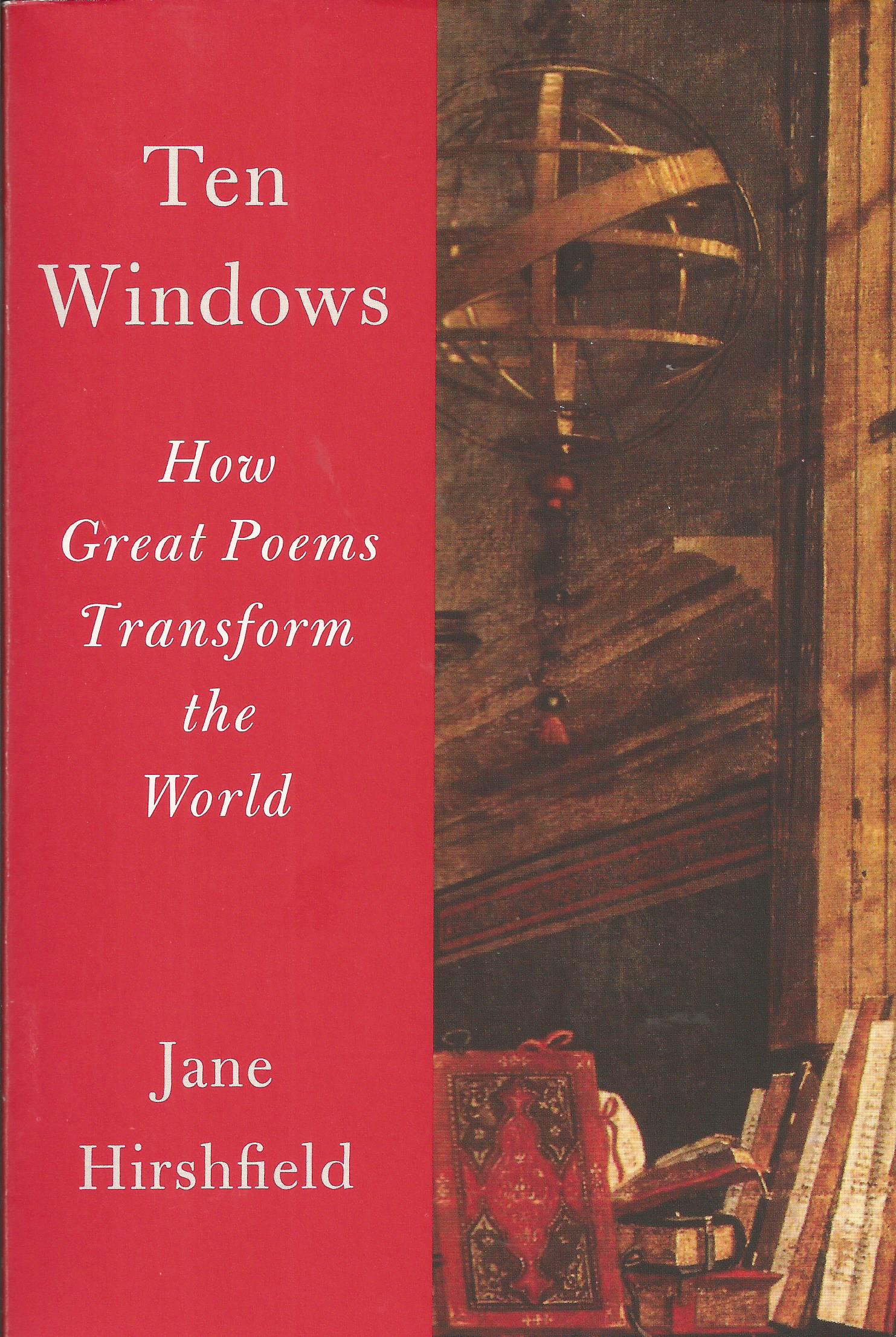
Book review: Ten Windows: How Great Poems Transform the World (by Jane Hirshfield)

Jane Hirshfield’s words perceptively reveal the seduction of poetry, of art. They open windows of clarity while simultaneously celebrating ambivalence and paradox. Ten Windows provides both a brilliant journey and practical guidance through the world of poetry for both readers and writers.

Poetry’s addition to our lives takes place in the border realm where inner and outer actual and possible, experienced and imaginable, heard and silent, meet…In a poem, everything travels inward and outward.

The essays in Ten Windows: How Great Poems Transform the World lead us from what is inherent in poetry (and the other arts) through metaphorical windows of language, image, sound/music, hidden/unsaid, ambiguity, surprise, transformation, and more. Throughout, Jane Hirshfield reminds us of the importance of poetry in our lives, how it reflects culture, and how it can even change cultural borders.

In “Seeing Through Words: An Introduction to Bashō, Haiku, and the Suppleness of Image” (Chapter Three), Hirshfield writes, “…if you see for yourself, hear for yourself, and enter deeply enough this seeing and hearing, all things will speak with and through you.” Haiku was not new when Bashō came around in the 17th century, but he changed it and influenced writing since. Bashō sought more from the form than did his predecessors. He sought

…to make of this brief, buoyant verse form a tool for emotional, psychological and spiritual discovery, for crafting new experience as moving, expansive, and complex ground as he felt existed in the work of earlier poets. He wanted to renovate human vision by putting what he saw into a bare handful of mostly ordinary words, and he wanted to renovate language by what he asked it to see.

Even for poets who veer from the Haiku form, this goal is an ambitious one. In this small poem of image and sound, Bashō excels in meeting the challenge:

seas darkening

the wild duck’s calls

grow faintly white

In Ten Windows, Hirshfield reminds writers and readers to see what isn’t said, to read between the lines. To me, this poem speaks volumes beyond what Bashō saw; it stirs emotions of darkness, of the fleetingness of experience, and of things disappearing/lost. Hirshfield notes:

“The reader who enters Bashō’s perceptions fully can’t help but find in them a kind of liberation. They unfasten the mind from any single or absolute story, unshackle us from the clumsy dividing of world into subjective and objective, self and other…. 

In a chapter about uncertainty, Hirshfield reminds us:

Poetry often enacts the recovering of emotional and metaphysical balance, whether in an individual (primarily the lyric poem’s task) or in a culture (the task of the epic). Yet to do that work, a poem needs to retain within its words some of the disequilibrium that called it forth, and to include when it is finished some sense also of uncomfortable remainder, the undissolvable residue carried over—disorder and brokenness are necessarily part of human wholeness.

A couple of paragraphs on, she continues developing her idea: “The most serene works on the bookshelf are…in the lineage of Scheherazade’s stories—art holding incoherence and death at bay by invention of beauty, detour, and suspense.” In the colloquial, we say show, don’t tell; leave something to the reader’s imagination; tie up loose ends, but leave the door open.

A work of art is not color knifed or brushed onto a canvas, not shaped rock or fired clay, a vibrating cello string, black ink on a page—it is our participatory, agile, and responsive collaboration with those forms, colors, symbols, and sounds.

Later, in the transformation chapter, Hirshfield writes:

The experience of art takes place within and under the skin. When we read the word “orange,” neuroscientists have found, our taste buds grow larger, more so if we are hungry. A mountain in a poem is known by what has been motionless and stony in us, and by what we have internalized of rock and steepness through legs and eyes. The characters of a story or play are lent our lives’ accumulated comprehensions and history, in order to make theirs our own.

Writing and reading is collaborative. “Poems are made of words that act beyond words’ own perimeter because what is infinite in them is not in the poem, but in what it unlocks in us.” This can be said of all art forms. Jane Hirshfield’s words perceptively reveal the seduction of poetry, of art. They open windows of clarity while simultaneously celebrating ambivalence and paradox. Ten Windows provides both a brilliant journey and practical guidance through the world of poetry for both readers and writers.

46 Ten Windows

Available through your local bookstore or online: Ten Windows

Journeys: a Writer’s (incomplete) Oeuvre (Prose: One Room in a Castle 1995; The Lizard Cage 2005; Burmese Lessons 2009; The Change Room 2017. Poetry: The Border Surrounds Us 2000; and Grace & Poison 1990 by Karen Connelly)

I know this. Our lives begin and end with journeys made alone.
“The Lid Over Europe” (100-101), One Room in a Castle

Karen Connelly makes many journeys. Travel introduces us to strangers and both her poems and prose reveal ways of understanding the other and experiencing ourselves.

In her 2017 novel, The Change Room, she notes two paths toward knowing: listening and storytelling. “Listening,” she writes, “was a way of pulling a stranger toward you without touching.” And so is storytelling: Shar or Shaharzad or Sheherazade – the great storyteller of One Thousand and One Nights – is the siren of enticement in The Change Room and the sensual “amazon” of the story. Listening and storytelling, strangers and borders, are common themes in Connelly’s oeuvre.

Writers’ recurrent themes interest me. I like their unfolding like fans, and their closing tight. I like the way they spread across continents and genres – always surprising, maturing, shifting but remaining, in important ways, the same. In Karen Connelly’s writing, the travellers and lovers among us glimpse ways of knowing ourselves and the other. This holds true from her earliest stories to the most recent novel.

In Connelly’s stories, strangers often become intimate in a variety of ways, sensuality being one. In “Esmeralda, a story” (One Room in a Castle 36-67), readers glimpse insights into what has matured into the novel The Change Room.

From Castle: “Our greatest similarity was our love of water, the freedom of motion it creates. ‘It’s flying,’ Esmé said. ‘It’s the closest we’ll come to being free of our bodies.’ We began to meet in the change-room before swimming….” Esmé swims; she is also a musician. Music, like water, is freeing and sensuous: “She closed her eyes, bent herself over the piano, and laid her hands on its black surface…. Then I leaned forward and kissed her eyelids.” These themes sown in Castle dominate in Room.

In The Change Room, the writing is more complex, layered and mature, but in the early work, we glimpsed seeds that later became mature fruit. (For more on recurring themes of individual writers, please also see my review of Bicycle Thieves by Mary di Michele.)

Connelly writes across genres, which leads me to think about truth in nonfiction and fiction. One Room in a Castle, for example, was published as nonfiction – purportedly as correspondence and travel. The Change Room – 22 years later — as fiction. It begins with an Emily Dickinson quote:

“Ourself, behind ourself, concealed,
should startle most.”

And we are left wondering about the difference between reality and imagination – a conundrum for writers and readers. Connelly does provide hints. For example, in “Extrah-dinary” (Castle 33-35) she writes “It is difficult to get to the truth of one’s self; how much more difficult to create an imaginary world and reveal its truth.” Still…. (For more on this topic of fact and truth, please see my review of Beatrice and Virgil by Yann Martel.)

I was introduced to Connelly’s writing through a book club reading of her mid-1990s memoir, Burmese Lessons, which still pops into consciousness despite the time lapse. But it’s the poetry collection, The Border Surrounds Us, which remains my favourite – especially section II – which I’ve read over-and-over again.  It is only recently that I discovered Grace & Poison, a compilation of Connelly’s first two poetry books. Even in 1990 her themes were clear and her voice strong. From that collection, a prose poem – “A Story for Suradev, In Bangkok” – stands out. In it we find her mature themes of intimacy/compassion, strangers/self. The closeness of her observations stand stark.

Her passion for travel and imagining the experiences of those she meets into story is continuous. Perhaps Connelly’s most intense book is The Lizard Cage, published in 2005, which drew me back to Burmese Lessons. Burmese Lessons is essentially a love story/a political story. The Lizard Cage is darker, taking readers inside a Burmese prison and into the isolation of an ancient man and a small boy, cruelty beyond comprehension, love, and survival. Somehow Connelly manages to maintain dignity, love, compassion, and beauty.

Karen Connelly began her writing career with the idea of borders, journeys from the known into the unknown: “Our lives begin and end with journeys made alone,” she wrote in her early twenties. In between life’s bookends, many other journeys are made and borders crossed: some geographic and cultural; some social and political; most intimate and sensual. They are all crossed personally, alone, and usually with risk of one sort or another. The intimacy with which she crosses borders can challenge us; she touches the heart, the soul, and the body.

22 Connelly Bks LR (1 of 1)

Various publishers have put Karen Connelly’s writing into print. Search her name or the name of one of her books and that will take you to a source. Most are available through your local bookstore or online.

Review (Poetry): Lines…and what’s between them (What the Soul Doesn’t Want by Lorna Crozier)

What the Soul Doesn’t Want is a new collection, the most recent of 17 books by Lorna Crozier. Five of her poetry collections live on my bookshelf and are frequently pulled off and carried to the oversize, plaid wingchair in my library/office to be read again. However, the poems in What the Soul Doesn’t Want are new to me; I haven’t had the time to ponder them, to return on a different day in a different mood to discover what they might offer. But it’s easy to see they are pure Lorna Crozier.

She writes with quirky wit and sensitive awareness. For readers, the poems provide pleasure and insight and the simple joy of the words she chooses. Her themes in What the Soul Doesn’t Want haven’t veered from past work, but the tautness and edginess are sharper here.

She draws from nature and not always what you might expect. In “Cockroach,” we get the sublime: “they creep from the baseboards, / climb the couch and burrow in her hair” which makes me involuntarily shudder. But I also learn that “In Japanese it’s gokiburi,” a word I expect my grandson teaching in Japan will be interested in adding to the personal dictionary he’s creating. Reading Crozier, one finds clear images and science next to odd bits of trivia and a telling that will cause you to smile and to think (even as you might shudder).

Aging and time are Crozier themes. My favourite poem in What the Soul Doesn’t Want is “When the Bones Get Cold.”

My husband sends me hummingbirds
from his eyes. Only he and I know
he’s going blind….
I am made beautiful by loss. The moon, too,

There’s a sweetness
that comes from accepting what I am,
not a mountain, not a river, not a tree.

Grief also ripples through her poems. In “Algorithm: The Way Out,” Crozier writes: “…Grief’s / a snowdrift that thickens / as you walk.” How simple. How brilliant. How true for all of us who have known sorrow and deep snow. It is this universality and, perhaps, the lightness (and the light) that gets the writer and the reader through the tough stuff she doesn’t shy from.

Crozier is an Officer of the Order of Canada, the Governor General’s Award for Poetry, and a three-time recipient of the Pat Lowther Award. After a long teaching career, she is now Professor Emerita at the University of Victoria (British Columbia). She must be the envy of poets everywhere.


07 Crozier covers LR-007

Lorna Crozier’s books are all available through your local bookstore or online: What the Soul Doesn’t Want