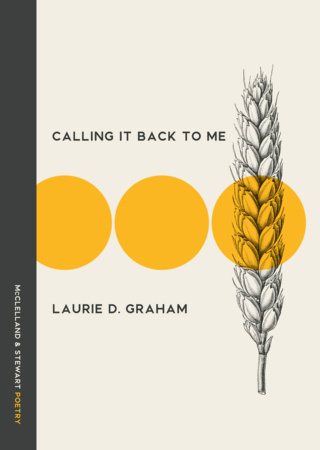
BOOK REVIEW: Calling It Back to Me by Laurie D. Graham

Calling It Back to Me by Laurie D. Graham is an unsettling reminder, an everywoman’s quest, to find and to understand the women of her lineage, their lost lives, their hopes, their names. Heirlooms are not enough: “a darning mushroom, / a tin of teaspoons. // Still the urge is for / story” (“Calling It Back to Me”, 3). From the first page, Graham goes in search for all the things that come together to make story, including the questions and the tensions, the conflicts that brought her maternal grandmothers to Canada’s prairies along with the colonialism that complicated their lives and the poet’s search.

The poetry is sparse, bare, leaving lots of white space on the page, which I imagine represents the unknown. So much white space. Couplets dominate, two lines working together or in opposition, run down the page in brief observations, thoughts cascading among discoveries found as in the 17-page title poem:

A small pink curl
of cloud.

No language
for any of it.

Edges of photographs
disintegrating.


Names  on the census misspelled.
Creases erasing the facts

Sadly, Graham notes, “Sometimes / a family doesn’t have / a story-keeper”.

Graham probes birth certificates, census records, ship’s records, and photographs. She questions, “Just a married name”. She admits, “I miss the lives / I have not lived”. And she draws the poem to a close and opens the way for the second section of the collection, “The Great-Grandmothers:”

This is the reckoning process.
To be careful, precise

about my thanks.
Would they be happy,

Would they be dismayed
to see me here in this future.

Graham’s crisp writing carries us forward into the puzzle of the great-grandmothers, where she gives each one her own form and voice on the page. Each is distinct, but the veil that shrouds each one makes them unknowable. Whether from Northern Ireland, or the “old country” of Sophia Czyzowski, or the beauty of the Clyde, or the one wearing a babushka in a photo, enticed by the promises of Uncle Prokop (“You can work / for yourself / not have anyone / over you”), each is mother to many, each resilient. Each unique under the homesteader category, each eking out a tough living on the prairies, each living a hard life, which takes us to the third section, “Toward an Origin Story”, where:

Under Russia’s boot,
under England’s boot,

they sailed off
to become the boot

of the plains, stamping
out the grasses and trees –

Smoothly, Laurie D. Graham broadens the focus to include environmental degradation and loss – “every arable, pilfered inch” – as well as the poli-colonial attitude toward both homesteaders and Indigenous.

To read to whole review published in TNQ, please click here.
McClelland & Stewart Poetry, 2026
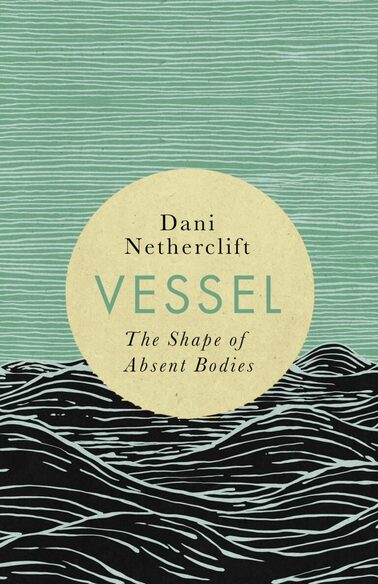
BOOK REVIEW: Dani Netherclift’s Vessel: The Shape of Absent Bodies

Vessel: The Shape of Absent Bodies is Dani Netherclift’s first book, a hybrid in content and form. We’re told that the elegiac and lyrical narrative is rooted in the 1993 drowning deaths of Netherclift’s brother and father. Much of the content, particularly in the middle section stems from the author’s research, which she calls “the creative artefact of my PhD” (179). This, along with images of rumpled envelopes link the author’s narrative to her grandmother’s, along with articles photocopied from newspapers of other drownings. These weave Netherclift’s experience with those of others. She probes literature, science and magical thinking, returning time and again to the day of the drownings, to memories (hers and others), to official records, to a search for herself trapped in absence.

Place and the coincidence of familial experience are essential to the unfolding of the storyline. We’re given a hint of this with the first lines of the largely prose poem (these blocks are centred left-right on the page, justified with wide margins):

The author is witness, and also conflicted, ambiguous.

I have a collection of one-hundred-year-old
envelopes addressed to my great-grandmother,
sent from the trenches in France and Belgium
in World War I. The address the envelopes
were sent to is the place my father and brother
departed from on the day they died. This land,
Ngurai-illum Wurrung Country, forty acres,
shaped like a lopsided house turned on its
side, was colonised by my Scottish ancestors
one hundred and seventy years ago.
These envelopes are empty now.

[…]

… I witness my father and brother drown, minutes—perhaps only seconds—apart (11).

I sayThough I witnessed every moment
of their drownings
,

but I didn’t witness every moment, only the
parts I could see
.

I say—I saw them die,

but I’m sure their hearts were still beating the
last time I saw them.

I say—I’m sure (23).

Netherclift contemplates the way awareness creeps up on a person. Invoking the death of a great-uncle in New Guinea, she notes her great-grandmother’s body “had been marked / indelibly with absence” (68). These disparate linkages run constantly through the book. Yet, Netherclift’s skill creates a cohesive weaving, moving from example to example of the surprise of death and the wounds it leaves on the living. In example after example, there is disjuncture between what happens in the physical world and what happens to those affected. Netherclift gives us the example of Schrödinger’s cat – the 1935 experiment that highlights the unknown time in-between (69).

For a period after a person dies, the mourner’s
brain conjures an expectation to see their dead
loved one walking in through familiar doors….

To read the full review, please go to The Temz website where the review was published. Click here.

Assembly Press, 2026