
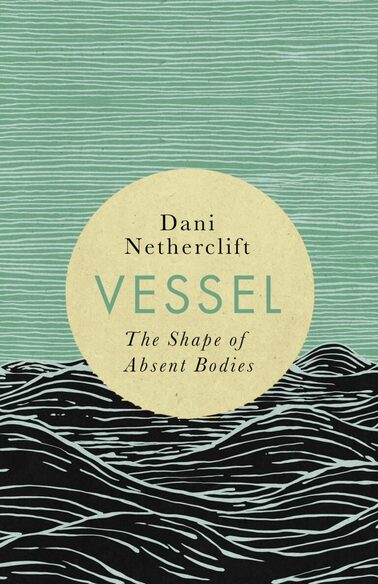
Vessel: The Shape of Absent Bodies is Dani Netherclift’s first book, a hybrid in content and form. We’re told that the elegiac and lyrical narrative is rooted in the 1993 drowning deaths of Netherclift’s brother and father. Much of the content, particularly in the middle section stems from the author’s research, which she calls “the creative artefact of my PhD” (179). This, along with images of rumpled envelopes link the author’s narrative to her grandmother’s, along with articles photocopied from newspapers of other drownings. These weave Netherclift’s experience with those of others. She probes literature, science and magical thinking, returning time and again to the day of the drownings, to memories (hers and others), to official records, to a search for herself trapped in absence.
Place and the coincidence of familial experience are essential to the unfolding of the storyline. We’re given a hint of this with the first lines of the largely prose poem (these blocks are centred left-right on the page, justified with wide margins):
The author is witness, and also conflicted, ambiguous.
I have a collection of one-hundred-year-old
envelopes addressed to my great-grandmother,
sent from the trenches in France and Belgium
in World War I. The address the envelopes
were sent to is the place my father and brother
departed from on the day they died. This land,
Ngurai-illum Wurrung Country, forty acres,
shaped like a lopsided house turned on its
side, was colonised by my Scottish ancestors
one hundred and seventy years ago.
These envelopes are empty now.
[…]
… I witness my father and brother drown, minutes—perhaps only seconds—apart (11).
I say—Though I witnessed every moment
of their drownings,
but I didn’t witness every moment, only the
parts I could see.
I say—I saw them die,
but I’m sure their hearts were still beating the
last time I saw them.
I say—I’m sure (23).
Netherclift contemplates the way awareness creeps up on a person. Invoking the death of a great-uncle in New Guinea, she notes her great-grandmother’s body “had been marked / indelibly with absence” (68). These disparate linkages run constantly through the book. Yet, Netherclift’s skill creates a cohesive weaving, moving from example to example of the surprise of death and the wounds it leaves on the living. In example after example, there is disjuncture between what happens in the physical world and what happens to those affected. Netherclift gives us the example of Schrödinger’s cat – the 1935 experiment that highlights the unknown time in-between (69).
For a period after a person dies, the mourner’s
brain conjures an expectation to see their dead
loved one walking in through familiar doors….
To read the full review, please go to The Temz website where the review was published. Click here.
Assembly Press, 2026


