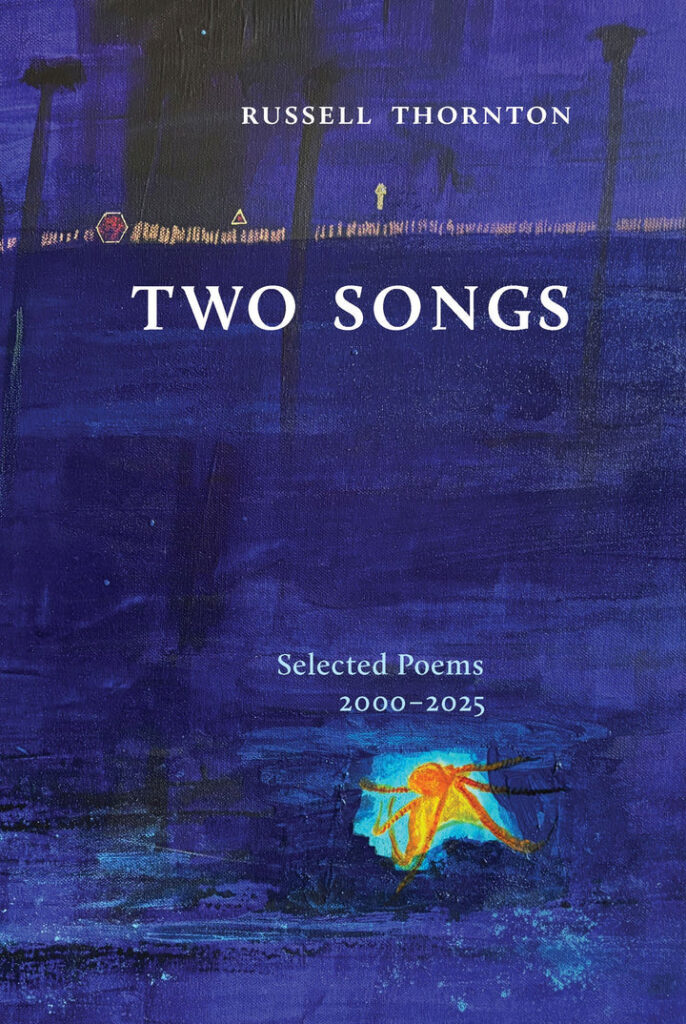
BOOK REVIEW: Two Songs: Selected Poems 2000-2025by Russell ThorntonHarbour Publishing (2026)

With nine previous collections, Russell Thornton is a poet whose name you will recognize. You may have one or two of his books on your poetry shelf, but don’t assume there’s nothing to be gained from diving into Two Songs. The selected poems not only echo across time and situations, they remain fresh, relevant, and beautifully satisfying to read. A great advantage in reading this collection over twenty-five years is that you will see the consistency and the development of one of Canada’s foremost poets.

The poems in Two Songs are collected chronologically in nine sections, each containing poems chosen from individual books, plus a final section: “Uncollected and New Poems” (223-238). Thornton takes us on a journey through life, with poems focussing on childhood and parental relations, parenthood and his own children, love and violence, his home on the West Coast and his travels abroad. The collection is far-ranging in topics, themes, and place. Across this wide spectrum, Thornton’s voice sings with lyricism, boldness, and energy. From the first poem, I was engaged and enchanted, torn open and somehow soothed.

Night Tide

I stood where a tide began rushing to fullness,
drawing out long grass as it wove through sand dunes,
then walked east …

suddenly aware I was no longer what I had been.

This awareness, this transformation, is emblematic. The poem continues with vivid imagery until we reach the turn:

Then an old woman was at an open door.
We’re all leaving, she said. I know, I’ll be ready, I told her.
You won’t be able to keep her a secret anymore,
will you? she said. While I watched her turn and go,
I felt the one she had spoken of showing through my face.

Writing through the “dream dark,” he takes us into a space literal and magical, lays physical reality alongside the mind’s reality.

The first two poems in the collection take my breath away; they are ripe, sensuous, and layered. I cannot stop underlining, scribbling in the margins, and turning pages, until I finish the section and come up for air. I am drawn in and held by the way Thornton weaves images and metaphor, how he builds the poems with words and images that circle and repeat, search and take the reader deep inside experience and all it offers. For example, in “Creek Trout” (13), he first describes the trout then moves into metaphor:

To see the trout, to gaze after it
as the doors of the water open before it,

as the innumerable chambers of the creek open before it,
each a new exultation, a new feeling of the tough of the creek,

a new entering and entering,

Already, in 2000, Thornton is an accomplished poet. . . .

My review is published online at FreeFall Magazine (2026-06-22). Click here to read the entire review.
BOOK REVIEW: Birdology by Carolyn Van Der Meer (Cactus Chapbook Press, 2025)

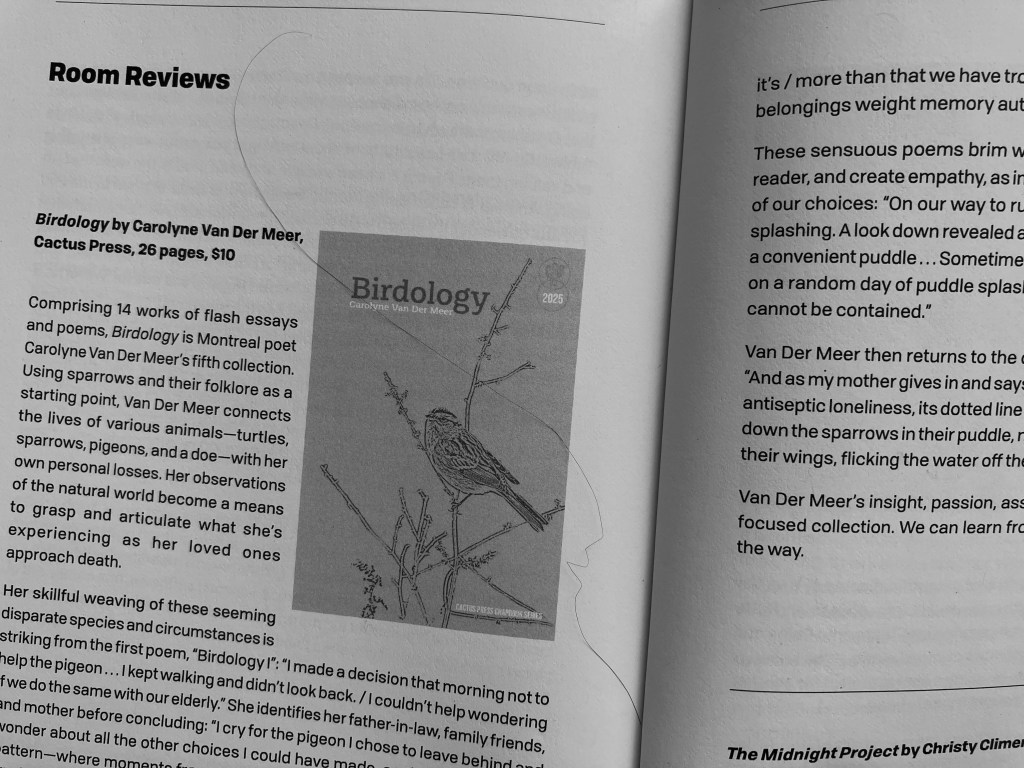
My review of Carolyne Van Der Meer‘s chapbook, Birdology (#cactuspress, 2025) is in now available in print from Room Magazine, 49.2, the Science issue.

“These sensuous poems brim with specificity; their images linger, engage the reader, and create empathy, as in ‘Birdology II’ where we experience the fullness of our choices . . . .” Her mother needs a care home, “a place of antiseptic loneliness.”

“Van Der Meer’s insight, passion, assurance, and skill are evident in this small, focused collection. We can learn from the sparrows. Van Der Meer shows us the way.”

To respect Room‘s copyright, the review is not copied in its entirety.

BOOK REVIEW: Long Exposure by Stephanie Bolster

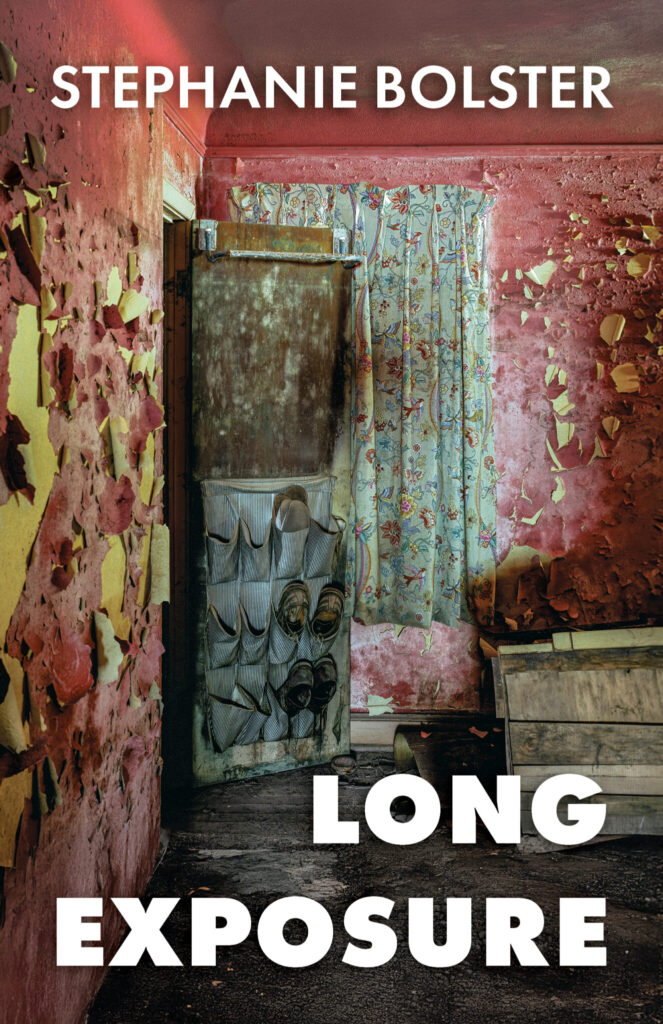
Long Exposure is Stephanie Bolster’s fifth and most recent poetry collection. Readers may know Bolster’s writing from her Governor General’s Award winning The Alice Poems, her first book (1998) through to her fourth, A Page from the Wonders of Life on Earth (2012). After Wonders, she noted in an online interview with Poetry in Voice, that “increasingly I feel that the best poetry arises from some social calling, or fulfills some social need.” Long Exposure does just that. 

The collection opens with the words, “It is not something that begins.” Following about a 10-line white space giving readers time to consider, then continues:

Before there was land there was water.
A place silted itself up.
Around the time of the pyramids
parts of other places made this place.

and, so, we are introduced to Long Exposure and to New Orleans, a key place for the unfolding of Bolster’s theme.

“What began in 2009,” Bolster writes in the acknowledgements, “as an interrogation of my unsettling fascination with Robert Polidori’s photographs of post-Katrina New Orleans became an education that has lasted for 16 years and does not end here.” As Bolster probes Polidori’s images, she notes how the hurricane’s destruction was multiplied many times over by failure of the unmaintained levies. And she resurrects other disasters: Chernobyl and the nuclear meltdown of 1986, the Interment of Japanese-Canadians in B.C. during WWII, Mothers of the Disappeared in Mexico. She exposes a litany of social atrocities in the compelling and extraordinarily-crafted singular poem, Long Exposure.

Bolster’s collection is a kind of rabbit hole, a warren of man-made disasters. She tells us: 

Sometimes to look
is merciful, sometimes
to turn away. (32)

The poetic images are, themselves, horrific. In “Shelter Object,” she introduces the first of the Chernobyl poems:

The constellations made of fear. Chaos
where a shape was. Stars where a roof.

A fire where a place. The world
asleep in its bed. World irrevocable.

The heat unfathomable. They worked
shirtless. Already acute in hospital.

Soon coffins of zinc. Soon
they’d gut the wards of the dead.

The writing builds to a crescendo. Following 17 couplets, the tone and pace shift, slow to conversational speed:

His mother asked when the bus was coming and in a while
she asked and again and then didn’t and
he turned she was dead.
He covered her there in her wheelchair outside the Convention Centre.

The review is published in FreeFall Magazine, to read the full review click here.