
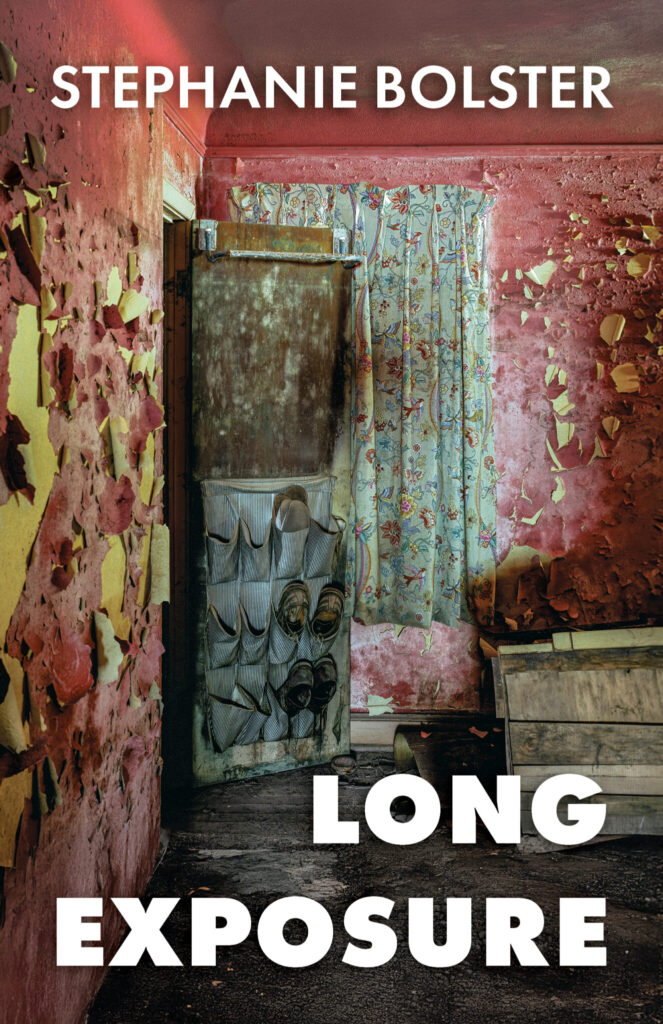
Long Exposure is Stephanie Bolster’s fifth and most recent poetry collection. Readers may know Bolster’s writing from her Governor General’s Award winning The Alice Poems, her first book (1998) through to her fourth, A Page from the Wonders of Life on Earth (2012). After Wonders, she noted in an online interview with Poetry in Voice, that “increasingly I feel that the best poetry arises from some social calling, or fulfills some social need.” Long Exposure does just that.
The collection opens with the words, “It is not something that begins.” Following about a 10-line white space giving readers time to consider, then continues:
Before there was land there was water.
A place silted itself up.
Around the time of the pyramids
parts of other places made this place.
and, so, we are introduced to Long Exposure and to New Orleans, a key place for the unfolding of Bolster’s theme.
“What began in 2009,” Bolster writes in the acknowledgements, “as an interrogation of my unsettling fascination with Robert Polidori’s photographs of post-Katrina New Orleans became an education that has lasted for 16 years and does not end here.” As Bolster probes Polidori’s images, she notes how the hurricane’s destruction was multiplied many times over by failure of the unmaintained levies. And she resurrects other disasters: Chernobyl and the nuclear meltdown of 1986, the Interment of Japanese-Canadians in B.C. during WWII, Mothers of the Disappeared in Mexico. She exposes a litany of social atrocities in the compelling and extraordinarily-crafted singular poem, Long Exposure.
Bolster’s collection is a kind of rabbit hole, a warren of man-made disasters. She tells us:
Sometimes to look
is merciful, sometimes
to turn away. (32)
The poetic images are, themselves, horrific. In “Shelter Object,” she introduces the first of the Chernobyl poems:
The constellations made of fear. Chaos
where a shape was. Stars where a roof.A fire where a place. The world
asleep in its bed. World irrevocable.The heat unfathomable. They worked
shirtless. Already acute in hospital.Soon coffins of zinc. Soon
they’d gut the wards of the dead.
The writing builds to a crescendo. Following 17 couplets, the tone and pace shift, slow to conversational speed:
His mother asked when the bus was coming and in a while
she asked and again and then didn’t and
he turned she was dead.
He covered her there in her wheelchair outside the Convention Centre.
The review is published in FreeFall Magazine, to read the full review click here.
 Kathryn MacDonald