Been traveling: Cuba’s Oriente

Journal map sketch-1 LR
One of my sketches showing the area of my recent visit where many adventures unfolded.


I’ve just returned from nearly a month’s stay in the eastern tip of Cuba where I explored nature, history, the unique Baracoa style of art and its many studios, and so much more. It was my third trip to the area and each visit opens doors to new experiences and insights.

Cuba’s eastern tip, known as Oriente, offers

  • one of the few rain forests in North America (although most of us think of Cuba as Caribbean, and it is that too) where Hurricane Matthew left a path of destruction but didn’t dispel the indomitable spirit of the people;
  • the tallest waterfall in the Caribbean (the 20th tallest in the world) and many lesser ones with their own special beauty;
  • a semi-desert in the region of Maisi (say My-see) and the Terraces that step up from the lowlands to the sea with breath-taking twists and views (and for geography buffs, the Maisi lighthouse on the Windward Channel is only 80 kilometres from Haiti);
  • the Farola Highway, which creates passage from the Atlantic Ocean to the Caribbean Sea, is known as an engineering marvel, not to mention an adventurous ride (and on the south shore where I set off on foot to the site of poet-revolutionary José Marti’s famous landing in 1895, which set off a revolution that aimed to free Cuba of Spain’s rule);
  • Baracoa — a provincial city with a two-kilometre-plus-long malacon, that brims with art galleries, parks, and the friendliest people you will ever meet. It’s the biggest city in the area and the starting point for numerous day-trips to places like Rio Yumuri, Rio Toa, Rio Miel, each providing its own unique experience and ambience — and Alejandro Humboldt Nation Park, a United Nations designated site to touch on only a few places to enjoy a boat ride or to hike.

Over the next few weeks I’ll be posting photos and stories; click below to follow my many adventures in one of the most varied and beautiful landscapes in the world (and this is not hyperbole).


The Last Journey (East of the Mountains by David Guterson)

Underfoot, a fine sand shifted and confounded his progress. A strange apprehension haunted his limbs. He changed his direction twice, three times. Low, barren mountains appeared on the horizon. A lunar barrenness, the topography of dreams, stones strewn artfully down an arroyo as if laid by a Japanese gardener, a sinuous bend in the dry bed of stones, one, stone, two, a stone carved in runes… .

Like David Guterson’s award-winning Snow Falling on Cedars, East of the Mountains, is dense with description that uses all of the senses to draw us into place and experience. Besides the extraordinary detail, the end-papers provide a map of the mountain journey to help us traverse the route taken. East of the Mountains is an Odyssey, except we cross mountains rather than sea.

In Snow, Guterson explores relationships between Japanese Americans and their Caucasian neighbours along the northwest coast of the U.S. during WWII. East of the Mountains moves inland but remains true to place, although in this book the relationships involve Mexican migrant farm labourers. Here, the major conflict is within his protagonist Dr. Ben Givens and between Givens and the orchardists and other residents of the area. But East of the Mountains is essentially a character study that reveals one man’s journey toward death and acceptance.

The story is raw with pain: of bereavements; of terminal cancer and dying; a particular gun and the hunting of small birds (with two Brittany spaniels); and Italy during WWII. Balancing the emotions these themes elicit are tranquil orchard scenes from Givens’ youth; love and sensuously drawn passion; and his openness to life’s surprises.

The doctor plans suicide to protect himself from the pain he knows lies ahead and to protect his family from witnessing it. He goes off toward his childhood home among orchards to see it one more time. He hasn’t reached it in this scene where he’s arrived at a rough town. He feels like “a transient pauper, a graybeard drifter, a derelict or vagrant.” He’s on a quest, which he’s beginning to recognize:

Sitting there with his jug in his lap he thought of those Hindu wanderers he’s seen on a public television documentary, mendicants abroad with begging bowls, dressed in rags and clutching staffs, divested of all other property, seeking to meet the world unencumbered, aspiring, always, toward—what did they call it?—atman, the self, God. 

Soon, Givens will wrangle a ride with a trucker. As they share their stories, he comes to another kind of realization:

Ben’s heart recoiled. The lean, spare life of the wanderer, which had held some attraction an hour before, held no attraction now.… He tried to embrace some other end than the one he’d chosen for himself—he thought of dying in a hospital room, imagined languishing in one. He fell silent and stared out the window. There were no good answers to important questions. He tried to picture the shape of Stu Robinson’s [the trucker’s] final days, but he couldn’t even begin.

Throughout, Ben Givens is pulled by his moral centre. Haunted by memories and a promise, he seeks—what? answers to the big unanswerable questions, but he tries. He becomes caught up in others’ lives and surmounts his pain (both the memories and the physical, which run a parallel course).

Inevitably, there was no other subject, and he forced himself to muse on death as though it were simply a form of sleep, warm and full of dreams.

His musing finally gave way to sleep, and Ben dreamed he was traveling in the desert. On a journey whose purpose he couldn’t guess.

The inevitability of death and the bigger questions of meaning and memory, and of promises, thread through East of the Mountains. At times, I thought the detail would overwhelm me, but I’m very glad I read to the end in order to experience the epiphanies of personal discovery. Guterson is a writer who isn’t afraid to probe the big questions, and I’m glad I journeyed through waste- and lush lands sharing the loves and fears and coming to acceptance of Ben Givens.

33 East of the Mountains

Available through your local bookstore or online: East of the Mountains

Zen Travel (Zen Seeing, Zen Drawing: Meditation in Action by Frederick Franck)

A true drawing is a very private dialogue between the artist-within and some facet of the world around him or her.

Zen Seeing, Zen Drawing came to my attention in 2013, already a 20-year-old book. Since then I’ve read it a few times and it continues to speak to me. I recommend it to you, especially the travellers and writers among us.

Like Franck, I cannot sit and meditate. I fail to clear my mind of the dribble that pushes its way into any space and silence. Yet, when I sit to sketch, everything disappears except the object of my attention. I slip into Zen-state where an hour or two passes as if it was a moment. Franck explains this magic as he walks readers along the path from his early days of gallery shows to his gradual movement into drawing and eventually to the transcendent moment of the unification between seeing-drawing and the experience of oneness. But I am more writer than sketcher – more years of practice – so besides the sketching advice, I’m taken with the writing advice he offers.

Bashō, the father of haiku, warned his students: “Jot down your haiku before the heat of perception cools!”

And this is the way Franck suggests we draw. See the object, enter it through the pen, and experience oneness with it. He compares this experience with the fleeting, but timeless, haiku:

An authentic haiku must, in one breath, grasp the joy as it flies, the tear as it trickles down the cheek. In its seventeen syllables a haiku must catch the unsayable, the mystery of being and non-being: timeless mini-satori in fleeting time:

This dewdrop universe
Just a dewdrop
And yet,
And yet …
            Issa

This is what the sketcher strives to achieve: the quick rendering and the immediacy of becoming other; the Zen moment (whether it passes in mere seconds or whether it stays with you minutes or more).

A final thought on haiku and drawing: “Haiku transmit neither an idea nor a philosophy; they transmit pure experience into a minimum of words that grasp a moment of grace, be it joyous or heartrending.” When I facilitate writing workshops, this finding the essence of experience is what participants are encouraged to discover through their stories.

One of the reasons I’m back at sketching after a bit of a hiatus is to really see what’s before me when I travel. Like Franck,

… I entrust my bones again and again to flying contraptions to circle the globe. I can’t help belonging to this generation of the restless, the globetrotters, the astronauts, obsessed with seeking, pursuing salvation elsewhere, as if the black-eyed Susans in Provence were more black-eyed than the ones in my backyard.

He ventures at some length to explain why taking photographs is less apt to allow us into a culture, for example (and can actually be intrusive and alienating) than drawing. In addition, with photography, the Zen experience is more elusive and, if it is present at all, passes within the nanosecond release of the shutter and, with rare exception, fails to capture the essential essence of the subject/experience. Nevertheless, I’ll continue to photograph my travels, but I’ll add to those images the pleasure of sitting in parks, standing in doorways or on a rock by the ocean with pen, blank journal page, and a box of watercolours. To give you two representative examples, recently in both Morocco and in Mexico, people shied away from the camera but when I got the sketchbook out, people came over to peek and to talk about the process.

Discovering the essence of the object, its authenticity, and its oneness in a Zen sense, is what painters and sketchers seek. It is what I seek in my humble, clumsy and beginner’s way. It enhances travel experiences and the memories that follow.


32 Zen Seeing-Zen Drawing

Available through your local bookstore or online: Zen Seeing, Zen Drawing

Japan across time (Tale of the Gengi by Murasaki Shikibu)

“She was clever for her age, and she interested him. Difficult and unconventional relationships always interested him.”

In some ways, The Tale of Genji is a coming of age story. A handsome and charming youth, Genji has a way, as they say, with the ladies.

What is old—and this story is old—is new again. Written in the 11th century in the milieu of the political court of Japan, Murasaki gives us a story that is timeless. Just remove it from the privilege of palaces and the political intrigue and we have a story that could have been written today. Murasaki has managed a story that isn’t dated in language, style, or content.

The Tale of Genji has been compared to Gilgamesh and to The Iliad in timeless appeal, and it has the force of Shakespeare. As Shakespeare’s plays are interspersed with poetry, so too is Murasaki’s prose:

He plucked a few notes on his koto, but the sound only made him sadder.

“The waves on the strand, like moans of helpless longing.
The winds—like messengers from those who grieve?”

But the poetry she inserts is not hers. It is attributed to Chinese and Japanese poets of the past (that is, previous to the 11th century). And, like haiku, the quotes are pithy, descriptive, and timeless, and they totally relate to the passages they enhance.

My reading has taken place during the period of recent “Me Too” revelations and accusations. Clearly, while many of the women in this novel were willing participants and, like Genji, shed tears when the affair took a hiatus, there’s often that awful power imbalance. At least in one instance, there are uncomfortable circumstances involving a young girl he’s raising like a daughter. Genji’s behaviour can create shudders, yet Murasaki paints a feeling, sensuous young man who makes his way through a convoluted, political maze and … (ah, no spoiler here).

As to how I happened across such an ancient story, I read an article by Joe Fassner published on Atlantic online, January 23, 2018 in which he discusses The Written World, by the Harvard professor Martin Puchner who calls The Tale of Genji a “foundational text.” Fassner quoted Puchner:

The book was written about 1,000 years ago, at a time when a lot of literature was still produced by scribes, collected from various sources and cobbled together by editors. The foundational epics and religious texts in circulation then were very different from the reading material we’re used to. In that context, Murasaki’s diary felt to me like a turning point in the history of literature—it sounds so recognizable, so intimate, so modern. The fact that someone living in an extremely different time, halfway around the world, a thousand years ago, could whisper in my ear in that way—it’s magical.

And that is what Murasaki did for me: she whispered in my ear during nights of bedtime reading.

She wrote her story at a time when women were not taught to read and write (apparently by listening from behind the paper screens to her brother’s lessons). Her topic is modern in subject and theme. The writing is accessible, despite the gap of eons and culture. And, adding to the magic, the story is illustrated with woodcuts that were first published in the 1650 edition of the Illustrated Tale of Genji. The world’s first novel is also one of the greatest, even if you’re not a Japanese aficionado, but if you are, you are in for a special treat.

31 The Tale of Genji

Note: I cannot locate a source for the edition I borrowed from the library (Vintage Classics Edition, June 1990) that is annotated and illustrated. The link (kindle edition) I’ve provided is also copyrighted by Edward G. Seidensticker and is most likely the closest to the version I read.

Available through your local bookstore or online: The Tale of Genji

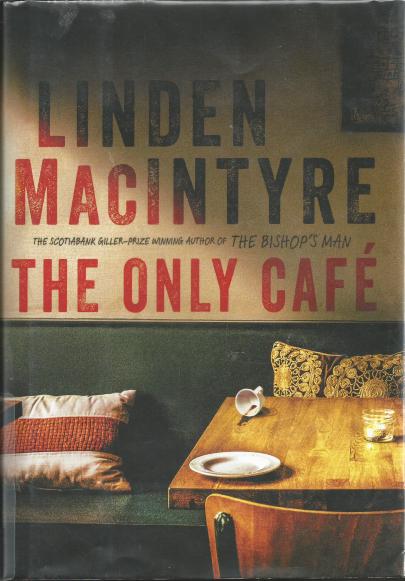
Secrets & the Father (The Only Café by Linden MacIntyre)

“In war and politics there is a selection of facts.”

I opened this novel-based-on-facts three days ago and whizzed through all 418 pages. From the epigraph by James Joyce – “Secrets, silent, stony sit in the dark palaces of both our hearts: secrets weary of their tyranny: tyrants willing to be dethroned” – I was hooked. Linden MacIntyre’s The Only Café is a book of secrets, secrets kept, lost, delved into, and secrets like ghosts that haunt.

At the story’s heart are war, Lebanon, a son bereft of family, and the strange turns life takes, turns that seem to be life-saving but that become life-destroying. It is also the story of that man’s son and the unraveling of a mystery. Clues come in a request, read as an addendum to a will, for an out-of-character “roast” to be held at The Only Café. They also come in clippings tucked into twenty-years of diaries that are in sparse notes-to-self jottings.

Like all good stories, this one has more than one thread running through: they intersect; split apart. And the story contains echoes. One that particularly haunts is the image of a woman with a basket of children’s clothes and pins that go flying.

Themes and sub-themes also run through. Like The Return: Fathers, Sons and the Land in Between by Hisham Matar (memoir, recently reviewed) this story explores the impact of an absent father. Pierre Cormier, however, was absent even before he disappeared.

One of the most disturbing threads exposed and returned to in the story is the massacre at Sabra and Shatila camps, the numbers beyond comprehension. And although a civil war was playing out in Lebanon, Lebanese are far from the only culprits in the unfolding of horrors. And this is where Ari comes in. Like Pierre, Ari has Middle Eastern roots, although Canadian-born. With Ari the mystery deepens and questions darken.

As in The Return, The Only Café makes me aware of how superficial my sense of history and politics is. I knew scant facts about Libya’s politics and revolutions except perhaps about the Lockerbie bomb and its link to Libya and a bit gleaned from the news about Qaddafi’s dictatorship. I know even less about Lebanon, although I attended a reception at the Lebanese Embassy in in Washington D.C. while participating in an international conference. My dearth of knowledge is an uncomfortable admission. However, these two books have filled in many gaps.

Readers learn details of life in Lebanon, hints about the secrets refugees carry, and the complexity of memory (how facts shift and half-truths are essential for survival), about marriages that fail and those that hold promises, about the world of work and friends and lovers. Linden MacIntyre’s The Only Café can be read on many levels, but regardless of whether you skim or do a bit of side-research, you’ll think about the characters he creates on history’s slate and see that the essential truth in fiction is truth.

(Linden MacIntyre was host of the fifth estate and a distinguished journalist as well as an award-winning author.)

30 The Only Café

Available through your local bookstore or online: The Only Café

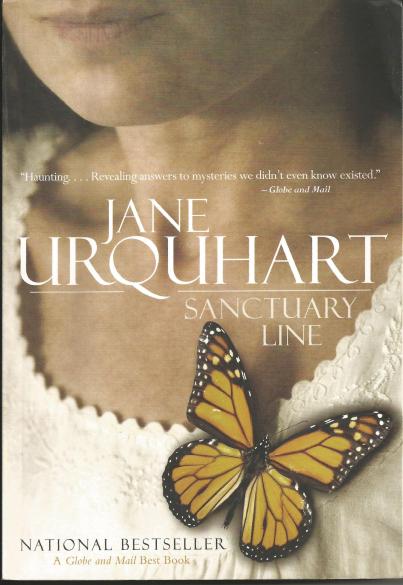
Living Memory (Sanctuary Line by Jane Urquhart)

“What are the four ways that a person can enter a book?” my uncle would often ask… . “Emotionally, aesthetically, intellectually, and philosophically… .”

Jane Urquhart opens all these doors for readers to enter Sanctuary Line, a layered story told through the memories of Liz Crane of the transplanted Butler clan. A woman now, Liz probes a childhood peopled with relatives – some, the “Great-greats” live through her uncle’s stories – while cousins and Teo (the son of a Mexican farm worker) play in the orchards and woods and grow up along Lake Erie’s shores.

The Butler clan’s roots were first transported from Ireland to Ohio. During the War of 1812, a branch of the family journeyed across Lake Erie to take up lighthouse keeping and farming – the clan’s traditional occupations – on Canada’s shores. Liz tells us that the Butlers are a “bifurcated” family. We come to learn they are split in other ways, as the story moves back and forth across time, place, and the complex world of memory. It is also a story of love and loss, of isolation and intimacy. It is a small, not uncommon story, a story magnificently told, a story of contradictions and surprises whose characters are full of the flaws that make them real.

In the novel, Sanctuary Line of the title is the name of the road that runs between Kingsville and Point Pelee. This alone intrigued me when I began to read. These are familiar places of my childhood and, reading, I could smell the ripening fruit and see the rivulets that run across wooded areas down to the Great Lake. And I, too, witnessed the life cycle of monarchs and saw a tree shimmer in late afternoon light with the beating wings of hundreds of butterflies as they prepared for the long journey across the water that would continue to Mexico, migrants not unlike the Mexican farm workers who arrive in the spring and depart in the fall.

Urquhart’s writing inspires: she quietly builds the tension toward her turning point and then weaves loose threads toward the conclusion. On the surface, Liz (mostly) maintains calm, but beneath run currents as threatening as those of the Great Lakes. Woven into the drama is the science of the monarchs and the changes being wrought to the landscape. Her skillfully integrated literary references are integral to the story – from the uncle’s old (and embroidered) tales to cousin Mandy’s passion for A Child’s Garden of Verses and later for the poetry of Emily Dickinson and others.

It has been years since I’ve read The Whirlpool (1986), Away (1993), The Underpainter (1997), and The Stone Carvers (2001). Now Sanctuary Line has been added to the list to make five of Urquhart’s eight novels, not to mention her poetry and non-fiction.With each book, her skills grow and she makes the handling of her complex themes seem simple, “seem” being the operative word. Readers who enjoy learning while they’re reading, who like stories that flow, who enjoy the continuity of history and the disjunction thrown in by life’s curves, and who take pleasure in a well-written story will love Sanctuary Line, and I bet will seek out other of Jane Urquhart’s books.

29 Sanctuary Line

Available through your local bookstore or online: Sanctuary Line

Seeking Libya (The Return: Fathers, Sons and the Land in Between by Hisham Matar)

“Pain shrinks the heart. This, I believe, is part of the intention. You make a man disappear to silence him but also to narrow the minds of those left behind, to pervert their soul and limit their imagination.”

In The Return, Hisham Matar provides two stories: the story of Libya and the story of a dissidents’ disappearance and the family left behind. We gain more than a glimpse into Libya’s history – from its little know past and vague borders through the Italian-colonial period, revolts and coups, to political intrigue involving Egypt and Britain, to cultural insights into the Bedoin and a family saga, the impact of exile (“Guilt is exile’s eternal companion.”) and especially the struggle of a man to find his father.

Hisham Matar is a young man studying in London when his father disappears from the family’s exile in Egypt. At the time, Libya has been taken over by Gaddafi. Much of the first part of the book looks back at the history of both the country and the family. Of his father, he writes that “he was a writer responding to ghosts and to history.” As the story progresses, Matar questions official stories and contemplates what happens to those left after the disappearances of dissidents: the dearth of creativity, the shrivelling of the soul.

Through the passing years, Matar waffles emotionally, often succumbing to the likeliness that his father is dead. “But then hope, cunning and persistent, crept back in… .” We ride emotional storms and political frustrations as the search moves from a personal one to an international one. Slowly, over decades, facts leak out, and eventually there is a regime change. The son makes a visit to the now-empty prison.

Abu Salim is the last place Jaballa Matar was known to be alive. It’s the site of the massacre of 1,270 prisoners, “the incident that all those years ago had started a chain of events that ultimately led to the overthrow of Gaddafi.” He visits the prison but fails to find closure: “The body of my father is gone, but his place is here and occupied by something that cannot just be called memory.” And later: “My father is both dead and alive… . I live, as we all live, in the aftermath.”

Matar’s writing and research skills are clear throughout The Return (as they are in his novel In the Country of Men that was shortlisted for the Booker Prize.) The memoir attempts a balancing act. However, I frequently found that he succumbs to an emotionally flat tone, and I wonder if it is a way to maintain a distance from the pain of loss and of grief forever raw and unresolved. But this is a small complaint given the scope of the story, its range across time, generations, the personal and the political.

28 The Return

Available through your local bookstore or online: The Return: Fathers, Sons and the Land in Between

Language’s Power (Snow Flower and the Secret Fan by Lisa See)

“For my entire life I longed for love. I knew it was not right for me – as a girl and later as a woman – to want or expect it, but I did, and this unjustified desire has been at the root of every problem I have experienced in my life.”

In Snow Flower and the Secret Fan we enter the life of 19th century women living in isolated Hunan Province, China. This is during the era when little girls’ feet were bound in order to make them beautiful in the eyes of husbands – at times hints of sexual overtones slip into the narrative, but these are not explored and remain subtle and innocent.

All I knew was that footbinding would make me more marriageable and therefore bring me closer to the greatest love and greatest joy in a woman’s life – a son. To that end, my goal was to achieve a pair of perfectly bound feet….

Lily was seven when the bones in her feet were broken and shaped over painful time into tiny arches.

Lily and Snow Flower lived in an era of matchmakers, during a time when a special bond, called laotong, might be formed between two young girls, and when fortuitous marriage matches were dreamed. It was also an era of girls’ and women’s isolation and of a secret written language called nu shu that was known only to women. Lessons – life-lessons – were taught in an upstairs women’s-only chamber. But when famine and war struck, all these beautiful-footed women’s lives became at risk. They could not run; they could barely, and only in pain, walk any distance.

Lisa See creates an intimate glimpse into women’s lonely lives. The narrative is packed with historical details that lend authenticity to the haunting tale of lives seen through the lens of Lily who was born in 1823 and who lived through the Taiping Rebellion (1851-1864). Lily shares a lifetime of hopes and realities as seen from her eightieth year, from “one who has not yet died.”

The writers among readers will be fascinated with the lyrical story the two girls write on the fan that passes between them throughout their lifetime. The messages are poetic, while adhering (for the most part) to tradition. The rituals and conventions of the time are stark and vivid. See delivers them without judgement and with honesty. Snow Flower and the Secret Fan provides a look into how women understand their lives and how they experience what love they manage to find.

27 Snow Flower and the Secret Fan

Available through your local bookstore or online: Snow Flower and the Secret Fan

Memories from Fort St. John, B.C.

Travel memories: Winter in Canada has kept me reading and sketching, hence the book reviews and now this ink and watercolour sketch.

Drawings 011

Without travels, I’ve been kept inside reading-like-a-writer (my creative writing muse seems to be on vacation) and sketching. These moccasins, purchased from the Beaver People in northern British Columbia Canada, now have holes in the soles. I still treasure them and the memories of that visit in the 1990s. Here they’re rendered in ink and watercolour.

Bus & Mind Travels (Oaxaca Journal 2002 and The River of Consciousness 2017 by Oliver Sacks)

“[W]e deceive ourselves if we imagine that we can ever be passive, impartial observers. Every perception, every scene, is shaped by us, whether we intend it or know it, or not. We are the directors of the film we are making – but we are its subjects too: every frame, every moment, is us, is ours.”

Oaxaca Journal documents physical travel, a trip taken, a journal kept. The River of Consicousness time travels across ideas that are wide-ranging and far-reaching toward an understanding of systems both physical and of the mind. A truly renaissance man, Sacks seems always to be looking simultaneously at details and the big picture of our understanding and of what makes us human, a holistic approach to physical science, neuroscience, creativity, and consciousness.

Oaxaca Journal:

Many of you will know Dr. Oliver Sacks from his book, Awakenings, or the movie starring Robert de Niro and Robin Williams. He was a prolific writer, often writing out of his observations and experiences from his medical practice, but not always.

The first book by Sacks’ that I read, Oaxaca Journal, is an adventure story, detailing his travels with the American Fern Society. The trip was “an introduction to a people, a country, a culture, a history, of which [he] knew almost nothing – this was wonderful, an adventure in itself… .” Sacks was a serious amateur biologist, an enthusiastic traveller, and also a lifelong journal-keeper. He had a keen eye for detail, was exceptionally curious, and he had an ability to weave a tale that keeps readers turning pages. He was anything but “a passive, impartial, observer.” For example, on this trip, he skips a bus tour to sit in the plaza, sees and analyses:

Tourists, pale-faced, awkward, uncouthly dressed, instantly stand out from the graceful indigenes… .
Writing, like this, at a café table, in a sweet outdoor square…this is la dolce vita. It evokes images of Hemingway and Joyce, expatriate writers at tables in Havana and Paris… . I love to write in an open sunny place, the windows admitting every sight and sound and smell of the outside world. I like to write at café tables, where I can see (though at a distance) society before me.

Oaxaca takes us on treacherous bus rides, roadside stops to examine ferns, inside a chocolate factory, and into plazas where children call “Peso, peso… .” We discover with him.


The River of Consciousness

We are also with him as he travels across eras – from Darwin’s ideas about evolution and his garden experiments in biology to the philosophy of the ancients right up to modern science and neuroscience on systems of the body and the mind.

Sacks is a weaver who could create a tapestry from disparate sciences and make sense of them, not just for scientists. One of my favourite chapters in the book is called “The Creative Self,” in which he explores play, mimicry, and imitation. “All of us,” he writes, “to some extent, borrow from others, from the culture around us. Ideas are in the air, and we may appropriate, often without realizing, the phrases and language of the times. We borrow language itself; we did not invent it.” And he also writes of the importance of incubation, “the hugely complex problems performed by an entire hidden, creative self,” often that come to us in the moments just before or just after sleep. And he says of creativity:

…that state when ideas seem to organize themselves into a swift, tightly woven flow, with a feeling of gorgeous clarity and meaning emerging – seems to me physiologically distinctive, and I think that if we had the ability to make fine enough brain images, these would show an unusual and widespread activity with innumerable connections and synchronizations occurring.

This, I suspect, is what the whole book might be about: the “innumerable connections an synchronizations” that occur across disciplines – arts and sciences.

For creative connections, playful curiosity, and a world of original ideas, one of Oliver Sacks’ fourteen books might be exactly where to turn. Oaxaca and The River of Consciousness provide just a glimpse.

26 River of Consciousness-Oaxaca J

Available through your local bookstore or online: Oaxaca Journal and River of Consciousness